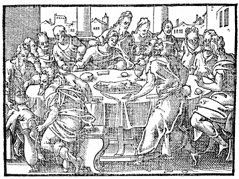
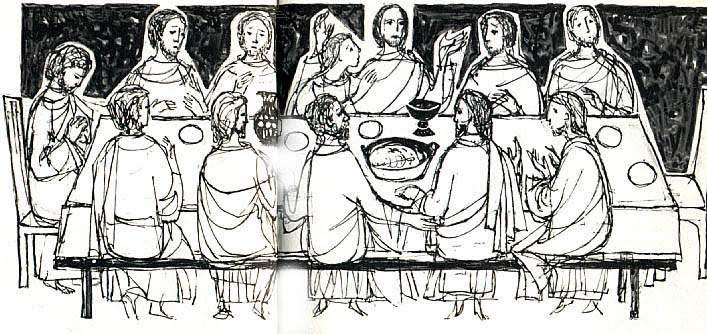
- Brat hits soldier in the face with a pebble.
- Dude naps on roof and dreams about food.
- Dude finds out his fiancee is pregnant and the child isn't his. He marries her anyway.
- One out of 10 people gives positive feedback after being treated for a skin condition.
- Public fracas over sexual misconduct disrupts sidewalk art project.
- Schoolboys thrive on vegetarian diet.
- Rare animal chokes to death on hairball.
- Theologian walks out of church whistling "Holy, Holy, Holy" after experiencing religious ecstasy.
- Wreck of prisoner transport results in no fatalities. Witnesses credit cool-headed prisoner with leading survivors to safety.
- Prison break unexplained. Guards, who previously failed to keep religious leader's body from vanishing out of a sealed tomb, may face discipline.
- Community organizer fails to ask for directions, followers spend 40 years wandering in the sticks.
- Pre-getaway bbq combines with home redecorating project.
- Ancient text suggests ancient Egypt had its own 2020.
- Holy man's presence turns wedding reception into massive bender.
- Gambling ring revealed at capital punishment site.
- Inspection standards under review after beach house collapses in storm.
- Judge reverses decision after woman renews her appeal.
- Property damaged, church vandalized during earthquake/eclipse.
- Property manager makes last-minute deals before turning books over to investigation.
- #MeToo defendant found guilty of sexual assault after claiming he was the victim.
Showing posts with label religion. Show all posts
Friday, July 10, 2020
Bible Stories Boringed
A game has been going around Facebook recently: "Can you describe your favorite movie as boring as possible?" In churchly circles, a variant I've seen replaces "movie" with "Bible story." Here are the boringed Bible stories that I contributed to that thread. Mostly written in headline style:
Saturday, May 9, 2015
Two Kinds of Affliction
I've noticed that people of a certain mild, middle-of-the-road flavor of Christianity, and even some completely secular folks of a culturally Christian background, often speak of their troubles as "crosses." Sometimes they say this in the context of accepting their problems with resignation. Sometimes they say it with a touch of resentment or self-pity. Very often, I think, they are trying to make a virtue of their suffering by doing so with fortitude, or by looking at it from a spiritual angle.
I'm sorry, but this irritates me. It irritates me when, for example, a person's hardship or disappointment was brought on by his own bad choices, by his own unfaithfulness to divine precepts, or by expectations on which God makes no promises. It irritates me when their "cross-bearing" is worn like a mark of virtue, justifying past, present or future straying from God's word. It irritates me when their inspiring example is carried no further than necessary to focus attention on them.
One gloomy morning when I was driving on business, my mind turned over this use of the term "crosses" while in one of those fugue states that can develop when you're alone at the wheel at 8-ish in the morning and your daily caffeine hasn't yet reached your heart. It was then, as if in a dream, an epigram descended upon me that captures the essence of what I think about this. It goes like this:
ALL SUFFERING IS NOT "THE CROSS." IT IS ONLY THE CROSS IF IT UPHOLDS CHRIST.
What I mean to point out is that there are two types of affliction, as the apostle Peter wrote: "For this is commendable, if because of conscience toward God one endures grief, suffering wrongfully. For what credit is it if, when you are beaten for your faults, you take it patiently? But when you do good and suffer, if you take it patiently, this is commendable before God." And a chapter later: "For it is better, if it is the will of God, to suffer for doing good than for doing evil."
A Christian's suffering can have a good spiritual use, and that distinguishes it from all other suffering in the world. Most of the pain experienced by human beings is simply an artifact of living in a fallen world. Some if it is a direct consequence of human sin. In certain specific instances, when God has directly revealed it to be so, one may also consider an affliction to be a visitation of God's judgment against man's wickedness or his children's unfaithfulness.
But for Christians and Christians only, affliction can have the extra purpose of turning eyes toward Jesus and strengthening the faith of His elect.
You don't see that use of affliction at work in would-be examples of Christian fortitude who want you to notice them. But you do see it in humble saints who, as it were, hide themselves in the glory of Jesus' cross. Their affliction can strengthen their faith because by it, the Holy Spirit teaches them to recognize it as a shadow or reflection of the suffering of Christ, and so they feel privileged and honored to bear it. They also know that they do not suffer alone because in Christ, our Lord suffered with us and for us all. And by showing such faith in Him, they strengthen the faith of many others - faith that is directed toward Jesus.
When they call their afflictions the cross, it is because they recognize them as a sort of sacrament that mysteriously unites them to Christ crucified, and that confesses Him in a language that goes beyond words. When they speak of their cross, they are speaking of their duty and privilege to carry their cross alongside their Master who is greater than they, and who gives them sufficient strength to bear it, and who will deliver them from it at the proper time, having passed through all things. He knows what they can bear, in part because he makes them able to bear it. And while their afflictions teach them not to put stock in this-worldly goods that are passing away, they also learn all the more to rely on Him and by patience and prayer to seek the next-worldly treasures that will not be destroyed or taken away.
Put in a nutshell, their pain holds the cross of Christ up before them, and it enables them to hold up Jesus' cross to others. And that's why they can truthfully say they bear the cross. God bless them.
I'm sorry, but this irritates me. It irritates me when, for example, a person's hardship or disappointment was brought on by his own bad choices, by his own unfaithfulness to divine precepts, or by expectations on which God makes no promises. It irritates me when their "cross-bearing" is worn like a mark of virtue, justifying past, present or future straying from God's word. It irritates me when their inspiring example is carried no further than necessary to focus attention on them.
One gloomy morning when I was driving on business, my mind turned over this use of the term "crosses" while in one of those fugue states that can develop when you're alone at the wheel at 8-ish in the morning and your daily caffeine hasn't yet reached your heart. It was then, as if in a dream, an epigram descended upon me that captures the essence of what I think about this. It goes like this:
ALL SUFFERING IS NOT "THE CROSS." IT IS ONLY THE CROSS IF IT UPHOLDS CHRIST.
What I mean to point out is that there are two types of affliction, as the apostle Peter wrote: "For this is commendable, if because of conscience toward God one endures grief, suffering wrongfully. For what credit is it if, when you are beaten for your faults, you take it patiently? But when you do good and suffer, if you take it patiently, this is commendable before God." And a chapter later: "For it is better, if it is the will of God, to suffer for doing good than for doing evil."
A Christian's suffering can have a good spiritual use, and that distinguishes it from all other suffering in the world. Most of the pain experienced by human beings is simply an artifact of living in a fallen world. Some if it is a direct consequence of human sin. In certain specific instances, when God has directly revealed it to be so, one may also consider an affliction to be a visitation of God's judgment against man's wickedness or his children's unfaithfulness.
But for Christians and Christians only, affliction can have the extra purpose of turning eyes toward Jesus and strengthening the faith of His elect.
You don't see that use of affliction at work in would-be examples of Christian fortitude who want you to notice them. But you do see it in humble saints who, as it were, hide themselves in the glory of Jesus' cross. Their affliction can strengthen their faith because by it, the Holy Spirit teaches them to recognize it as a shadow or reflection of the suffering of Christ, and so they feel privileged and honored to bear it. They also know that they do not suffer alone because in Christ, our Lord suffered with us and for us all. And by showing such faith in Him, they strengthen the faith of many others - faith that is directed toward Jesus.
When they call their afflictions the cross, it is because they recognize them as a sort of sacrament that mysteriously unites them to Christ crucified, and that confesses Him in a language that goes beyond words. When they speak of their cross, they are speaking of their duty and privilege to carry their cross alongside their Master who is greater than they, and who gives them sufficient strength to bear it, and who will deliver them from it at the proper time, having passed through all things. He knows what they can bear, in part because he makes them able to bear it. And while their afflictions teach them not to put stock in this-worldly goods that are passing away, they also learn all the more to rely on Him and by patience and prayer to seek the next-worldly treasures that will not be destroyed or taken away.
Put in a nutshell, their pain holds the cross of Christ up before them, and it enables them to hold up Jesus' cross to others. And that's why they can truthfully say they bear the cross. God bless them.
Parable of the Software Update
To what shall I compare the kingdom of heaven?
It is like a software operating system whose manufacturer sent out regular updates to patch security problems. As users connected to the internet, their computers downloaded and installed new software to protect them from the threat of malicious programs. The need for these updates was endless, because hackers were always creating new ways to infiltrate people's computers, either to steal private data or simply to wreak havoc.
But some users opted out of the automatic updates because they were concerned about the installation tying up their machine when they were trying to use it. They also wanted to avoid the risk of glitches caused by mistakes in the software manufacturer's code. But mostly they just resented the company for being smug, controlling and anti-competitive.
So they refused to permit the patches to install on their system without their direct consent. And more often than not, they let the updates slide. They lost track of when new patches were coming out. Sometimes they went long periods without an update. And so one by one their computers were crashed by malware threats they were not protected from.
Let the one hear who has ears to hear.
It is like a software operating system whose manufacturer sent out regular updates to patch security problems. As users connected to the internet, their computers downloaded and installed new software to protect them from the threat of malicious programs. The need for these updates was endless, because hackers were always creating new ways to infiltrate people's computers, either to steal private data or simply to wreak havoc.
But some users opted out of the automatic updates because they were concerned about the installation tying up their machine when they were trying to use it. They also wanted to avoid the risk of glitches caused by mistakes in the software manufacturer's code. But mostly they just resented the company for being smug, controlling and anti-competitive.
So they refused to permit the patches to install on their system without their direct consent. And more often than not, they let the updates slide. They lost track of when new patches were coming out. Sometimes they went long periods without an update. And so one by one their computers were crashed by malware threats they were not protected from.
Let the one hear who has ears to hear.
Sunday, February 22, 2015
Two Gruesome Parables
Everyone is a theologian. Most people are bad theologians, that's all. Some theologians, like my late stepfather, consider themselves too wise to accept what God has told us about, for example, His existence, His power, His goodness, and the reality of heaven and hell. And yet a few snarky parables may show just what their wisdom is made of...
To what shall I compare the theologian who says, "I cannot believe in a God who would be so cruel that he would send people to hell for not believing in him"?
He is like a man who walks off a cliff into a deep chasm after being warned by a park ranger to stay on the path. As he plunges to his death, he curses the park ranger for putting the chasm there.
He is like a woman who falls asleep while smoking in bed and awakes trapped in a burning house. When the fire chief risks his life to enter the inferno and save her, she threatens to sue him for letting her live in a flammable building until he leaves.
To what shall I compare the theologian who says, "I cannot believe in a God who would be so cruel that he would send people to hell for not believing in him"?
He is like a man who walks off a cliff into a deep chasm after being warned by a park ranger to stay on the path. As he plunges to his death, he curses the park ranger for putting the chasm there.
He is like a woman who falls asleep while smoking in bed and awakes trapped in a burning house. When the fire chief risks his life to enter the inferno and save her, she threatens to sue him for letting her live in a flammable building until he leaves.
Saturday, January 31, 2015
How to Pray in Public and Not Sound Like an Ass
In a recent conversation with my pastor, I recalled an event I attended as a journalist where a civic organization's chaplain, not a clergyman, said grace before barbecue was served. It was a painful memory. The poor man rambled at length, frequently repeating the phrases "Father God" and "we just want" and really not asking for much in particular. At times he seemed to get stuck in a kind of verbal thicket and had to mouth sweet nothings in order to keep up a semblance of saying something while he clearly didn't have a thought in his head.
It made me realize once again what a disservice some church groups do to themselves and the larger community by refusing to countenance written or memorized prayers. In American Protestantism there is a widespread sensibility that prayer, to be genuine, must come "from the heart," or perhaps by a direct intervention of the Holy Spirit, and so must not have been prepared ahead of time.
Apart from an argument from Scripture, and indeed the words of Jesus, that could readily demolish this thinking in him who has ears to hear, the main problem with this is that most people are so very, very bad at ex corde prayer. The thought of being asked to say grace in front of a group of people must, and should, give them cold sweats. The experience of having to listen to them trying, regardless of their inadequacy to the task, should school us not to ask that of them. It's hard on the rest of us, and it makes a hash of the Golden Rule. We wouldn't want to be put in their position; why do we do it to them?
Now I can say all this with righteous detachment, because I do in fact know how to pray off-script, and how to sound good doing it. And though I don't accept it as given that such prayers are any better than, say, the prayer the Lord Himself taught us, I'm not above sharing a few pointers that, with a bit of practice, should be able to help anybody pray in public without the benefit of notes or rote memory, and without making a pitiful fist of it.
In short, here are a few tips on how you, too, can pray in public without sounding like a complete ass.
1. Stop and think. Even if you must pray without a net, that doesn't mean you shouldn't have some preparation. Take a moment to prepare yourself mentally. Insist on having a good five minutes to think, without someone talking at you and without being expected to talk. Excuse yourself from the room, say, to freshen up in the bathroom, and enjoy a moment of privacy with your own thoughts. Or just close your eyes and take a time out.
Use this time to decide where your prayer is going to begin and where it's going to end, and if you can, try to visualize something like a route between the two points. If the mob is clamoring to hear you pray and they are too inconsiderate to grant you a moment's leave or reprieve, let your fallback strategy be to call on everyone to share with you a moment of silence while they frame their own petitions in their heart; then use that moment to frame yours.
2. Don't be caught without a book. Even if you know the group would frown on being led in a prayer read out of it, you should have it with you. A good first choice is the Bible. A close second, a hymnal or prayer-book. A distant third, a book of sermons, devotions or spiritual exercises. If there's any risk that you will be called forward to pray - say, because the regular chaplain or minister became unavailable on short notice and you're the next best thing - such a book should be as much part of your survival kit as road flares and bottled water.
In the first place, having something to hang onto may help control the panic. In the second place, you can use part of your five minutes of thinking time to rifle through the book in search of a quotation to use as a jumping off place or an organizing metaphor, or even to give you an idea what to pray about. "Lord, you told the prophet Isaiah that the breath of your mouth will slay the wicked. Breathe mercifully on this conference of the Halitosis Sufferers Prayer Circle..."
3. Prepare in advance for even the slight possibility you will be called on to pray in front of a group. You can do this, first of all, by making a habit of praying daily, or even oftener. Pray aloud and listen to yourself. Record yourself praying and listen to the playback. Write down your prayers and read them later. Note ways your praying could be improved and work on those. Second of all, you can prepare for prayer by studying. Be first and foremost a student of Scripture, armed with a wide range of biblical references as well as the theological raw material of prayer. Liturgy, theological literature and the written prayers of previous generations can also be useful models to study.
Observe, for example, the structure of collects, those stylized liturgical prayers that compress so much thought into so few words. If you remember to do all the things a collect does - addressing God by name, asking for something He is sure to give, stating an appropriate precedent or rationale for that assurance, and closing with a doxology - you won't go too far wrong. And if you can manage to tie all these parts together in a unity, as though each part of the prayer were a piece of evidence in a lawsuit, you might even pull it off with real style.
4. If you get stuck, stop talking. Needing to fill every second with blab is a rookie mistake. Some of the most effective prayers can be ones in which each sentence is set off by a pause at least as long as itself. Breathe deeply, stay calm, and think. Use the pause to plan the next sentence or two. And who knows, your hearers may find it makes you sound deep.
If you find that you've run clean out of ideas and can't seem to find a way out of your prayer, head straight for the exit. I don't mean run out of the room; I mean just end the prayer, preferably before the point where everyone else realizes what a hard time you're having and becomes uncomfortable for you. Having a stock outro like, "In your most holy name, Lord Jesus, Amen" could save your bacon. With a little more thought and preparation you could finesse a "Whatever else we should ask, we leave in Your loving hands," or a "Help us to trust you with humble and thankful hearts," etc.
5. Actually pray. I've said this in a previous post on this topic, so I won't belabor it here; but really, if you're going to take the podium to pray on behalf of any group of people, it behooves you to understand just what you're about. Praying is, at the simplest level, asking God for stuff. It can be spiritual stuff; it can be material stuff. But if you don't actually ask God for anything, you haven't prayed. You can put forth petition after petition thanking God for this and praising God for that, and it's all very well; but you haven't hit the target until you actually make a request.
So if you're going to pray in public, and you give yourself the necessary five minutes to order your thoughts, try not to let even one of those minutes pass without thinking of something for which to pray. You're not ready if all you've got to say is, "Father God, we just want to thank you for what an awesome God you are, and for bringing us all here to share this incredible food or to do this excellent work, or whatever, but Father God, gee whiz, Lord, you're just the greatest," and so on and on and on.
6. Earn extra credit by being brief. Speech is silver; silence is golden. While having a single thought in your head may mark an improvement over most impromptu public prayers, holding yourself to just the one, or at most two or three, could save you from becoming annoyingly long-winded. The way of virtue lies not in having much to say, or saying many words, or filling many minutes, but in getting right to the point and making it pointedly.
It isn't enough to sit down and shut up when you've run out of things to say; it is just as important to stop short of saying more than necessary. Those who asked you to stand up probably didn't mean to hear you rattle off a harangue listing all 1,001 sins of spiritual pride; they will thank you for restricting it to a statement of the general topic and a request for help staying humble by the Lord who knows all about that.
7. Fight the cliche. Contend for all you're worth against the besetting sin of triteness. If the whole point of being required to pray off the cuff is to avoid vain repetition of empty formulas, whence comes this wasting illness of constantly repeating the phrases "Father God" and "we just want"? (These are only a couple examples.) The "Our Father" addresses God with more spiritual depth, and it doesn't come off sounding like a whiny excuse. But if you're bound and determined to ignore Jesus' command to "Pray this way," then at least engage your native reason.
Not that I'm accepting, even for the sake of argument, the assumption that Jesus forbids the slightest taint of ritual; but if you're going to go with that assumption, then when you repeat such faddish mumbo-jumbo you are in effect sinning against your own conscience. To scurrilously misapply Luther's words, if you must sin, sin boldly and use the rituals Christ Himself instituted rather than those popularized by mediocre religious pundits of our time. Or, at a hazard, come up with a wider variety of synonyms for "Father God" and "we just want." You don't have to read them out loud, but those collects I mentioned can help you collect a nice assortment of those synonyms, such as "Heavenly Father" and "we beseech you."
8. Act like you believe. Pray with assurance. Don't whine pitifully. Don't emote dramatically (unless you can't help it). Don't cajole God like a sullen teenager who already knows before he asks his Dad for the car keys that the likeliest answer will be No. Don't argue like a lawyer who has to convince a jury with an airtight case. To be sure, there is Tip No. 9 to contend with, but don't let that stop you from following Jesus' example, again in the Our Father, and submitting your requests to God with boldness and confidence. "Dear God, give us this, grant us that, protect us from the other thing, and because we know You can and because we know You care we all say Amen."
9. Don't be presumptuous. Be careful to check your demands against the revealed and hidden will of God. If what you're going to ask for runs contrary to God's revealed will, swallow it and reconsider. If what you're going to ask for may or may not be His will - and here it helps to have done your homework as per Tip No. 3 - hearken to Jesus' example and conclude, "Not our will, but Your will be done."
In Miracles, C. S. Lewis makes an interesting case that because God is all-knowing and we are not, we can pray for a result that has already happened (only we don't know about it) without falling guilty of tempting God. For example, we can pray that Grandma made it on the plane from which we hope to collect her at the airport in a little while, even after the plane has departed, because even though that has already either happened or not, from our point of view it is still an open question while before God all of time lies open like a book. He, Lewis says, can take prayers received at 10 a.m. into account while shaping the events of 9 a.m.
That's a mindblowing idea, and a wonderful comfort, but it doesn't give us a blank check to tempt God. So be careful not to demand anything of him in prayer that is frustrated by our own deliberate actions, or that conflicts with what we know about Him, or that requires Him to reveal more about His will for our contingent reality than He has promised to reveal at this time. Be careful, for example, not to attempt to blackmail God into doing favors for us, or giving us signs, or fulfilling our desires, in order to justify our faith in Him. If He hasn't promised it in so many words, we submit it to His loving Fatherly will and we accept whatever answer He gives us, even if it be "No."
10. Don't Actually Be an Ass. You can't fix stupid. You can't train pigs to sing opera; you'll only ruin the music and annoy the pigs. And it is futile to expect false teachers and misinterpreters of Scripture to straighten up for even one little prayer.
I am learning to think of biblical hermeneutics as a set of philosophical axioms that are permanently fixed in one's mind, in many cases before an exegete even begins to approach the text. No argument is likely to alter the way they think about things once they have begun. So on a certain level, it is pointless to suggest that to pray in public without sounding like an ass it helps not to be one, or to advise them not to mess it all up by applying bad theology and twisted biblical exegesis to the task of prayer. They'll teach what they teach and read the text the way they read it and that's that. So what this tip really amounts to is posterior protection. Did you follow all my tips and still couldn't pray your way out of square corner? You may want to consider the possibility that your problem goes deeper and there is no ten-step process to fix it. Instead of advice, I can only offer the prayer that God will operate on you to "cast down arguments and every high thing that exalts itself against the knowledge of God, bringing every thought into captivity to the obedience of Christ" (2 Corinthians 10:5).
It made me realize once again what a disservice some church groups do to themselves and the larger community by refusing to countenance written or memorized prayers. In American Protestantism there is a widespread sensibility that prayer, to be genuine, must come "from the heart," or perhaps by a direct intervention of the Holy Spirit, and so must not have been prepared ahead of time.
Apart from an argument from Scripture, and indeed the words of Jesus, that could readily demolish this thinking in him who has ears to hear, the main problem with this is that most people are so very, very bad at ex corde prayer. The thought of being asked to say grace in front of a group of people must, and should, give them cold sweats. The experience of having to listen to them trying, regardless of their inadequacy to the task, should school us not to ask that of them. It's hard on the rest of us, and it makes a hash of the Golden Rule. We wouldn't want to be put in their position; why do we do it to them?
Now I can say all this with righteous detachment, because I do in fact know how to pray off-script, and how to sound good doing it. And though I don't accept it as given that such prayers are any better than, say, the prayer the Lord Himself taught us, I'm not above sharing a few pointers that, with a bit of practice, should be able to help anybody pray in public without the benefit of notes or rote memory, and without making a pitiful fist of it.
In short, here are a few tips on how you, too, can pray in public without sounding like a complete ass.
1. Stop and think. Even if you must pray without a net, that doesn't mean you shouldn't have some preparation. Take a moment to prepare yourself mentally. Insist on having a good five minutes to think, without someone talking at you and without being expected to talk. Excuse yourself from the room, say, to freshen up in the bathroom, and enjoy a moment of privacy with your own thoughts. Or just close your eyes and take a time out.
Use this time to decide where your prayer is going to begin and where it's going to end, and if you can, try to visualize something like a route between the two points. If the mob is clamoring to hear you pray and they are too inconsiderate to grant you a moment's leave or reprieve, let your fallback strategy be to call on everyone to share with you a moment of silence while they frame their own petitions in their heart; then use that moment to frame yours.
2. Don't be caught without a book. Even if you know the group would frown on being led in a prayer read out of it, you should have it with you. A good first choice is the Bible. A close second, a hymnal or prayer-book. A distant third, a book of sermons, devotions or spiritual exercises. If there's any risk that you will be called forward to pray - say, because the regular chaplain or minister became unavailable on short notice and you're the next best thing - such a book should be as much part of your survival kit as road flares and bottled water.
In the first place, having something to hang onto may help control the panic. In the second place, you can use part of your five minutes of thinking time to rifle through the book in search of a quotation to use as a jumping off place or an organizing metaphor, or even to give you an idea what to pray about. "Lord, you told the prophet Isaiah that the breath of your mouth will slay the wicked. Breathe mercifully on this conference of the Halitosis Sufferers Prayer Circle..."
3. Prepare in advance for even the slight possibility you will be called on to pray in front of a group. You can do this, first of all, by making a habit of praying daily, or even oftener. Pray aloud and listen to yourself. Record yourself praying and listen to the playback. Write down your prayers and read them later. Note ways your praying could be improved and work on those. Second of all, you can prepare for prayer by studying. Be first and foremost a student of Scripture, armed with a wide range of biblical references as well as the theological raw material of prayer. Liturgy, theological literature and the written prayers of previous generations can also be useful models to study.
Observe, for example, the structure of collects, those stylized liturgical prayers that compress so much thought into so few words. If you remember to do all the things a collect does - addressing God by name, asking for something He is sure to give, stating an appropriate precedent or rationale for that assurance, and closing with a doxology - you won't go too far wrong. And if you can manage to tie all these parts together in a unity, as though each part of the prayer were a piece of evidence in a lawsuit, you might even pull it off with real style.
4. If you get stuck, stop talking. Needing to fill every second with blab is a rookie mistake. Some of the most effective prayers can be ones in which each sentence is set off by a pause at least as long as itself. Breathe deeply, stay calm, and think. Use the pause to plan the next sentence or two. And who knows, your hearers may find it makes you sound deep.
If you find that you've run clean out of ideas and can't seem to find a way out of your prayer, head straight for the exit. I don't mean run out of the room; I mean just end the prayer, preferably before the point where everyone else realizes what a hard time you're having and becomes uncomfortable for you. Having a stock outro like, "In your most holy name, Lord Jesus, Amen" could save your bacon. With a little more thought and preparation you could finesse a "Whatever else we should ask, we leave in Your loving hands," or a "Help us to trust you with humble and thankful hearts," etc.
5. Actually pray. I've said this in a previous post on this topic, so I won't belabor it here; but really, if you're going to take the podium to pray on behalf of any group of people, it behooves you to understand just what you're about. Praying is, at the simplest level, asking God for stuff. It can be spiritual stuff; it can be material stuff. But if you don't actually ask God for anything, you haven't prayed. You can put forth petition after petition thanking God for this and praising God for that, and it's all very well; but you haven't hit the target until you actually make a request.
So if you're going to pray in public, and you give yourself the necessary five minutes to order your thoughts, try not to let even one of those minutes pass without thinking of something for which to pray. You're not ready if all you've got to say is, "Father God, we just want to thank you for what an awesome God you are, and for bringing us all here to share this incredible food or to do this excellent work, or whatever, but Father God, gee whiz, Lord, you're just the greatest," and so on and on and on.
6. Earn extra credit by being brief. Speech is silver; silence is golden. While having a single thought in your head may mark an improvement over most impromptu public prayers, holding yourself to just the one, or at most two or three, could save you from becoming annoyingly long-winded. The way of virtue lies not in having much to say, or saying many words, or filling many minutes, but in getting right to the point and making it pointedly.
It isn't enough to sit down and shut up when you've run out of things to say; it is just as important to stop short of saying more than necessary. Those who asked you to stand up probably didn't mean to hear you rattle off a harangue listing all 1,001 sins of spiritual pride; they will thank you for restricting it to a statement of the general topic and a request for help staying humble by the Lord who knows all about that.
7. Fight the cliche. Contend for all you're worth against the besetting sin of triteness. If the whole point of being required to pray off the cuff is to avoid vain repetition of empty formulas, whence comes this wasting illness of constantly repeating the phrases "Father God" and "we just want"? (These are only a couple examples.) The "Our Father" addresses God with more spiritual depth, and it doesn't come off sounding like a whiny excuse. But if you're bound and determined to ignore Jesus' command to "Pray this way," then at least engage your native reason.
Not that I'm accepting, even for the sake of argument, the assumption that Jesus forbids the slightest taint of ritual; but if you're going to go with that assumption, then when you repeat such faddish mumbo-jumbo you are in effect sinning against your own conscience. To scurrilously misapply Luther's words, if you must sin, sin boldly and use the rituals Christ Himself instituted rather than those popularized by mediocre religious pundits of our time. Or, at a hazard, come up with a wider variety of synonyms for "Father God" and "we just want." You don't have to read them out loud, but those collects I mentioned can help you collect a nice assortment of those synonyms, such as "Heavenly Father" and "we beseech you."
8. Act like you believe. Pray with assurance. Don't whine pitifully. Don't emote dramatically (unless you can't help it). Don't cajole God like a sullen teenager who already knows before he asks his Dad for the car keys that the likeliest answer will be No. Don't argue like a lawyer who has to convince a jury with an airtight case. To be sure, there is Tip No. 9 to contend with, but don't let that stop you from following Jesus' example, again in the Our Father, and submitting your requests to God with boldness and confidence. "Dear God, give us this, grant us that, protect us from the other thing, and because we know You can and because we know You care we all say Amen."
9. Don't be presumptuous. Be careful to check your demands against the revealed and hidden will of God. If what you're going to ask for runs contrary to God's revealed will, swallow it and reconsider. If what you're going to ask for may or may not be His will - and here it helps to have done your homework as per Tip No. 3 - hearken to Jesus' example and conclude, "Not our will, but Your will be done."
In Miracles, C. S. Lewis makes an interesting case that because God is all-knowing and we are not, we can pray for a result that has already happened (only we don't know about it) without falling guilty of tempting God. For example, we can pray that Grandma made it on the plane from which we hope to collect her at the airport in a little while, even after the plane has departed, because even though that has already either happened or not, from our point of view it is still an open question while before God all of time lies open like a book. He, Lewis says, can take prayers received at 10 a.m. into account while shaping the events of 9 a.m.
That's a mindblowing idea, and a wonderful comfort, but it doesn't give us a blank check to tempt God. So be careful not to demand anything of him in prayer that is frustrated by our own deliberate actions, or that conflicts with what we know about Him, or that requires Him to reveal more about His will for our contingent reality than He has promised to reveal at this time. Be careful, for example, not to attempt to blackmail God into doing favors for us, or giving us signs, or fulfilling our desires, in order to justify our faith in Him. If He hasn't promised it in so many words, we submit it to His loving Fatherly will and we accept whatever answer He gives us, even if it be "No."
10. Don't Actually Be an Ass. You can't fix stupid. You can't train pigs to sing opera; you'll only ruin the music and annoy the pigs. And it is futile to expect false teachers and misinterpreters of Scripture to straighten up for even one little prayer.
I am learning to think of biblical hermeneutics as a set of philosophical axioms that are permanently fixed in one's mind, in many cases before an exegete even begins to approach the text. No argument is likely to alter the way they think about things once they have begun. So on a certain level, it is pointless to suggest that to pray in public without sounding like an ass it helps not to be one, or to advise them not to mess it all up by applying bad theology and twisted biblical exegesis to the task of prayer. They'll teach what they teach and read the text the way they read it and that's that. So what this tip really amounts to is posterior protection. Did you follow all my tips and still couldn't pray your way out of square corner? You may want to consider the possibility that your problem goes deeper and there is no ten-step process to fix it. Instead of advice, I can only offer the prayer that God will operate on you to "cast down arguments and every high thing that exalts itself against the knowledge of God, bringing every thought into captivity to the obedience of Christ" (2 Corinthians 10:5).
Sunday, August 17, 2014
DOs and DON'Ts of Prayer
Many people say they don't pray because they don't know how. They're happy to step aside and let other people do it for them. But judging by some tortured efforts at prayer I have heard, out loud, in public, and from the heart, many of these folks find themselves in situations where they have to do it anyway. You never know when it might happen to you—when you might find a microphone thrust into your hands and be asked to open a meeting, or a ball game, or a locker room pep talk, or a family reunion, with a word of prayer. Here are some tips that I hope will help.
DO bear in mind that you are talking to God. This is not the time to be scoring verbal hits on other people, present or absent. Nor is it appropriate to sneak news bulletins or editorial remarks, directed at your audience, into the prayer. Ask God nicely for things, and thank Him for what He has given. Express remorse for misconduct, always including yourself among the wrongdoers. Ask for forgiveness, not only for those who have wronged you but for yourself as well. If you must ask God to chastise the wicked, remember that judgment is His, and as you measure out, so it will be measured back to you.
DO set your thoughts in order before you open your mouth. You can even jot down some notes, even a word-for-word manuscript if you wish, and if time permits. Regardless of some people's prejudices against premeditated prayer (as opposed to praying "from the heart"), there is no law against praying even a prayer written by someone else, or one that you rehearsed ahead of time, or one learned by heart and used again and again. After all, the Lord's Prayer is precisely how Jesus instructed his disciples to pray. Provided that you read, recite, or extemporize your prayer with attention to its meaning, it is probably an improvement on the long-winded, rambling, repetitive, and sometimes painfully awkward prayers that often result when a speaker goes into prayer mode unprepared.
DO be clear about what God you are praying to. Don't let the presence of people of other denominations or religions scare you into being vague and wishy-washy about the recipient of your prayer, any more than you would soft-pedal the fact that God exists out of consideration for agnostics and atheists in the house. Stand up for what you stand for. Direct your spiritual letter in such a way that it will arrive at the correct address, and let no one hearing it be confused about whom you are addressing. It is better to take the heat for sounding a clear signal that upsets some armchair general, than to make an indefinite sound that no one can follow. Just because the Spirit "helps in our weakness" and whatnot (Romans 8) does not mean we should let our theology slip when we pray.
DO show respect and humility when you speak to God, especially in front of other people. Affecting a buddy-buddy relationship with Jesus, or worse, a type of romantic involvement with him, isn't in good taste. You wouldn't use a pet name to address a judge in the open court, or a professor in the packed lecture hall, or a general in front of his troops, even if you were on intimate terms with him. Remember who you are, and how unequal you are with God, and how much you depend on His undeserved favor, and the fact that you're no better than any of your listeners; then, if you're still not sure where you stand, imagine that someone else in the room was leading the prayer and show God at least as much respect you would demand of them.
DO mention your rationale for asking God to hear your specific request. This is a good place to stick Bible verses into your prayer (another way that it helps to be prepared). It isn't so much that God needs to be convinced, as that sometimes you and other people listening in need help believing that such a prayer will be accepted by God. Remind yourself, and them, that it is in God's character, expressed by the salvation history recorded in Scripture, to do the very thing we now ask of him. This is how, without having an axe to grind, you can use the time of prayer to instruct the people and strengthen their faith. Prayer is, after all, an exercise of faith.
DO end your prayer with some sort of doxology. It has to end somehow. It might as well be to the glory of God. A well turned doxology is an excellent way to cue the crowd to say Amen. In a certain sense, it's another way of saying Amen. Which is to say, "This is true," or "So we believe," or simply, "We trust You."
DO let the people say Amen. It's not as if they have too much to do. If they don't come right in on cue, give them a gentle prompt, such as: "Let the people say..."
DO listen to yourself—if possible, by playing back a recording of the event where you prayed. Notice your awkward and tedious mannerisms and make a conscious effort to correct them the next time. Listen for sentence fragments, thoughts that went astray, repetitions, cliches, meaningless platitudes, embarrassing gaffes (even ones you're sure no one else noticed), inordinate amounts of throat-clearing, hemming and hawing, fancy rhetoric and complex grammar that most likely went over the people's heads. Then reconsider how much time you could and should spend preparing when you are next called on to pray.
DON'T be a pompous bore. While it's OK to pray in King James Bible language, don't lay it on any thicker than you need to. Having a stained glass voice isn't as important as directing the people's faith toward God's blessings, like a beggar's hand opening to receive alms.
DON'T make yourself conspicuous by your wit, eloquence, or charisma. Use it to the glory of God, for the building-up of the brethren. You aren't supposed to be on display. You're supposed to be a spiritual telephone for God's people to talk to Him. Try not to stand in the way.
DON'T assert anything that you can't defend based on God's Word, and don't demand anything of Him that He has not promised. Remember that "Thy will be done" comes before "Give us our daily bread" in the prayer Jesus taught us to pray. Remember that the church has always been, and still is, a refuge for the poor, sick, troubled, grieving, aged, and dying. If you pray in a way that suggests that health, wealth, youth, a happy family, and other gifts are unfailing signs of being right with God, you bear false witness against Him and the suffering faithful. Also remember that these outward signs of God's blessing have often concealed hypocrites who brought shame and scandal to the church.
DON'T string together too many clauses before coming to a full stop. Try using shorter sentences, and make one point at a time. A rule of thumb: If you can't remember which Person of the Trinity you were addressing at the start of the petition, you're probably doing it wrong.
DON'T fall back on trendy catch-phrases to fill moments when your mouth has run ahead of your brain. If you feel a litany of Lord, we just want to thank yous, Father Gods, sweet Jesuses, and what-not, bite your tongue. Saying nothing for a few seconds wouldn't be any worse than chucking in a piece of thoughtless blab. Listen to someone who often falls into these traps when praying, and you'll be amazed that they can be so ritualistic in their "from the heart" prayer while condemning you for preparing ahead. Bottom line, think before you speak—even to God. He deserves that much, at least.
DO name names. Don't just pray for people in general, or for so-and-so's relative or acquaintance. If someone among us, or close to us, or even a public figure has an illness, or an operation, or some other problem, we should certainly intercede for him or her by name. Even a list of names—"Christian" names are enough—added to a general petition for the hungry, sick, recuperating, etc., can make a general case so concrete and specific that the people will feel the difference prayer makes. We're not just entrusting all needs to God; we're putting our needs in His hands.
DO read written prayers, such as collects, litanies, and general prayers, at least from time to time. You can learn a lot from them about what to pray for and how to structure your thoughts.
DO bear in mind that you are talking to God. This is not the time to be scoring verbal hits on other people, present or absent. Nor is it appropriate to sneak news bulletins or editorial remarks, directed at your audience, into the prayer. Ask God nicely for things, and thank Him for what He has given. Express remorse for misconduct, always including yourself among the wrongdoers. Ask for forgiveness, not only for those who have wronged you but for yourself as well. If you must ask God to chastise the wicked, remember that judgment is His, and as you measure out, so it will be measured back to you.
DO set your thoughts in order before you open your mouth. You can even jot down some notes, even a word-for-word manuscript if you wish, and if time permits. Regardless of some people's prejudices against premeditated prayer (as opposed to praying "from the heart"), there is no law against praying even a prayer written by someone else, or one that you rehearsed ahead of time, or one learned by heart and used again and again. After all, the Lord's Prayer is precisely how Jesus instructed his disciples to pray. Provided that you read, recite, or extemporize your prayer with attention to its meaning, it is probably an improvement on the long-winded, rambling, repetitive, and sometimes painfully awkward prayers that often result when a speaker goes into prayer mode unprepared.
DO be clear about what God you are praying to. Don't let the presence of people of other denominations or religions scare you into being vague and wishy-washy about the recipient of your prayer, any more than you would soft-pedal the fact that God exists out of consideration for agnostics and atheists in the house. Stand up for what you stand for. Direct your spiritual letter in such a way that it will arrive at the correct address, and let no one hearing it be confused about whom you are addressing. It is better to take the heat for sounding a clear signal that upsets some armchair general, than to make an indefinite sound that no one can follow. Just because the Spirit "helps in our weakness" and whatnot (Romans 8) does not mean we should let our theology slip when we pray.
DO show respect and humility when you speak to God, especially in front of other people. Affecting a buddy-buddy relationship with Jesus, or worse, a type of romantic involvement with him, isn't in good taste. You wouldn't use a pet name to address a judge in the open court, or a professor in the packed lecture hall, or a general in front of his troops, even if you were on intimate terms with him. Remember who you are, and how unequal you are with God, and how much you depend on His undeserved favor, and the fact that you're no better than any of your listeners; then, if you're still not sure where you stand, imagine that someone else in the room was leading the prayer and show God at least as much respect you would demand of them.
DO mention your rationale for asking God to hear your specific request. This is a good place to stick Bible verses into your prayer (another way that it helps to be prepared). It isn't so much that God needs to be convinced, as that sometimes you and other people listening in need help believing that such a prayer will be accepted by God. Remind yourself, and them, that it is in God's character, expressed by the salvation history recorded in Scripture, to do the very thing we now ask of him. This is how, without having an axe to grind, you can use the time of prayer to instruct the people and strengthen their faith. Prayer is, after all, an exercise of faith.
DO end your prayer with some sort of doxology. It has to end somehow. It might as well be to the glory of God. A well turned doxology is an excellent way to cue the crowd to say Amen. In a certain sense, it's another way of saying Amen. Which is to say, "This is true," or "So we believe," or simply, "We trust You."
DO let the people say Amen. It's not as if they have too much to do. If they don't come right in on cue, give them a gentle prompt, such as: "Let the people say..."
DO listen to yourself—if possible, by playing back a recording of the event where you prayed. Notice your awkward and tedious mannerisms and make a conscious effort to correct them the next time. Listen for sentence fragments, thoughts that went astray, repetitions, cliches, meaningless platitudes, embarrassing gaffes (even ones you're sure no one else noticed), inordinate amounts of throat-clearing, hemming and hawing, fancy rhetoric and complex grammar that most likely went over the people's heads. Then reconsider how much time you could and should spend preparing when you are next called on to pray.
DON'T be a pompous bore. While it's OK to pray in King James Bible language, don't lay it on any thicker than you need to. Having a stained glass voice isn't as important as directing the people's faith toward God's blessings, like a beggar's hand opening to receive alms.
DON'T make yourself conspicuous by your wit, eloquence, or charisma. Use it to the glory of God, for the building-up of the brethren. You aren't supposed to be on display. You're supposed to be a spiritual telephone for God's people to talk to Him. Try not to stand in the way.
DON'T assert anything that you can't defend based on God's Word, and don't demand anything of Him that He has not promised. Remember that "Thy will be done" comes before "Give us our daily bread" in the prayer Jesus taught us to pray. Remember that the church has always been, and still is, a refuge for the poor, sick, troubled, grieving, aged, and dying. If you pray in a way that suggests that health, wealth, youth, a happy family, and other gifts are unfailing signs of being right with God, you bear false witness against Him and the suffering faithful. Also remember that these outward signs of God's blessing have often concealed hypocrites who brought shame and scandal to the church.
DON'T string together too many clauses before coming to a full stop. Try using shorter sentences, and make one point at a time. A rule of thumb: If you can't remember which Person of the Trinity you were addressing at the start of the petition, you're probably doing it wrong.
DON'T fall back on trendy catch-phrases to fill moments when your mouth has run ahead of your brain. If you feel a litany of Lord, we just want to thank yous, Father Gods, sweet Jesuses, and what-not, bite your tongue. Saying nothing for a few seconds wouldn't be any worse than chucking in a piece of thoughtless blab. Listen to someone who often falls into these traps when praying, and you'll be amazed that they can be so ritualistic in their "from the heart" prayer while condemning you for preparing ahead. Bottom line, think before you speak—even to God. He deserves that much, at least.
DO name names. Don't just pray for people in general, or for so-and-so's relative or acquaintance. If someone among us, or close to us, or even a public figure has an illness, or an operation, or some other problem, we should certainly intercede for him or her by name. Even a list of names—"Christian" names are enough—added to a general petition for the hungry, sick, recuperating, etc., can make a general case so concrete and specific that the people will feel the difference prayer makes. We're not just entrusting all needs to God; we're putting our needs in His hands.
DO read written prayers, such as collects, litanies, and general prayers, at least from time to time. You can learn a lot from them about what to pray for and how to structure your thoughts.
Saturday, May 3, 2014
Churchspeak Explained
It is often embarrassing to realize, when you respond to a statement you have heard or read, that the speaker or writer was using a special linguistic register and that you didn't really understand their intended meaning. This can be most uncomfortable when it comes to communication within the church, where we're all meant to be united by a bond of brotherly or sisterly love. So here, for your future convenience, is a translation of some expressions commonly used in a church-related context. In each example, the words you hear or read are followed by the literal meaning.
The pastor's doctrine is all right, it's his personality that's the problem.
Translation: We've had it up to here with faithful Law and Gospel preaching.
Our kids would come back to the church if it would only make its services more seeker-friendly.
Translation: The church doesn't feel comfortable enough to unbelievers.
You shouldn't be so afraid of a change of style if the substance stays the same.
Translation: Please ignore the fact that we are replacing one religion with another.
You should have followed proper procedures of 8th Commandment/Matthew 18 admonition.
Translation: How dare you take a faithful stand against apostasy!
Let's lodge a complaint about this guy without following 8th/18 procedures.
Translation: We have to deal with this faithful twerp. There's no time to lose.
We've got to change how we (teach/worship) or our numbers will never grow.
Translation: The Word of God is not effective enough without added help.
Pastor, we're all going to withhold our offerings from the general fund.
Translation: If we can't sack you in an ungodly way, we will afflict you and your family until you quit.
Of course So-and-So (seldom seen in worship) is eligible to chair the Finance Committee. He's a lifelong member and highly capable!
Translation: Mammon is our God. Get out of the way.
Of course So-and-So (who resigned in protest under the previous pastor) should be reinstated as head elder, now that he's transferred back into membership.
Translation: He helped us get rid of the previous guy, maybe he can do it again.
We chose this congregation over three churches closer to home because we love it. But this, this, and this need to change.
Translation: We have chosen this church as our mission field to convert you all to the one true faith.
We just want what's best for you, pastor.
Translation: We think you should try another line of work.
Pastor has been faithful in every way, but we think it's time for him to move on.
Translation: He didn't do what we wanted him to do, so he must go.
The problem with you, pastor is (insert personal opinion about his character or that of his family).
Translation: I'm about to say the kind of thing to you that, if you said it to me, would end with me breaking my fist against your teeth. Now shut up and take it.
The pastor's doctrine is all right, it's his personality that's the problem.
Translation: We've had it up to here with faithful Law and Gospel preaching.
Our kids would come back to the church if it would only make its services more seeker-friendly.
Translation: The church doesn't feel comfortable enough to unbelievers.
You shouldn't be so afraid of a change of style if the substance stays the same.
Translation: Please ignore the fact that we are replacing one religion with another.
You should have followed proper procedures of 8th Commandment/Matthew 18 admonition.
Translation: How dare you take a faithful stand against apostasy!
Let's lodge a complaint about this guy without following 8th/18 procedures.
Translation: We have to deal with this faithful twerp. There's no time to lose.
We've got to change how we (teach/worship) or our numbers will never grow.
Translation: The Word of God is not effective enough without added help.
Pastor, we're all going to withhold our offerings from the general fund.
Translation: If we can't sack you in an ungodly way, we will afflict you and your family until you quit.
Of course So-and-So (seldom seen in worship) is eligible to chair the Finance Committee. He's a lifelong member and highly capable!
Translation: Mammon is our God. Get out of the way.
Of course So-and-So (who resigned in protest under the previous pastor) should be reinstated as head elder, now that he's transferred back into membership.
Translation: He helped us get rid of the previous guy, maybe he can do it again.
We chose this congregation over three churches closer to home because we love it. But this, this, and this need to change.
Translation: We have chosen this church as our mission field to convert you all to the one true faith.
We just want what's best for you, pastor.
Translation: We think you should try another line of work.
Pastor has been faithful in every way, but we think it's time for him to move on.
Translation: He didn't do what we wanted him to do, so he must go.
The problem with you, pastor is (insert personal opinion about his character or that of his family).
Translation: I'm about to say the kind of thing to you that, if you said it to me, would end with me breaking my fist against your teeth. Now shut up and take it.
Wednesday, October 16, 2013
Parable of the Hazard Signs, Etc.
To what shall I compare this generation, which demands that ministers of religion teach the faith without comparing it to, or condemning, false doctrine?
It is like a state that voted to remove all hazard signs from its highways. This way people wouldn't be frightened or offended by approaching hazards, such as sharp curves, steep grades, falling rocks, slippery bridges, animals crossing the road, and approaching cross-traffic. Removing the signs does not remove the danger in these things. In fact, it makes the danger greater.
It is like a ruler who instructed his officials to strip containers of hazardous chemicals of their warning labels, because these warnings cause needless fear and worry. Removing the warning label does not make the chemical less poisonous or explosive or flammable or corrosive. Nor does it lower the chances of an accident.
It is like a kingdom whose posted laws never tell you what not to do, but only what is permitted. Crime is still punishable, but you have to figure out for yourself how to avoid committing it.
It is like a navy that issued sea charts to its officers, omitting the precise positions of dangerous rocks, reefs, and shoals. After all, why put pressure on people to be accurate? That just hurts their morale!
It is like a police force that stopped publishing wanted posters, giving the description of wanted criminals and the crimes they were suspected of. After all, why encourage people to be suspicious of their neighbors? That's bad for the community!
It is like an eagle that covered up one eye before flying out to hunt for prey. How well will it judge its swoop? Or it is like a bat that put a wax plug in one ear before flying out into the dark forest. How well will it echolocate its nighttime surroundings?
It is like a state that voted to remove all hazard signs from its highways. This way people wouldn't be frightened or offended by approaching hazards, such as sharp curves, steep grades, falling rocks, slippery bridges, animals crossing the road, and approaching cross-traffic. Removing the signs does not remove the danger in these things. In fact, it makes the danger greater.
It is like a ruler who instructed his officials to strip containers of hazardous chemicals of their warning labels, because these warnings cause needless fear and worry. Removing the warning label does not make the chemical less poisonous or explosive or flammable or corrosive. Nor does it lower the chances of an accident.
It is like a kingdom whose posted laws never tell you what not to do, but only what is permitted. Crime is still punishable, but you have to figure out for yourself how to avoid committing it.
It is like a navy that issued sea charts to its officers, omitting the precise positions of dangerous rocks, reefs, and shoals. After all, why put pressure on people to be accurate? That just hurts their morale!
It is like a police force that stopped publishing wanted posters, giving the description of wanted criminals and the crimes they were suspected of. After all, why encourage people to be suspicious of their neighbors? That's bad for the community!
It is like an eagle that covered up one eye before flying out to hunt for prey. How well will it judge its swoop? Or it is like a bat that put a wax plug in one ear before flying out into the dark forest. How well will it echolocate its nighttime surroundings?
Wednesday, September 11, 2013
Harry Potter: Two Religious Interpretations
Harry Potter: A Christian Chronicle
by Sonia Falaschi-Ray
The Boy Who Lived: Magic(k)al Spirituality in the Harry Potter Universe
by Rik Potter
In the DVD special features for the movie Groundhog Day, director Harold Ramis describes the feedback he received from Catholics, Protestants, Jews, Buddhists, and members of other religions, all convinced that the film has a coded message connected with their beliefs. Ramis's bemused response suggests that most, if not all, of these religious interpretations spring from the fertile imagination of the beholder. I would like to say that I have been wiser than all those people, too wise to put a sectarian spin on my own pet enthusiasm, the Harry Potter series. But my record is not entirely clean. My first exposure to Harry Potter was as a Lutheran pastor, who went to see the Sorcerer's Stone movie at the request of a parishioner who wanted my opinion as to whether it would be spiritually safe for his kids. The fandom bug didn't bite until later, when I started reading the books; at the time, my only view on this subject was, "Meh. Harmless." Later, also, I wrote a satirical column comparing theories about the authorship of the Bible to the Harry Potter series; it was even printed in a serious theological journal. But today, if you ask me what I think about the relationship between Harry Potter (or other fantasy tales) and religion, I will say something like: "I've noticed that many fantasy tales are open to a wide variety of religious interpretations. Personally I just read them for the entertainment."
I appreciate them as stories. I like what J. K. Rowling does with the raw materials of mythic archetypes, literary traditions, character development, and humor. I think she spins a great yarn. I have been repeatedly and powerfully moved by what she has done. And I am proud of the work it has inspired me to do, on MuggleNet and beyond. By personal conviction and vocation, I am bound to confess the Christian faith. I make no secret of, or excuses for, the fact that my taste in books is somewhat influenced by my faith, and that some tales of magic cross a line that does not sit well with my conscience. I have factored those feelings into my reviews of some books; I have declined to review a few other books because of them; and I have taken my lumps in feedback from readers who concluded that I was close-minded. I prefer to look at it as "knowing myself."
Meanwhile, in relation to the Harry Potter fandom, I am bound to be respectful of everyone's beliefs. So I try to remember to put out an "adult content advisory" where appropriate, to show respect toward parents who believe it is their job to protect their children from early exposure to graphic sex and vulgarity. I also sometimes throw in an "occult content advisory," out of respect for Christians and others who find pagan spirituality distasteful. For this duplex book review, I think an "occult content advisory" is in order. But out of respect for other points of view, it may also be time to put out a "Christian content advisory" as well.
I have had two books sitting on my desk for too long. Each was sent to me by the author, a gift that I clearly did not deserve, since it has taken me months to work up the nerve to read them and write a review. To be honest, even after the idea came to me of combining them into one article, I still dragged my feet. So my first criticism is of myself. I simply lacked the self-discipline to take a break from reading stories, to devote even a few hours to reading about stories. Or perhaps it was just that I was too embarrassed to get in the middle of a duel between different religions' interpretation of Harry Potter; only the prospect of having to read a Bible study series based on the Boy Who Lived could be more discouraging. But then, I could always make it fun by sneering knowingly at the whole enterprise of reading Harry Potter through a religious filter—check! So what else held me up? The length of the books is no excuse. They are both thin paperbacks; I read both of them today, from cover to cover, one after the other. I only regret that a scientist wasn't present to measure the critical mass of guilt that finally touched off my reading frenzy. At last, I can fulfill my commitment to discussing these two books!
Long story short: Sonia Falaschi-Ray, an adult convert to Christianity who is now an ordained Anglican priest, argues in her book that there is nothing in the Harry Potter books that could harm the faith of Christian children. Indeed, she finds many correspondences between the characters, worldview, and values of the Bible and J. K. Rowling's wizarding world. Modern witch Rik Potter, meanwhile, shares his own testimony, and the testimony of several other neo-pagan/Wiccan people, to the difference Harry Potter made in their lives. And though he frankly admits there is no explicitly Wiccan or pagan content in the series, he makes his own case for correspondences between Harry and the world of Wicca.
Long evaluation short: It pains me very much to say it, but while my religious views are similar to Sonia's, I found Rik's presentation more effective. Maybe part of it is that I've been dragged through the arguments for a Christian interpretation of Harry Potter so many times before, and Sonia's book adds little to what I've already heard. Maybe part of it is my lack of enthusiasm for the whole apologetic task—either defending Harry Potter to ignorant Christians who fear that it's satanic, or defending Christianity against its critics. In both cases, I think the best medicine is to hear or read what they have to say for themselves, as proclamation or as story. They will either win you over or they won't. The apologetic reasonings are only helpful to doubting believers. I need no convincing, either of the Christian faith or of the excellence of J. K. Rowling's storytelling.
But these aren't the only reasons I was underwhelmed by S. F-R.'s presentation. A tiny bit of it was irritation with her theology and her interpretation of Bible texts, which I found a little weak at several points. But since this isn't the place to go into all that, I'll move on to the big problem: structural weakness. To be sure, Sonia crafts her book in the classic "introduction-body-conclusion" form where, as the saying goes, you "say what you're going to say, then you say it, and then you say what you've said." Also, she has her main points organized in a nice, tight outline, and follows up the whole thing up with a chart that could be used to lead a Bible study, comparing excerpts from Harry Potter to similarly themed passages in the Bible. The trouble is that, beneath each heading in her outline, she tends to ramble without purpose, and often lays out less-than-convincing evidence to support her arguments.
Rik Potter, meanwhile, writes engagingly and persuasively about his topic. While drawing parallels to the characters in Harry Potter's world, the subjects he studies at Hogwarts, and the way things seem to work there, he leads the reader through a highly informative survey of the high points of Wicca, shamanism, alchemy, and the real-world history of magic (sometimes spelled magick). He even gives beginners' tips for practicing witchcraft, doing Harry Potter-themed interior decor, and sorting out the energies involved in yoga. Though he openly admits that his speculation about the Potterverse is no more valid than, for example, Sonia Falaschi-Ray's, he makes his points so much more clearly that one could really end up convinced. Why? Because his writing is tighter and better organized, his reasoning more controlled. And while Rik also writes with a clear "beginning, middle, and end," he never repeats himself in quite as tediously literal a way as Sonia does; he never leaves you complaining to yourself, "That's exactly what he said before."
The weakness in Rik Potter's book is the chapter in which he lets several other representatives of Wicca, witchcraft, or paganism speak for themselves. Logospilgrim, Tom & Bella, and Lucius & Draco either vary or alternate between being long-winded, repellently weird, and incomprehensible. For long stretches, they say nothing that seems relevant to the book's central thesis that Harry Potter goes hand-in-glove with Wicca. One of them shares a personal testimony of a very idiosyncratic spiritual journey. Another focuses mostly on role-play gaming and its impact on his personal and professional life, when he isn't making elaborate excuses for running the character of Voldemort. The third seems to be talking about his career as a Malfoy impersonator and his connection with the fan community. I'm happy for all of them, to be sure. But the chapter, close to the end of a not-very-long book, became so boring that I almost gave up.
I prefer not to go to the places Rik Potter's book led me—and I say this not just as a Christian, but as the son of a former Wiccan, and one who has thus had as close a look as I would like at that religion. Nevertheless, in this grudge match against Sonia Falaschi-Ray, I'm afraid the winner is Rik Potter. On a five-star scale, I would give the Wiccan author four stars (deducting a star for that one awful chapter), and three stars to the Anglican contender. If you want to read another book by Sonia Falaschi-Ray, in spite of this review, check out Missing: Three Days in Jerusalem. If you're interested in what other authors have to say about the intersection between Harry Potter and religion (and related fields of study), here are a few more titles you can look up for yourself. Please don't wait for me to review them, though.
by Sonia Falaschi-Ray
The Boy Who Lived: Magic(k)al Spirituality in the Harry Potter Universe
by Rik Potter
In the DVD special features for the movie Groundhog Day, director Harold Ramis describes the feedback he received from Catholics, Protestants, Jews, Buddhists, and members of other religions, all convinced that the film has a coded message connected with their beliefs. Ramis's bemused response suggests that most, if not all, of these religious interpretations spring from the fertile imagination of the beholder. I would like to say that I have been wiser than all those people, too wise to put a sectarian spin on my own pet enthusiasm, the Harry Potter series. But my record is not entirely clean. My first exposure to Harry Potter was as a Lutheran pastor, who went to see the Sorcerer's Stone movie at the request of a parishioner who wanted my opinion as to whether it would be spiritually safe for his kids. The fandom bug didn't bite until later, when I started reading the books; at the time, my only view on this subject was, "Meh. Harmless." Later, also, I wrote a satirical column comparing theories about the authorship of the Bible to the Harry Potter series; it was even printed in a serious theological journal. But today, if you ask me what I think about the relationship between Harry Potter (or other fantasy tales) and religion, I will say something like: "I've noticed that many fantasy tales are open to a wide variety of religious interpretations. Personally I just read them for the entertainment."
I appreciate them as stories. I like what J. K. Rowling does with the raw materials of mythic archetypes, literary traditions, character development, and humor. I think she spins a great yarn. I have been repeatedly and powerfully moved by what she has done. And I am proud of the work it has inspired me to do, on MuggleNet and beyond. By personal conviction and vocation, I am bound to confess the Christian faith. I make no secret of, or excuses for, the fact that my taste in books is somewhat influenced by my faith, and that some tales of magic cross a line that does not sit well with my conscience. I have factored those feelings into my reviews of some books; I have declined to review a few other books because of them; and I have taken my lumps in feedback from readers who concluded that I was close-minded. I prefer to look at it as "knowing myself."
Meanwhile, in relation to the Harry Potter fandom, I am bound to be respectful of everyone's beliefs. So I try to remember to put out an "adult content advisory" where appropriate, to show respect toward parents who believe it is their job to protect their children from early exposure to graphic sex and vulgarity. I also sometimes throw in an "occult content advisory," out of respect for Christians and others who find pagan spirituality distasteful. For this duplex book review, I think an "occult content advisory" is in order. But out of respect for other points of view, it may also be time to put out a "Christian content advisory" as well.
I have had two books sitting on my desk for too long. Each was sent to me by the author, a gift that I clearly did not deserve, since it has taken me months to work up the nerve to read them and write a review. To be honest, even after the idea came to me of combining them into one article, I still dragged my feet. So my first criticism is of myself. I simply lacked the self-discipline to take a break from reading stories, to devote even a few hours to reading about stories. Or perhaps it was just that I was too embarrassed to get in the middle of a duel between different religions' interpretation of Harry Potter; only the prospect of having to read a Bible study series based on the Boy Who Lived could be more discouraging. But then, I could always make it fun by sneering knowingly at the whole enterprise of reading Harry Potter through a religious filter—check! So what else held me up? The length of the books is no excuse. They are both thin paperbacks; I read both of them today, from cover to cover, one after the other. I only regret that a scientist wasn't present to measure the critical mass of guilt that finally touched off my reading frenzy. At last, I can fulfill my commitment to discussing these two books!
Long story short: Sonia Falaschi-Ray, an adult convert to Christianity who is now an ordained Anglican priest, argues in her book that there is nothing in the Harry Potter books that could harm the faith of Christian children. Indeed, she finds many correspondences between the characters, worldview, and values of the Bible and J. K. Rowling's wizarding world. Modern witch Rik Potter, meanwhile, shares his own testimony, and the testimony of several other neo-pagan/Wiccan people, to the difference Harry Potter made in their lives. And though he frankly admits there is no explicitly Wiccan or pagan content in the series, he makes his own case for correspondences between Harry and the world of Wicca.
Long evaluation short: It pains me very much to say it, but while my religious views are similar to Sonia's, I found Rik's presentation more effective. Maybe part of it is that I've been dragged through the arguments for a Christian interpretation of Harry Potter so many times before, and Sonia's book adds little to what I've already heard. Maybe part of it is my lack of enthusiasm for the whole apologetic task—either defending Harry Potter to ignorant Christians who fear that it's satanic, or defending Christianity against its critics. In both cases, I think the best medicine is to hear or read what they have to say for themselves, as proclamation or as story. They will either win you over or they won't. The apologetic reasonings are only helpful to doubting believers. I need no convincing, either of the Christian faith or of the excellence of J. K. Rowling's storytelling.
But these aren't the only reasons I was underwhelmed by S. F-R.'s presentation. A tiny bit of it was irritation with her theology and her interpretation of Bible texts, which I found a little weak at several points. But since this isn't the place to go into all that, I'll move on to the big problem: structural weakness. To be sure, Sonia crafts her book in the classic "introduction-body-conclusion" form where, as the saying goes, you "say what you're going to say, then you say it, and then you say what you've said." Also, she has her main points organized in a nice, tight outline, and follows up the whole thing up with a chart that could be used to lead a Bible study, comparing excerpts from Harry Potter to similarly themed passages in the Bible. The trouble is that, beneath each heading in her outline, she tends to ramble without purpose, and often lays out less-than-convincing evidence to support her arguments.
Rik Potter, meanwhile, writes engagingly and persuasively about his topic. While drawing parallels to the characters in Harry Potter's world, the subjects he studies at Hogwarts, and the way things seem to work there, he leads the reader through a highly informative survey of the high points of Wicca, shamanism, alchemy, and the real-world history of magic (sometimes spelled magick). He even gives beginners' tips for practicing witchcraft, doing Harry Potter-themed interior decor, and sorting out the energies involved in yoga. Though he openly admits that his speculation about the Potterverse is no more valid than, for example, Sonia Falaschi-Ray's, he makes his points so much more clearly that one could really end up convinced. Why? Because his writing is tighter and better organized, his reasoning more controlled. And while Rik also writes with a clear "beginning, middle, and end," he never repeats himself in quite as tediously literal a way as Sonia does; he never leaves you complaining to yourself, "That's exactly what he said before."
The weakness in Rik Potter's book is the chapter in which he lets several other representatives of Wicca, witchcraft, or paganism speak for themselves. Logospilgrim, Tom & Bella, and Lucius & Draco either vary or alternate between being long-winded, repellently weird, and incomprehensible. For long stretches, they say nothing that seems relevant to the book's central thesis that Harry Potter goes hand-in-glove with Wicca. One of them shares a personal testimony of a very idiosyncratic spiritual journey. Another focuses mostly on role-play gaming and its impact on his personal and professional life, when he isn't making elaborate excuses for running the character of Voldemort. The third seems to be talking about his career as a Malfoy impersonator and his connection with the fan community. I'm happy for all of them, to be sure. But the chapter, close to the end of a not-very-long book, became so boring that I almost gave up.
I prefer not to go to the places Rik Potter's book led me—and I say this not just as a Christian, but as the son of a former Wiccan, and one who has thus had as close a look as I would like at that religion. Nevertheless, in this grudge match against Sonia Falaschi-Ray, I'm afraid the winner is Rik Potter. On a five-star scale, I would give the Wiccan author four stars (deducting a star for that one awful chapter), and three stars to the Anglican contender. If you want to read another book by Sonia Falaschi-Ray, in spite of this review, check out Missing: Three Days in Jerusalem. If you're interested in what other authors have to say about the intersection between Harry Potter and religion (and related fields of study), here are a few more titles you can look up for yourself. Please don't wait for me to review them, though.
- Abanes, Richard. Harry Potter and the Bible: The Menace Behind the Magick.
- Bell, Luke. Baptizing Harry Potter: A Christian Reading of J. K. Rowling.
- Dickerson, Matthew T. and David L. O'Hara. From Homer to Harry Potter: A Handbook on Myth and Fantasy.
- Granger, John. How Harry Cast His Spell: The Meaning Behind the Mania for J. K. Rowling's Bestselling Books.
- Granger, John. Looking for God in Harry Potter.
- Granger, John. Unlocking Harry Potter: Five Keys for the Serious Reader.
- Killinger, John. God, the Devil, and Harry Potter: A Christian Minister's Defense of the Beloved Novels.
- Murphy, Derek. Jesus Potter Harry Christ: The Fascinating Parallels Between Two of the World's Most Popular Literary Characters. (This book uses Harry Potter as a running metaphor to debunk Christianity.)
- Neal, Connie. The Gospel According to Harry Potter: The Spiritual Journey of the World's Greatest Seeker.
- Neal, Connie. What's a Christian to Do with Harry Potter?
- Tumminio, Danielle. God and Harry Potter at Yale: Teaching Faith and Fantasy Fiction in an Ivy League Classroom.
Thursday, July 18, 2013
Sixteen Thoughts About God
A social-networking friend suggested that I read this article yesterday, and I did. Once you get past sentences like, "The problem with the story that you should have no story except the story you choose when you had no story is that story is a story that you have not chosen," which hit the eye as the kind of philosophical drivel that could have been twice as clear in half as many words, it's an excellent, thought-provoking piece. I slept on it, got up this morning, and put in order a few of the thoughts the article had provoked. And here they are:- A god who is not free to be who he is, but is constrained to be who you believe him to be, is a god of your own inventing.
- A god who needs you to believe in him, cannot help you.
- A god you freely choose to serve, can impose no moral or ethical restrictions on you.
- A god who would not be in the right to destroy you, cannot meaningfully show mercy and save you.
- A god whose promises are at all conditional, even if the condition is only that you believe his promises, cannot be trusted with full assurance.
- A god who accepts you as you are, and does not challenge you to repent, is a fantasy personifying your desire to justify yourself.
- A god whose revelation is open to a wide range of interpretations, is not real enough to reveal himself with any authority.
- Worship designed to appeal to people who are allergic to religion, is the worship of an unreal god.
- Preaching centered on success, prosperity, or the collection of funds to enrich the ministry, is the preaching of the god Mammon.
- Preaching centered on happiness, personal fulfillment, and healthy relationships, is the preaching of the god Self.
- A god whose revelation is subordinate to one's religious reasonings, is the god of one's Mind.
- A god whose revelation is subordinate to one's religious experiences, is the god of one's Feelings.
- A god whose revelation is subordinate to one's pious service or observances, is the god of one's Works.
- A god whose revelation can be fully grasped by human thought, cannot be a transcendent god.
- A god whose presence and activity is not located in ceremonies that he specifically commanded, can only be approached through one's pious sentiments and imagination.
- A god whose chief characteristic is that he incarnates (or has incarnated) himself, will always be rejected by the majority.
Friday, June 7, 2013
Ten Whines Against Weekly Communion
I am currently blessed to attend a church that celebrates the Lord's Supper every Sunday, plus some religious holidays. Several other congregations I have belonged to and/or served also celebrated the Eucharist weekly, at least at one of multiple Sunday services. My last LCMS church, while it did not have weekly Communion on the Lord's Day, had a Wednesday evening parlor service with the Sacrament every week except during Advent and Lent. Nevertheless it seems I have very often been in a position to hear these Top Ten Whines against the proposal that the congregation move from having Communion two or three times a month to every-Sunday Communion. And I kid you not. I have heard all of these whines pulled out, in person.
WHINE #1. "It will make Communion less special." Answer: Say that to someone who has experienced weekly Communion and then has to visit another church on "Non-Communion Sunday." Their hunger and thirst for the Lord's Supper puts the lie to this objection.
WHINE #2. "It will be too expensive." Answer: Maybe we should revisit our spending priorities. Most families in the congregation could well afford to commit to a higher standard of stewardship. But you should bite your tongue off before you compare the value of Christ's body and blood to any other treasure.
WHINE #3. "It will be too much work for the elders & altar guild." Answer: This could be an excellent opportunity to invite new people to join the Board and the Guild. Don't just give up before you've even tried to find the resources (human and otherwise) to make it doable.
WHINE #4. "It will make the service longer." Answer: We're quibbling over the sacrifice of a handful of minutes on top of the hour, +/- a quarter of an hour, most regular worshipers spend in God's presence each week. And this isn't time idly wasted. This is time devoted to one of God's most powerful means of reaching His children.
WHINE #5. "What if I don't want to take Communion every Sunday?" Answer: If you don't feel remorse for any sins or need for the grace of God, then by all means, abstain from the Sacrament. But that's a pretty mean reason for refusing to make the Sacrament available to someone who does need it, any given Sunday.
WHINE #6. "We'll never be able to invite our non-Lutheran friends to visit this church without getting into a fight about closed communion." Answer: If your friends and loved ones cannot be reasoned with on this delicate subject, then declare it a closed subject and refuse to argue about it. Meantime, the value of their feeling comfortably at home in our worship hour is probably overrated. Why not let the discomfort and strangeness of what they experience here work on them for a change?
WHINE #7. "We're going to miss saying the Apostles' Creed during the worship hour." Answer: On the other hand, once you stop going back and forth between Communion (Nicene) and Non-Communion (Apostles') Sundays, there won't be so much stumbling over the differences between the two Creeds. And if you really miss the Apostles' Creed, you can relieve your sorrow by attending the opening of Sunday School or learning to follow Luther's instructions for daily prayer (cf. the Small Catechism).
WHINE #8. "Are you trying to convert us into Catholics?" Answer: Pull the other one. It would be thrilling just to see you act like a Christian.
WHINE #9. "When I was growing up, four times a year was good enough." Answer: That was either because of a necessity that no longer exists, or because of imperfect knowledge that has been corrected since then. Some of us grew up before polio vaccines came along, and most folks got by well enough; and yet, everyone has been better off since we started taking polio vaccines.
WHINE #10. "You can't resist changing things, Pastor, so you obviously have no respect for our traditions." Answer: I have no respect for this objection, but that's not the same thing. If there are good reasons to make the change, and no good reasons not to, the last resort is to plead, "You just don't respect our customs." But really, how sacrosanct are these customs? I've heard this whine from a congregation that had existed less than 10 years. I've heard this whine from people who had let a whole series of previous pastors lead them farther and farther from historic Lutheran teaching and practice. I've heard this whine from people who, out of the other side of their mouth, were pressuring their congregation to switch to "contemporary" or "blended" worship. Whine #10 is basically unanswerable because it's irrational, dishonest, and/or a baited trap, loaded to spring against any possible answer. And so the best answer is to shrug this one off and move forward.
The fact that I have heard each and every one of these whines entertained, many times over, is a consequence of a fundamental mistake. The question of whether or not the congregation should move toward weekly Communion should never have been raised for discussion. The result is only and always an endless, unresolved, and increasingly contentious debate. And because the objections are irrational, they cannot be reasoned away. Rather than arguing pointlessly about the feasibility of instituting weekly Communion, why not just do it and take your lumps?
WHINE #1. "It will make Communion less special." Answer: Say that to someone who has experienced weekly Communion and then has to visit another church on "Non-Communion Sunday." Their hunger and thirst for the Lord's Supper puts the lie to this objection.WHINE #2. "It will be too expensive." Answer: Maybe we should revisit our spending priorities. Most families in the congregation could well afford to commit to a higher standard of stewardship. But you should bite your tongue off before you compare the value of Christ's body and blood to any other treasure.
WHINE #3. "It will be too much work for the elders & altar guild." Answer: This could be an excellent opportunity to invite new people to join the Board and the Guild. Don't just give up before you've even tried to find the resources (human and otherwise) to make it doable.
WHINE #4. "It will make the service longer." Answer: We're quibbling over the sacrifice of a handful of minutes on top of the hour, +/- a quarter of an hour, most regular worshipers spend in God's presence each week. And this isn't time idly wasted. This is time devoted to one of God's most powerful means of reaching His children.
WHINE #5. "What if I don't want to take Communion every Sunday?" Answer: If you don't feel remorse for any sins or need for the grace of God, then by all means, abstain from the Sacrament. But that's a pretty mean reason for refusing to make the Sacrament available to someone who does need it, any given Sunday.
WHINE #6. "We'll never be able to invite our non-Lutheran friends to visit this church without getting into a fight about closed communion." Answer: If your friends and loved ones cannot be reasoned with on this delicate subject, then declare it a closed subject and refuse to argue about it. Meantime, the value of their feeling comfortably at home in our worship hour is probably overrated. Why not let the discomfort and strangeness of what they experience here work on them for a change?
WHINE #7. "We're going to miss saying the Apostles' Creed during the worship hour." Answer: On the other hand, once you stop going back and forth between Communion (Nicene) and Non-Communion (Apostles') Sundays, there won't be so much stumbling over the differences between the two Creeds. And if you really miss the Apostles' Creed, you can relieve your sorrow by attending the opening of Sunday School or learning to follow Luther's instructions for daily prayer (cf. the Small Catechism).WHINE #8. "Are you trying to convert us into Catholics?" Answer: Pull the other one. It would be thrilling just to see you act like a Christian.
WHINE #9. "When I was growing up, four times a year was good enough." Answer: That was either because of a necessity that no longer exists, or because of imperfect knowledge that has been corrected since then. Some of us grew up before polio vaccines came along, and most folks got by well enough; and yet, everyone has been better off since we started taking polio vaccines.
WHINE #10. "You can't resist changing things, Pastor, so you obviously have no respect for our traditions." Answer: I have no respect for this objection, but that's not the same thing. If there are good reasons to make the change, and no good reasons not to, the last resort is to plead, "You just don't respect our customs." But really, how sacrosanct are these customs? I've heard this whine from a congregation that had existed less than 10 years. I've heard this whine from people who had let a whole series of previous pastors lead them farther and farther from historic Lutheran teaching and practice. I've heard this whine from people who, out of the other side of their mouth, were pressuring their congregation to switch to "contemporary" or "blended" worship. Whine #10 is basically unanswerable because it's irrational, dishonest, and/or a baited trap, loaded to spring against any possible answer. And so the best answer is to shrug this one off and move forward.
The fact that I have heard each and every one of these whines entertained, many times over, is a consequence of a fundamental mistake. The question of whether or not the congregation should move toward weekly Communion should never have been raised for discussion. The result is only and always an endless, unresolved, and increasingly contentious debate. And because the objections are irrational, they cannot be reasoned away. Rather than arguing pointlessly about the feasibility of instituting weekly Communion, why not just do it and take your lumps?
Thursday, August 9, 2012
Ways to Spot a Confessional Lutheran that You Won't Learn by Reading the Lutheran Confessions
Caveat #1: I kid because I love.
Caveat #2: I myself resemble many of these remarks.
- Wingtip shoes
- Serving scalloped potatoes at a funeral
- Singing the rhythmic version of "A Mighty Fortress"
- Roman-style clerical shirts (the "dot," not the "dog collar")
- Not taking Communion at church conferences (By now I must be in trouble with somebody!)
- Coffee that tastes like the inside of a tin can
- Ending the table prayer with "Let THY gifts to us be blessed"
- Saying "And with thy spirit" instead of "And also with you"
- Manischewitz
- Wondering whether communing twice in one month will cancel each other out
- Singing "Lift up your heads, ye mighty gates" to the Third Tune
- Always saying "quick" and "spake" even if "living" and "spoke" are printed in the book
- Ever, even once, saying the words "pastor loci." (I spent my first 6 months in the ministry wondering when I was going to meet this Pastor Lohtse and why he always seemed to be absent when circuit functions took place at his church.)
- Refusing to allow wedding marches by Wagner or Mendelssohn
- The pastor speaking and the congregation singing in response
- Reading the psalms responsively, half verse by half verse
- Knowing exactly which flag (American or Christian) should be on each side of the altar
- Pectoral crucifix tucked in shirt pocket
- Full set of Luther's works serving a mostly decorative purpose; full set of Lenski commentaries worn to tatters
Saturday, December 24, 2011
Table Prayer Fellowship
I grew up in a home where people said grace before, and sometimes after, every meal. But as I have moved around the country, and visited different parts of my family, I have picked up a number of variants in what is considered the "common table prayer."
First of all, there's the one that Missouri Synod Lutherans everywhere seem to know, and fall back on as a default at church dinners and family get-togethers. They seem to consider it the Common Table Prayer, with capitalized initials. It goes something like this:
This would be an adequate reason for squeezing both "these" and "Thy" into the ditty, but when he explains his reasons for the redaction, my Dad doesn't stop there. He goes on to wax nostalgic about an older pastor, brought up in the days when LCMS worship and instruction were all in German, whom he had heard rattling off the original German table prayer. Dad swears up and down he heard a "diese deine" in there.
To no effect, then, do I remind him that I have also dined in at least one Lutheran home where they said the Common Table Prayer in German. The one before the meal, from which our English version is translated, goes:
The table grace for before the meal in the Daily Prayers section of Luther's Small Catechism, imported directly from Roman Catholicism, says (after a few preliminary Psalm verses):
Out west, where I pastored my second parish, I discovered an appendix to the Common Table Prayer that many people automatically recited, swearing that they had always done so regardless of where in the country they came from:
Some of my Calvinist relatives used a different rhyming prayer, which I learned while visiting them in my childhood years:
Luther's Daily Prayers also include a brief after-meal grace, which I have yet to hear anybody use in real life (except myself, on purpose to try to get the tradition going). Again, after a preliminary excerpt from the Psalms, it says:
I suppose the awkwardness of the sentence structure might have something to do with this formula's unpopularity. Still, I find that it sticks in the memory pretty well.
When my brother and I were snotty little brats, we frequently livened up the saying of grace at family get-togethers by starting additional table prayers after the initial petition had been said. Just when everyone was starting to unfold their hands, open their eyes, and dart a greedy paw toward the mashed potatoes, one of us (by turns) would start another prayer rolling, and quiver with impious glee at the frustration of everyone else who felt it his or her duty to fold their hands, close their eyes, and pray along with us again. Sometimes, and not without the encouragement of some very irresponsible adults, our repertoire would wind down to almost blasphemously silly table prayers, such as:
It wasn't until I was actually a Lutheran seminarian that I learned that John Chapman was, in fact, proselytizing for a heretical sect known as the Schwenckfelders, which might even have been considered a cult by some modern definitions of the term. You can't imagine how it tickles me to think about those pious Lutheran families, reverently singing a Disney song from a cartoon about a sectarian missionary. I wonder how they feel about the Tannhäuser march being used in church weddings... Anyway, I'm not saying this to condemn anyone. Just to explain a few of the many reasons that scene made me snicker.
I reckon you can almost perceive the boundaries of denominational fellowship within a large group of dinner guests, such as members of your extended family, by observing what (if anything) they pray before meals. There are those middle-of-the-road Lutherans ("these gifts"), the right-wingers ("Thy gifts"), and then my Dad ("these Thy gifts") who is so far beyond the right winger that he may actually be on the left wing of the next goose over. You have the side of the family that converted to Presbyterianism ("God is great"), the old uncle who stayed put in the Catholic church ("Lord God, heavenly Father") and who may be the only person who crosses himself at the end of his prayer; and, if the juvenile delinquents can manage to stifle their giggles long enough to sneak past the restraints of their parents' chilly stare, perhaps a whimsical table grace as well. But if you hear someone start to sing, "The Lord's been good to me," you'd better break out the cider. Preferably a nice, stiff, hard cider.
First of all, there's the one that Missouri Synod Lutherans everywhere seem to know, and fall back on as a default at church dinners and family get-togethers. They seem to consider it the Common Table Prayer, with capitalized initials. It goes something like this:
I say "something like" because one still sometimes runs across a very tradition-oriented group who insist on preserving King James English, and so they put "Thy" in the place of "these." Under my father's roof, meanwhile, you can hear a compromise position: "these, Thy gifts..." It doesn't scan well, but nobody can complain that the word they prefer was left out.Come, Lord Jesus;
Be our Guest,
And let these gifts
To us be blessed.
This would be an adequate reason for squeezing both "these" and "Thy" into the ditty, but when he explains his reasons for the redaction, my Dad doesn't stop there. He goes on to wax nostalgic about an older pastor, brought up in the days when LCMS worship and instruction were all in German, whom he had heard rattling off the original German table prayer. Dad swears up and down he heard a "diese deine" in there.
To no effect, then, do I remind him that I have also dined in at least one Lutheran home where they said the Common Table Prayer in German. The one before the meal, from which our English version is translated, goes:
Komm, Herr Jesu, sei Du unser Gast,The after-meal blessing was even shorter and sweeter:
und segne, was Du uns bescheret hast.
Gott sei Dank...For what it's worth. No matter; Dad, invincible in his (ahem) conviction, is willing to agree to disagree on the assumption that some people obviously learned a corrupted version of the original German. Still, I'm pretty sure I can explain his "diese deine" memory.
für Speis und Trank
durch Jesum Christum, Amen.
The table grace for before the meal in the Daily Prayers section of Luther's Small Catechism, imported directly from Roman Catholicism, says (after a few preliminary Psalm verses):Lord God, heavenly Father, bless us and these Thy gifts, which we receive from Thy bountiful goodness, through Jesus Christ our Lord. Amen.Of course, that's too "catholic" for most Lutherans' sensibilities; though exactly why that's a bad thing, I'm sure I don't know. I find it a little odd to see eyebrows tilted at no less a Lutheran authority than Luther's Small Catechism. But that's just me.
Out west, where I pastored my second parish, I discovered an appendix to the Common Table Prayer that many people automatically recited, swearing that they had always done so regardless of where in the country they came from:
...And let there be an equal shareI went along with this add-on so as not to stir up needless conflict, but I had never experienced it anywhere else, and have never encountered it since. Besides this, it always brought to mind the proverb, "Be careful what you wish for"—or, in paraphrase, "what you pray for." I mean, it could be quite awful if everyone actually got an equal share. It depends on how big or small that share is. It seems to me that you're better of just asking God to bless what He has given you, and leaving it at that.
On every table, everywhere.
Some of my Calvinist relatives used a different rhyming prayer, which I learned while visiting them in my childhood years:
God is great, God is good;That's all very well, I suppose. I just can't help noticing that Jesus isn't in it. And, in a typical Reformed move, the greatness-of-God card is played on the first trick.
Let us thank Him for our food.
By His hand we all are fed;
Give us, Lord, our daily bread.
Luther's Daily Prayers also include a brief after-meal grace, which I have yet to hear anybody use in real life (except myself, on purpose to try to get the tradition going). Again, after a preliminary excerpt from the Psalms, it says:
We thank Thee, Lord God, heavenly Father, through Jesus Christ our Lord, for all your benefits; who livest and reignest forever and ever. Amen.
When my brother and I were snotty little brats, we frequently livened up the saying of grace at family get-togethers by starting additional table prayers after the initial petition had been said. Just when everyone was starting to unfold their hands, open their eyes, and dart a greedy paw toward the mashed potatoes, one of us (by turns) would start another prayer rolling, and quiver with impious glee at the frustration of everyone else who felt it his or her duty to fold their hands, close their eyes, and pray along with us again. Sometimes, and not without the encouragement of some very irresponsible adults, our repertoire would wind down to almost blasphemously silly table prayers, such as:
Rub-a-dub-dub,and:
Thank God for the grub
Good bread,Still, I can't help feeling that all our mischief falls short of the fundraising video for the LCMS seminary in Fort Wayne, Indiana, which came out while I was a student there. One scene depicted a classmate of mine sitting down to dinner with his wife and kids. They folded their hands and, obviously modeling a widespread practice among Fort Wayne-area Lutherans, sang "The Lord's been good to me" from the classic Disney animated short about Johnny Appleseed. I remember, as a schoolboy in Fort Wayne, being impressed to see John Chapman's grave from the window of my school bus every day, situated next to a big Lutheran church. The unspoken assumption then followed that Johnny Appleseed was some kind of Lutheran saint. Even Disney depicted him walking the length and breadth of the Ohio River drainage basin, planting apple trees and proclaiming the Word of God.
Good meat;
Good Lord,
Let's eat!
It wasn't until I was actually a Lutheran seminarian that I learned that John Chapman was, in fact, proselytizing for a heretical sect known as the Schwenckfelders, which might even have been considered a cult by some modern definitions of the term. You can't imagine how it tickles me to think about those pious Lutheran families, reverently singing a Disney song from a cartoon about a sectarian missionary. I wonder how they feel about the Tannhäuser march being used in church weddings... Anyway, I'm not saying this to condemn anyone. Just to explain a few of the many reasons that scene made me snicker.I reckon you can almost perceive the boundaries of denominational fellowship within a large group of dinner guests, such as members of your extended family, by observing what (if anything) they pray before meals. There are those middle-of-the-road Lutherans ("these gifts"), the right-wingers ("Thy gifts"), and then my Dad ("these Thy gifts") who is so far beyond the right winger that he may actually be on the left wing of the next goose over. You have the side of the family that converted to Presbyterianism ("God is great"), the old uncle who stayed put in the Catholic church ("Lord God, heavenly Father") and who may be the only person who crosses himself at the end of his prayer; and, if the juvenile delinquents can manage to stifle their giggles long enough to sneak past the restraints of their parents' chilly stare, perhaps a whimsical table grace as well. But if you hear someone start to sing, "The Lord's been good to me," you'd better break out the cider. Preferably a nice, stiff, hard cider.
Saturday, December 10, 2011
Worship Director?
I've been reading the job description of a position currently open at LCMS headquarters: "Worship Director & International Center Chaplain." The language of the Worship Director's list of duties creates some interesting dissonance against the theology of worship I have been brought up to. Here are some examples:
1. "Propose and create programs that will carry out the purposes and aims of the Synod in matters of worship"—Does that mean every act of worship has a measurable objective? Or are we talking about this job in terms of a bully pulpit for liturgical reform?
3. "Render informal chaplaincy and counseling services to employees as requested... keeping in mind the employer role through input/feedback from the Department of Human Resources where necessary or requested"—Does that mean you have to balance pastoral confidentiality against the fact that you're in a management position over the people you may be counseling?
4. "Provide pastoral leadership to develop a faithful Lutheran community at the International Center, counting with the collaboration of the Department of Human Resources as needed or requested"—In other words, you can't assume that everyone who works at LCMS Headquarters is a faithful Lutheran Christian; but if you're going to whine about it, whine to H.R.
5. "Periodically review the performance and effectiveness of worship programs and report results to the Executive Director and the Board of National Mission"—In other words, since the objectives of worship are measurable (see #1), you should occasionally measure your success.
8. "Be accountable for the technical and professional work of various adjunct committees as they produce worship materials"—though a previous item hints that you only have an advisory role in selecting these committee members. As far as I.C. chapel services are concerned, this means "just doing it by the book" is out of the question; in terms of the "bully pulpit,"
however, I can see where having a few extra hands writing the weekly prayers and lectionary summaries could be a help.
9. "Consult with the worship and music departments of the Synod schools to establish principles and practices in this area of the Church’s life which best reflect the biblical and confessional spirit of Lutheran worship"—principles which, obviously, haven't been discovered yet, or which change frequently enough that someone needs to do this on an ongoing basis.
All that, surprisingly, is beside duties of the I. C. Chaplain, which include some of the same duties, only stripped of prolix qualifying clauses that make the position sound like a stooge for whatever side of the "worship wars" is currently in favor. I think I would rather be the I. C. Chaplain than Julie the Worship Director, and I don't know how anyone could really be both; but I will probably never be either, because the requirements of the job include "significant knowledge and resourcefulness coupled with sound judgment in the fields of theology, liturgy, hymnody, church music, and related arts"—all of which I daresay I have, except perhaps the "sound judgment" part—and whether I've got that, too, seems a politically charged, subjective question.
To be sure, there's also the matter of having at least five years in the parish ministry (when I resigned after three and a half) and a master's or terminal degree in music and/or theology (when I have a B.A. in one and an M.Div., which in purely academic terms is virtually another B.A., in the other). But still, I can thank God I'm not qualified for this position because, from where I stand now, the spiritual compromises and conflicting priorities of the job would be a real cross to bear.
1. "Propose and create programs that will carry out the purposes and aims of the Synod in matters of worship"—Does that mean every act of worship has a measurable objective? Or are we talking about this job in terms of a bully pulpit for liturgical reform?3. "Render informal chaplaincy and counseling services to employees as requested... keeping in mind the employer role through input/feedback from the Department of Human Resources where necessary or requested"—Does that mean you have to balance pastoral confidentiality against the fact that you're in a management position over the people you may be counseling?
4. "Provide pastoral leadership to develop a faithful Lutheran community at the International Center, counting with the collaboration of the Department of Human Resources as needed or requested"—In other words, you can't assume that everyone who works at LCMS Headquarters is a faithful Lutheran Christian; but if you're going to whine about it, whine to H.R.
5. "Periodically review the performance and effectiveness of worship programs and report results to the Executive Director and the Board of National Mission"—In other words, since the objectives of worship are measurable (see #1), you should occasionally measure your success.
8. "Be accountable for the technical and professional work of various adjunct committees as they produce worship materials"—though a previous item hints that you only have an advisory role in selecting these committee members. As far as I.C. chapel services are concerned, this means "just doing it by the book" is out of the question; in terms of the "bully pulpit,"
9. "Consult with the worship and music departments of the Synod schools to establish principles and practices in this area of the Church’s life which best reflect the biblical and confessional spirit of Lutheran worship"—principles which, obviously, haven't been discovered yet, or which change frequently enough that someone needs to do this on an ongoing basis.
All that, surprisingly, is beside duties of the I. C. Chaplain, which include some of the same duties, only stripped of prolix qualifying clauses that make the position sound like a stooge for whatever side of the "worship wars" is currently in favor. I think I would rather be the I. C. Chaplain than Julie the Worship Director, and I don't know how anyone could really be both; but I will probably never be either, because the requirements of the job include "significant knowledge and resourcefulness coupled with sound judgment in the fields of theology, liturgy, hymnody, church music, and related arts"—all of which I daresay I have, except perhaps the "sound judgment" part—and whether I've got that, too, seems a politically charged, subjective question.
To be sure, there's also the matter of having at least five years in the parish ministry (when I resigned after three and a half) and a master's or terminal degree in music and/or theology (when I have a B.A. in one and an M.Div., which in purely academic terms is virtually another B.A., in the other). But still, I can thank God I'm not qualified for this position because, from where I stand now, the spiritual compromises and conflicting priorities of the job would be a real cross to bear.
Tuesday, August 2, 2011
Limerick of the Day
Not coming any time soon to a tacky church sign-board near you... A little ditty that I made up in my head during yesterday's homeward commute. Puzzling out how to make it as nasty as possible made a lively diversion from the almost mortal heat.When sheep have for shepherd a skeptic
He feeds them in pastures dyspeptic;
Then well may the Sem
Hear this query from them:
"Are you a think tank, or a septic?"
Saturday, April 2, 2011
Happy Birthday, KJV
I was browsing the electronics section at Walmart this afternoon, looking to see if they carried the third season of Star Trek: Voyager (alas, they didn't), when by chance I stumbled upon an end-of-aisle display belonging to the adjacent books department. There I found, on sale for only $5.00, a hard-bound facsimile edition of the 1611 King James Bible put out by Zondervan in honor of the KJV's 400th anniversary. I was so impressed that I immediately grabbed a copy and called my pastor and my father to ask if they wanted one. (Pastor didn't pick up. His loss.)
Now that I'm back at home, I've been looking through the 1611-2011 facsimile edition. It really is just a photographic reproduction of the original printing, complete with ornate capitals at the beginning of each chapter, Gothic script where s looks like f and the v's and u's seem to have swapped places, thousands of marginal notes, the translators' preface, gorgeous woodcuts, and page upon page of genealogical charts, maps, guides for finding the date of Easter, a guide for reading the whole Psalter in 30 days, and tables of "First Readings" appointed for Matins and Evensong for every Sunday and high feast of the church year. This last piece of info could be quite valuable in tracing the history of the (mostly) Old Testament lectionary, which couldn't have come into use alongside the older Epistle and Gospel series much earlier than this.
One detail on this table caught my eye: a reading from a book of the Apocrypha. I flipped through the anniversary edition, looking for where the King James publishers might have parked the Apocrypha. I couldn't find it anywhere. I finally resorted to reading Zondervan's brief introduction to the book, where they admitted altering the original publication in two ways: (1) by shrinking it down from the massive, podium-dominating tome it was to the cute little fits-in-the-hand keepsake it is now; and (2) by expunging the deuterocanonical books from the record.
I smell a rat.
There's even a page from the old KJV which lists the books of both Testaments, in order, followed by the number of chapters in each book; there is a blank space near the bottom of the page that looks as though the books of the Apocrypha might fit there.
So, Zondervan's tribute to the original 1611 edition of the Authorized Version only carries its page-for-page fidelity so far. It looks to me as though Zondervan has chosen to serve the American Bible Society's vast, Reformed-Protestant conspiracy to erase the memory of the Apocrypha from the consciousness of modern Bible readers. Likewise, it seems to me that this destructively anti-historical agenda fetches a higher priority with Zondervan than faithfulness to the great document it purports to reproduce.
Don't get me wrong. I say this not out of a conviction that the Apocrypha is inspired, Holy Scripture, but because I think people should be free to study it and discuss it in the context where that is best done: namely, alongside God's Word. Surely, fourteen decidedly little books would not have added that much bulk to Zondervan's shrunk-down edition. Plus, given that readings from the Apocrypha are indicated in the KJV lectionary charts they have so faithfully preserved, it seems a bit of a cheat not to include these books.
There is some bizarre and perhaps even foolish material in them, but there is also wisdom, narrative of historical interest, and devotional literature that I myself have found illuminating and even comforting. I am not one to bind people's conscience to these deuterocanonical books... but why is the American Evangelical establishment so bound against them?
Anyway, I would love to see Wisdom, Ecclesiasticus, the Song of the Three Holy Children, and the Prayer of Manasses in the KJV's original Gothic script. For now, I'll have to make do with my thin Cambridge University Press edition of the KJV Apocrypha, notwithstanding its Roman typeface and the comparatively plain drop caps. I'm surprised at how much typesetting means to me...
Now that I'm back at home, I've been looking through the 1611-2011 facsimile edition. It really is just a photographic reproduction of the original printing, complete with ornate capitals at the beginning of each chapter, Gothic script where s looks like f and the v's and u's seem to have swapped places, thousands of marginal notes, the translators' preface, gorgeous woodcuts, and page upon page of genealogical charts, maps, guides for finding the date of Easter, a guide for reading the whole Psalter in 30 days, and tables of "First Readings" appointed for Matins and Evensong for every Sunday and high feast of the church year. This last piece of info could be quite valuable in tracing the history of the (mostly) Old Testament lectionary, which couldn't have come into use alongside the older Epistle and Gospel series much earlier than this.One detail on this table caught my eye: a reading from a book of the Apocrypha. I flipped through the anniversary edition, looking for where the King James publishers might have parked the Apocrypha. I couldn't find it anywhere. I finally resorted to reading Zondervan's brief introduction to the book, where they admitted altering the original publication in two ways: (1) by shrinking it down from the massive, podium-dominating tome it was to the cute little fits-in-the-hand keepsake it is now; and (2) by expunging the deuterocanonical books from the record.
I smell a rat.
There's even a page from the old KJV which lists the books of both Testaments, in order, followed by the number of chapters in each book; there is a blank space near the bottom of the page that looks as though the books of the Apocrypha might fit there.So, Zondervan's tribute to the original 1611 edition of the Authorized Version only carries its page-for-page fidelity so far. It looks to me as though Zondervan has chosen to serve the American Bible Society's vast, Reformed-Protestant conspiracy to erase the memory of the Apocrypha from the consciousness of modern Bible readers. Likewise, it seems to me that this destructively anti-historical agenda fetches a higher priority with Zondervan than faithfulness to the great document it purports to reproduce.
Don't get me wrong. I say this not out of a conviction that the Apocrypha is inspired, Holy Scripture, but because I think people should be free to study it and discuss it in the context where that is best done: namely, alongside God's Word. Surely, fourteen decidedly little books would not have added that much bulk to Zondervan's shrunk-down edition. Plus, given that readings from the Apocrypha are indicated in the KJV lectionary charts they have so faithfully preserved, it seems a bit of a cheat not to include these books.
There is some bizarre and perhaps even foolish material in them, but there is also wisdom, narrative of historical interest, and devotional literature that I myself have found illuminating and even comforting. I am not one to bind people's conscience to these deuterocanonical books... but why is the American Evangelical establishment so bound against them?Anyway, I would love to see Wisdom, Ecclesiasticus, the Song of the Three Holy Children, and the Prayer of Manasses in the KJV's original Gothic script. For now, I'll have to make do with my thin Cambridge University Press edition of the KJV Apocrypha, notwithstanding its Roman typeface and the comparatively plain drop caps. I'm surprised at how much typesetting means to me...
Friday, October 29, 2010
The Last Supper in Grayscale
Not telling why, but I've recently had cause to collect a whole bunch of grayscale images (sketches, studies, engravings, etc.) of Jesus' Last Supper, as depicted by a variety of artists. The artists' names are embedded in the filenames of the images below. To learn a bit more about them, and to see some full-color art work on the same subject, click here.
Here the act of instituting the Eucharist is placed at the center of a swirl of activity that encompasses heavenly angels and human service.
I like the oblique angle of the point of view in this one. It combines an almost photographic realism with a symbolic contrast between the varying levels of darkness emanating from the disciples' figures (especially Judas, foreground left) and the light that seems to glow off of Jesus.
This one is noteworthy for depicting the ancient near-eastern custom of "reclining at table." It freezes Judas in the act of dipping his bread in the bowl with Jesus.
More of the same. I gather that Weigel did illustrations for an edition of the Bible. He must have created a separate engraving for each of the three Synoptic accounts of the Last Supper!
And here is the one where Weigel shows the scene head-on. Notice that a certain somebody seems impatient to leave....
Elegant in its simplicity. Jesus sits at the head of the table, a modern visual metaphor for being the host of the feast. I wish I could show you a bigger version of this, but I have no idea where Annie Vallotton's stuff is parked these days!
Leonardo does a kids' Bible story book...
Even more childish and stereotyped...
Somehow this reminds me of the head table at a wedding reception...
This looks like a cozy gathering!
In this version, some of the disciples look like little kids!
I like the ones where the disciples are sitting on all sides of a roundish table, rather than along one side of a long, rectangular one.
Here Jesus is passing the bread, as if to say: "This is My body..."
Somebody seems to be on the point of pouring out one of those big, tall jugs in a lot of these pictures. I wonder where that convention came from?
Not sure whether the lozenge-shape behind Jesus' head is a funny window or a nimbus. John is really having a fit in this one, poor guy.
Some fancy upper room, eh? I love it when there are dogs in the picture! Notice the candle in the window.
My Mom used to have this kind of table in her dining room, with long benches down both sides. Here Jesus is sitting in the midst of his disciples, not at the head of the table.
Not exactly sure what's going on here. Maybe Jesus and the boys stopped by a pool-hall after supper?
Something about this scribbly type of ink-and-paper study really takes me. This is Rembrandt after Leonardo.
This one is even more so.
There's something perilous in this picture, like the bench on the right is about to tip right over.
That guy across the table from Jesus has to feel like he's been put on the spot!
A gorgeous depiction of the reclining-at-table custom.
Another interesting, oblique point-of-view.
In this one, it looks like Jesus is actually hand-feeding his disciples.
Consider the signifance of all that vertical space above the scene. Also, study the light source and the pattern of light and shadow. Those nearest to Jesus seem to be basking in his glow, an illumination independent of the lamp suspended from above. Plus, I love that this painting has not one but two dogs!
This setting has an interesting feel about it, as of a Virginia plantation in the early years of the American republic.
The perspective in this one is kind of weird. There seems to be quite a multitude present.
Languid decadence at the Last Supper?
The cuddling between John and Jesus gets a lot of play in these woodcuts. Hmm...
No equivocation in the one, between the window and the nimbus. The table seems solidly built & the foreground details are quite interesting. The picture seems to invite you to crawl under the table, like a toddler messing around at an extended family's holiday dinner.
This one differs from the previous example as night differs from day....
Soft-focus romanticism here. Jesus appears to be teaching his disciples.
Very modern-artsy, but cool in some unexpected ways. Jesus is shorn & youthful-looking. The disciples look like a collection of real characters, several of whom have hair-loss problems.
Now this place is HUGE. I'm not even sure it's indoors!
Here's a girly Jesus who seems to have taken one too many Valiums. And is it me, or does that table look a bit off-bubble to you?
This one is dramatically awesome. I'm not quite sure what I'm seeing here. If that's Jesus in the foreground, he looks like he might be choking on something. Or maybe drawing on the floor???
A much more sedate depiction, but still in an improbably humongous space. Lots of servants. What's that coming out from under the table?
Another Jesus with a spaced-out look....
Boy, would this look nice if it were completed. Though that guy in the foreground left is showing a bit more leg than is absolutely necessary...
Jesus praying over the bread....
Jesus could be using sign-language in this picture. That dude with the jug is getting up to his tricks again!
Peter (if my guess is correct about the guy leaning in towards Jesus) looks really keen on what Jesus is saying in his consecratory prayer. Maybe he's trying to pick up a few tricks for when he's the Pope. Again, maybe it's the way the picture was cropped, or maybe it's just me, but the table doesn't look level. The guys on Jesus' right (our left) certainly look more comfortable than the guys on his left/our right.
The condition of this piece is a tragedy. I'm not just saying this because of the dog. Note the "Dr. Evil" look Judas is giving as he flees from the table.
Here's an interesting perspective, looking up the length of the table at a Jesus who seems to be receding into the ineffable distance. But really, what IS the deal with the guy and the jug in the foreground?
Jesus communicating His disciples. Not quite the "take one down and pass it around" image so many of us carry in our heads... but very churchly!
Three observations: 1) This place is ginormous! Pillars and everything! 2) Judas has a really twisted, arthritic look about him. 3) The tipped-over stool seems to signify the scandal of the cross, as good a motive as any for the bad, bad thing Judas is about to do.
Sketchy, but expressive. What catches my eye, in this case, is the figure in the foreground who seems to be swooning with emotion.
This sketch, after the same artist as the previous one, casts the disciples as the chorus in H.M.S. Pinafore: "He said damme! He said damme!"
Nice use of white on a beige background! But why does Jesus seem to be wearing a baseball cap?
This reminds me of Louis Slobodkin's Caldecott-medal-winning illustrations for James Thurber's Many Moons: squiggly, yet substantial.
I believe I cropped a good deal off the top of this one. The original had a tall arch kind of thing behind Jesus. The draperies behind the table are another common theme in this era. Jesus looks really upbeat about things, even while Judas plots his guts out. Meanwhile, the disciples are all going, "Whoa! It's not me!! How can you even SAY that?"
There's something very Worldwide Church of God about this one. The detail is totally focused on the characters. But the atmosphere is about right, don't you think?
This version of the Last Supper looks more like coffee and brandy in the parlor after supper. If Jesus doesn't hurry up, somebody might just break out a deck of cards....
Here the act of instituting the Eucharist is placed at the center of a swirl of activity that encompasses heavenly angels and human service.
I like the oblique angle of the point of view in this one. It combines an almost photographic realism with a symbolic contrast between the varying levels of darkness emanating from the disciples' figures (especially Judas, foreground left) and the light that seems to glow off of Jesus.
This one is noteworthy for depicting the ancient near-eastern custom of "reclining at table." It freezes Judas in the act of dipping his bread in the bowl with Jesus.
More of the same. I gather that Weigel did illustrations for an edition of the Bible. He must have created a separate engraving for each of the three Synoptic accounts of the Last Supper!
And here is the one where Weigel shows the scene head-on. Notice that a certain somebody seems impatient to leave....
Elegant in its simplicity. Jesus sits at the head of the table, a modern visual metaphor for being the host of the feast. I wish I could show you a bigger version of this, but I have no idea where Annie Vallotton's stuff is parked these days!
Leonardo does a kids' Bible story book...
Even more childish and stereotyped...
Somehow this reminds me of the head table at a wedding reception...
This looks like a cozy gathering!
In this version, some of the disciples look like little kids!
I like the ones where the disciples are sitting on all sides of a roundish table, rather than along one side of a long, rectangular one.
Here Jesus is passing the bread, as if to say: "This is My body..."
Somebody seems to be on the point of pouring out one of those big, tall jugs in a lot of these pictures. I wonder where that convention came from?
Not sure whether the lozenge-shape behind Jesus' head is a funny window or a nimbus. John is really having a fit in this one, poor guy.
Some fancy upper room, eh? I love it when there are dogs in the picture! Notice the candle in the window.
My Mom used to have this kind of table in her dining room, with long benches down both sides. Here Jesus is sitting in the midst of his disciples, not at the head of the table.
Not exactly sure what's going on here. Maybe Jesus and the boys stopped by a pool-hall after supper?
Something about this scribbly type of ink-and-paper study really takes me. This is Rembrandt after Leonardo.
This one is even more so.
There's something perilous in this picture, like the bench on the right is about to tip right over.
That guy across the table from Jesus has to feel like he's been put on the spot!
A gorgeous depiction of the reclining-at-table custom.
Another interesting, oblique point-of-view.
In this one, it looks like Jesus is actually hand-feeding his disciples.
Consider the signifance of all that vertical space above the scene. Also, study the light source and the pattern of light and shadow. Those nearest to Jesus seem to be basking in his glow, an illumination independent of the lamp suspended from above. Plus, I love that this painting has not one but two dogs!
This setting has an interesting feel about it, as of a Virginia plantation in the early years of the American republic.
The perspective in this one is kind of weird. There seems to be quite a multitude present.
Languid decadence at the Last Supper?
The cuddling between John and Jesus gets a lot of play in these woodcuts. Hmm...
No equivocation in the one, between the window and the nimbus. The table seems solidly built & the foreground details are quite interesting. The picture seems to invite you to crawl under the table, like a toddler messing around at an extended family's holiday dinner.
This one differs from the previous example as night differs from day....
Soft-focus romanticism here. Jesus appears to be teaching his disciples.
Very modern-artsy, but cool in some unexpected ways. Jesus is shorn & youthful-looking. The disciples look like a collection of real characters, several of whom have hair-loss problems.
Now this place is HUGE. I'm not even sure it's indoors!
Here's a girly Jesus who seems to have taken one too many Valiums. And is it me, or does that table look a bit off-bubble to you?
This one is dramatically awesome. I'm not quite sure what I'm seeing here. If that's Jesus in the foreground, he looks like he might be choking on something. Or maybe drawing on the floor???
A much more sedate depiction, but still in an improbably humongous space. Lots of servants. What's that coming out from under the table?
Another Jesus with a spaced-out look....
Boy, would this look nice if it were completed. Though that guy in the foreground left is showing a bit more leg than is absolutely necessary...
Jesus praying over the bread....
Jesus could be using sign-language in this picture. That dude with the jug is getting up to his tricks again!
Peter (if my guess is correct about the guy leaning in towards Jesus) looks really keen on what Jesus is saying in his consecratory prayer. Maybe he's trying to pick up a few tricks for when he's the Pope. Again, maybe it's the way the picture was cropped, or maybe it's just me, but the table doesn't look level. The guys on Jesus' right (our left) certainly look more comfortable than the guys on his left/our right.
The condition of this piece is a tragedy. I'm not just saying this because of the dog. Note the "Dr. Evil" look Judas is giving as he flees from the table.
Here's an interesting perspective, looking up the length of the table at a Jesus who seems to be receding into the ineffable distance. But really, what IS the deal with the guy and the jug in the foreground?
Jesus communicating His disciples. Not quite the "take one down and pass it around" image so many of us carry in our heads... but very churchly!
Three observations: 1) This place is ginormous! Pillars and everything! 2) Judas has a really twisted, arthritic look about him. 3) The tipped-over stool seems to signify the scandal of the cross, as good a motive as any for the bad, bad thing Judas is about to do.
Sketchy, but expressive. What catches my eye, in this case, is the figure in the foreground who seems to be swooning with emotion.
This sketch, after the same artist as the previous one, casts the disciples as the chorus in H.M.S. Pinafore: "He said damme! He said damme!"
Nice use of white on a beige background! But why does Jesus seem to be wearing a baseball cap?
This reminds me of Louis Slobodkin's Caldecott-medal-winning illustrations for James Thurber's Many Moons: squiggly, yet substantial.
I believe I cropped a good deal off the top of this one. The original had a tall arch kind of thing behind Jesus. The draperies behind the table are another common theme in this era. Jesus looks really upbeat about things, even while Judas plots his guts out. Meanwhile, the disciples are all going, "Whoa! It's not me!! How can you even SAY that?"
There's something very Worldwide Church of God about this one. The detail is totally focused on the characters. But the atmosphere is about right, don't you think?
This version of the Last Supper looks more like coffee and brandy in the parlor after supper. If Jesus doesn't hurry up, somebody might just break out a deck of cards....
Subscribe to:
Posts (Atom)