About a week ago, I went to see The Senior, not my first movie out of Angel Studios. Previous ones I've checked out included Sound of Freedom – that Jim Caviezel vehicle about child trafficking; The Last Rodeo – the Neal McDonough flick about the washed-up bull rider who goes back to the mad and hairy to raise money for his grandson's operation; and Sketch, the Tony Hale picture about a kid whose drawings came to monstrous life. Others that I did not see included Cabrini, Sight and Bonhoeffer, all screened in my local small-town movie theater, which I think has something to do with the owners' Christian faith commitments. Other evidence of this passion is their showing of such faith-friendly flicks as Father Stu, Light of the World and Ordinary Angels and, I guess, the second movie in this twofer reviewfer.
Something many, but not necessarily all, of these films have in common is their success at tugging at the heart strings, bringing tears to my cheeks, without actually beating me over the head with a sectarian message. In fact, you could actually look pretty hard for anything specifically Christian in many of these films, apart from the fact that ministers and churchgoers in general are depicted as OK folks. This movie's foray into Christian evangelism goes as deep as showing the main character discovering his late father's Bible (not having known the old man even had one) and having a personal epiphany connected with the prayer for forgiveness handwritten in it. Mention is made of faith being restored and becoming important in the main character's life (a real-life person named Mike Flynt who, at age 59, became the oldest college football player to actually play in an official game).
This movie features Michael Chiklis as Flynt, a scrappy fellow who got kicked out of college football during his senior year for fighting. Not just off the football team, of which he was the captain; out of college altogether. One day he realizes he could go back to complete his senior year and be eligible to play one last season, and he decides that's what he needs to do to lay his personal demons, etc. Other cast members include Mary Stuart Masterson as Flynt's longsuffering wife, Rob Corddry as the head coach who could be described with the same adjective and up and coming TV star Brandon Flynn as his estranged son.
A bit of the movie focuses on the problematic way fathers (try to) pass fisty tendencies onto their sons, and the various ways that screws things up between generations and for their lives in general. Then there's a bit of fighting your way back against tremendous odds (including an almost season-ending injury during the preseason). And finally, actually spoken out loud in the movie, there's the scent of "a 59-year-old Rudy" to it, complete with a season-long struggle for Flynt to earn his spot on the field, only to save the last game of the season at the last moment. And miraculously heal the schism between him and his son. You know. Some moving, inspirational stuff. And also, plenty of football.
Don't get me wrong. I didn't come out of the theater dry-eyed. But you know what? That's usually how sports movies take me. Field of Dreams? Remember the Titans? Hoosiers? You name it. I cried during it, exactly when called upon. It wasn't the Christian message that did it for me. And I think Mike Flynt wanted to say something more specifically Christian than the movie actually did. See the advertisy bit at the end. So I can say with a clear conscience that the Three Scenes That Made It For Me were not the result of a theological bias. This is pure cinephile stuff. (1) Masterson goes to bat (to risk mixing sports metaphors) for her husband with Corddry, telling him to put her husband in the game. A moment later, by chance, Chiklis crosses her so hard that it almost ends their marriage – leading to a moment of truth between them. (2) Corddry puts Chiklis in charge of the locker room at halftime of their last game of the season – opening the way for a pep talk that turns the tide of the game. (3) Well, that last play, right? I don't want to spoil it for you. It's pretty awesome.
Not an Angel film, but also a piece of vaguely faith-related inspiration, Soul on Fire features Joel Courtney (remember the hero kid from Super 8?) as the grown-up version of a kid who, at age 9, burned down his family home and suffered burns over 100 percent of his body, many of them third-degree. After barely surviving, he fights through a long, agonizing rehab process, learning to walk, feed himself and, despite having all his fingers amputated, play the piano a little. His spiritual journey continues to have ups and downs, but he eventually becomes an again real-life motivational speaker and author. You might know him as John O'Leary, author of On Fire: The 7 Choices to Ignite a Radically Inspired Life, on which the movie was based.
Also featured in the movie are John Corbett as John's dad, whose promise, "I love you and there's nothing you can do about it," has a profound effect on the son. And also William H. Macy as St. Louis Cardinals commentator Jack Buck, who heard about John's predicament and decided to take on encouraging the kid as a personal project. As a longtime resident of St. Louis, I of course appreciated the city's role as a character in the movie. Whoever I didn't mention in the cast, you can look up for yourself.
Without going into spoiler, or even non-spoiler, detail about the storyline, let me just say parts of this movie did legitimately get me in the feels. Nevertheless, I didn't think it was a particularly well structured film. The ending came across as weak, in my opinion. But it does dramatize the moving conclusion Courtney's character himself draws – that had it not been for his horrible accident, he might not have enjoyed the greatest blessings in his life. Such as, for starters, marrying his best friend and starting a big family with her. So let's close straight in on the Three Scenes That Made It For Me: (1) Courtney acknowledges all the people to whom he owes his life, from the big brother who smothered the flames on his poor little body (suffering burns of his own) to the little sister who ran back into the burning house three times to fill glasses of water to dash in his face, all the way to the janitor who kept his hospital room clean so he wouldn't develop an infection. It's a bit repetitive of previously established material, but it shows his maturity as he puts it together. (2) The scene in which boy and girl decisively exit the Friend Zone. You'll know it if and when you see it. (3) Everything Corbett does, but perhaps especially his line, "You've been running from that gas can for 25 years. When are you going to realize it isn't chasing you?"
Showing posts with label sports. Show all posts
Thursday, October 16, 2025
Tuesday, September 12, 2023
The Hill
This past Sunday, I was the sole audience member of a matinee showing of this movie, which I've wanted to see since the first time I watched a trailer for it. It's a sports movie, which (if you've been following this blog for any length of time) you probably know means it made me cry. It's just something I've known about myself since way back in Field of Dreams. It's also, supposedly, based on the true story of a certain Ricky Hill, who overcame a degenerative spinal condition to play minor league baseball for about the latter half of the 1970s, despite also having a bad ankle injury only weeks before MLB tryouts, to say nothing of a preacher father who was anything but supportive of his baseball dreams.
The movie features Colin Ford (We Bought a Zoo, Canadian TV's Daybreak) in a role that, I feel, should do for his career what October Sky did for Jake Gyllenhaal all those years ago. What those roles have in common, for example, is how nicely each showcases its young star's soulful gaze. Their all but hopeless hope goes right to your heart, and if big-time casting directors don't take notice, they must not be going to the movies much.
Also in it are Dennis Quaid as the Bible-thumping but not altogether unsympathetic dad (he makes a heroic attempt to steal the show toward the end, when he confesses his arrogance to the members of his small, salt-of-the-earth congregation); Bonnie Bedelia (Die Hard, etc.) as the grandma who don't take no nonsense from her son-in-law, and who gets an emotional death scene; Joelle Carter (Justified) as the minister's mostly loyal and longsuffering wife (just wait till she tells him off!), a dry-aged Scott Glenn as an MLB scout, country singer Randy Houser as a supporter of young Ricky's aspirations, singer Siena Bjornerud as Ricky's love interest, and the actual Ricky Hill in a small role.
Three Scenes That Made It For Me: (1) James Hill (the dad) takes Ricky's older brother, Robert, out back to give him a whuppin', then has a crisis of conscience and sends the kid back inside. The kid is so shocked, he almost insists on being whupped. (2) James's tearful confession to the members of his flock who are missing Ricky's big game (you know, the one where he D.H.es for both teams and gets a hit in 11 straight at-bats), explaining why he has proudly never seen his son play baseball and why he now realizes he was wrong. (3) Naturally, Ricky's big tryout, when he basically bullies Glenn's MLB scout into letting him bat in the exhibition game and then refuses to cave when he's basically told he should just give up and go home. It was actually the practice scene where Ricky hits 16 home runs in a row (dropping the balls right next to Glenn in the adjoining stadium) where my emotions really peaked.
Man, that kid had guts. The real kid, mind you. A postscript to the movie gives you the good, mediocre and sad news, in order: the boy got the girl (James married them at home plate); he was drafted into the Montreal Expos farm system (so, not quite major league); and after his spine went out, he never played baseball again (but he does coach Little League and work as a golf instructor). So, his dreams only came true up to a certain point. But he's still kicking, and that makes the viewer's feelings so much more interesting as he walks out of this movie.
The movie features Colin Ford (We Bought a Zoo, Canadian TV's Daybreak) in a role that, I feel, should do for his career what October Sky did for Jake Gyllenhaal all those years ago. What those roles have in common, for example, is how nicely each showcases its young star's soulful gaze. Their all but hopeless hope goes right to your heart, and if big-time casting directors don't take notice, they must not be going to the movies much.
Also in it are Dennis Quaid as the Bible-thumping but not altogether unsympathetic dad (he makes a heroic attempt to steal the show toward the end, when he confesses his arrogance to the members of his small, salt-of-the-earth congregation); Bonnie Bedelia (Die Hard, etc.) as the grandma who don't take no nonsense from her son-in-law, and who gets an emotional death scene; Joelle Carter (Justified) as the minister's mostly loyal and longsuffering wife (just wait till she tells him off!), a dry-aged Scott Glenn as an MLB scout, country singer Randy Houser as a supporter of young Ricky's aspirations, singer Siena Bjornerud as Ricky's love interest, and the actual Ricky Hill in a small role.
Three Scenes That Made It For Me: (1) James Hill (the dad) takes Ricky's older brother, Robert, out back to give him a whuppin', then has a crisis of conscience and sends the kid back inside. The kid is so shocked, he almost insists on being whupped. (2) James's tearful confession to the members of his flock who are missing Ricky's big game (you know, the one where he D.H.es for both teams and gets a hit in 11 straight at-bats), explaining why he has proudly never seen his son play baseball and why he now realizes he was wrong. (3) Naturally, Ricky's big tryout, when he basically bullies Glenn's MLB scout into letting him bat in the exhibition game and then refuses to cave when he's basically told he should just give up and go home. It was actually the practice scene where Ricky hits 16 home runs in a row (dropping the balls right next to Glenn in the adjoining stadium) where my emotions really peaked.
Man, that kid had guts. The real kid, mind you. A postscript to the movie gives you the good, mediocre and sad news, in order: the boy got the girl (James married them at home plate); he was drafted into the Montreal Expos farm system (so, not quite major league); and after his spine went out, he never played baseball again (but he does coach Little League and work as a golf instructor). So, his dreams only came true up to a certain point. But he's still kicking, and that makes the viewer's feelings so much more interesting as he walks out of this movie.
Monday, January 10, 2022
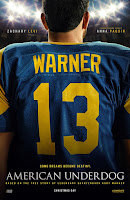
American Underdog
Sports movies almost always get me emotionally, which is weird because I'm not much into sports. But show me Field of Dreams, Remember the Titans, Hoosiers, Miracle, and lo, many more whose names I could rattle off, and I always get choked up and teary-eyed. American Underdog: The Kurt Warner Story was no exception, when I saw it last night at the local movie house. And it gave me the added pleasure of glimpsing my former city, St. Louis – still the place I've lived longer than anywhere else, even seven years after leaving – although the story reaches its climax (the 2000 Super Bowl) before I moved there. Nevertheless, I was able to (kind of) answer a fellow audience member's question about the story. There's a scene where starting QB Trent Green goes down with a knee injury and the lady thought he had been killed. I was able to reassure her that, at a later date, when I was living in Kansas City, Trent Green played football there (and, indeed, he went back to play in St. Louis again, years later, and is alive to this day.)
Even that (Trent Green's later career in KC) was before my time in SL, so clearly what moved me about this movie wasn't any particular crossover with my life or the fact that I followed the story when it happened (which I didn't). It's not even, particularly, the blandly Christian spirituality portrayed by the movie, as it depicts Kurt and Brenda Warner's spiritual struggles as their fortunes rose and fell; or rather, fell and rose. I can't even claim to really understand the appeal of watching football, let alone playing it, though I've done a tiny bit of both (way, way back). I think what really grabbed me about this movie was the instant bond that formed when Kurt Warner, still a college football player having a tough time getting off the bench, paid a surprise visit to his future wife's house after sparks flew between the two at a barn dance, and her blind, brain-damaged son pulled him into the house, made him lie down next to him on the bathroom floor, and sang "You and me goin' fishin' in the dark" along with the radio. You could see this big jock falling instantly in love with a mentally handicapped kid and you just knew they were going to be a family, and watching that happen meant more to me emotionally than whatever football heroics Warner managed to pull off.
And yes, he pulled of some serious stuff. Despite not being drafted by an NFL team – despite languishing for four years in poverty, trying to support his family with a job at Hy-Vee and later, settling for a stint in the Arena Football League – he ended up becoming a starting quarterback for the St. Louis Rams, league MVP, Super Bowl MVP, the first quarterback ever to win the Super Bowl in his first year in the NFL, the first undrafted quarterback to win a Super Bowl, and breaking Joe Montana's record for passing plays in a Super Bowl game; and it wasn't the only Super Bowl he won, either. Successful, 12-year career, yadda yadda, all very nice, but the real underline goes under the bit where he and Brenda raised seven kids and her oldest, whom Kurt eventually adopted, is still doing great.
You feel glad that the guy proved himself despite everyone laughing at the idea of him leading an NFL team; you feel a share in the pride of the people who knew him at his lowest, and during his rise, when they see him eking greatness out of a seemingly hopeless situation; but in the last analysis, what gets you (and by you, I mean me) choked up, and keeps you up thinking about it all night afterward, is the part where an ungoverned man-child gets caught by a divorced woman and her two kids and becomes the man and the dad they need. The little kid's note to "Daddy Kurt" before his first game as an NFL starter opens the floodgates, if they haven't burst already, by recalling to mind their whole journey as a family in a few, loving words.
Besides these Kurt-becomes-a-daddy scenes (and there are a few others in that arc that I haven't mentioned), here are the Three Scenes That Made It For Me: (1) Kurt tries to propose to Brenda, but she says "yes" before he can finish. (2) In general, the football scenes that mercifully, and effectively, compress hours of tedious back-and-forth to the big plays where Warner either gets sacked, or throws and interception, or (increasingly often) nails the receiver. (3) His man-to-man talk with Brenda's father in the garage, challenging Kurt to man up and make a commitment to the family.
I could name a bunch of others. I enjoyed pretty much the whole movie, including the sad parts (like Brenda's parents' sudden fate), the frustrating parts (like Kurt's brief stint with the Green Bay Packers), the grim and gray parts (like when they're so broke they can't pay their electric bill and Kurt has to run several miles in the snow to buy a can of fuel to put in their empty gas tank), and yes, even a sequence where Kurt and Brenda break up. Ouch. But even I knew, to a certain point, that things turned out all right in the end; watching it actually do so is very satisfying, and seeing a picture of the Warners' big family really is the big payoff.
Playing the Warners themselves are Zachary Levi of Chuck and Shazam and Anna Paquin of The Piano, X-Men, Almost Famous and True Blood. It also features supporting turns by Dennis Quaid, Adam Baldwin and Bruce McGill.
Even that (Trent Green's later career in KC) was before my time in SL, so clearly what moved me about this movie wasn't any particular crossover with my life or the fact that I followed the story when it happened (which I didn't). It's not even, particularly, the blandly Christian spirituality portrayed by the movie, as it depicts Kurt and Brenda Warner's spiritual struggles as their fortunes rose and fell; or rather, fell and rose. I can't even claim to really understand the appeal of watching football, let alone playing it, though I've done a tiny bit of both (way, way back). I think what really grabbed me about this movie was the instant bond that formed when Kurt Warner, still a college football player having a tough time getting off the bench, paid a surprise visit to his future wife's house after sparks flew between the two at a barn dance, and her blind, brain-damaged son pulled him into the house, made him lie down next to him on the bathroom floor, and sang "You and me goin' fishin' in the dark" along with the radio. You could see this big jock falling instantly in love with a mentally handicapped kid and you just knew they were going to be a family, and watching that happen meant more to me emotionally than whatever football heroics Warner managed to pull off.
And yes, he pulled of some serious stuff. Despite not being drafted by an NFL team – despite languishing for four years in poverty, trying to support his family with a job at Hy-Vee and later, settling for a stint in the Arena Football League – he ended up becoming a starting quarterback for the St. Louis Rams, league MVP, Super Bowl MVP, the first quarterback ever to win the Super Bowl in his first year in the NFL, the first undrafted quarterback to win a Super Bowl, and breaking Joe Montana's record for passing plays in a Super Bowl game; and it wasn't the only Super Bowl he won, either. Successful, 12-year career, yadda yadda, all very nice, but the real underline goes under the bit where he and Brenda raised seven kids and her oldest, whom Kurt eventually adopted, is still doing great.
You feel glad that the guy proved himself despite everyone laughing at the idea of him leading an NFL team; you feel a share in the pride of the people who knew him at his lowest, and during his rise, when they see him eking greatness out of a seemingly hopeless situation; but in the last analysis, what gets you (and by you, I mean me) choked up, and keeps you up thinking about it all night afterward, is the part where an ungoverned man-child gets caught by a divorced woman and her two kids and becomes the man and the dad they need. The little kid's note to "Daddy Kurt" before his first game as an NFL starter opens the floodgates, if they haven't burst already, by recalling to mind their whole journey as a family in a few, loving words.
Besides these Kurt-becomes-a-daddy scenes (and there are a few others in that arc that I haven't mentioned), here are the Three Scenes That Made It For Me: (1) Kurt tries to propose to Brenda, but she says "yes" before he can finish. (2) In general, the football scenes that mercifully, and effectively, compress hours of tedious back-and-forth to the big plays where Warner either gets sacked, or throws and interception, or (increasingly often) nails the receiver. (3) His man-to-man talk with Brenda's father in the garage, challenging Kurt to man up and make a commitment to the family.
I could name a bunch of others. I enjoyed pretty much the whole movie, including the sad parts (like Brenda's parents' sudden fate), the frustrating parts (like Kurt's brief stint with the Green Bay Packers), the grim and gray parts (like when they're so broke they can't pay their electric bill and Kurt has to run several miles in the snow to buy a can of fuel to put in their empty gas tank), and yes, even a sequence where Kurt and Brenda break up. Ouch. But even I knew, to a certain point, that things turned out all right in the end; watching it actually do so is very satisfying, and seeing a picture of the Warners' big family really is the big payoff.
Playing the Warners themselves are Zachary Levi of Chuck and Shazam and Anna Paquin of The Piano, X-Men, Almost Famous and True Blood. It also features supporting turns by Dennis Quaid, Adam Baldwin and Bruce McGill.
Thursday, October 6, 2016
The Crossover
The Crossover
by Kwame Alexander
Recommended Ages: 12+
Josh Bell and his twin brother Jordan, a.k.a. JB, are seventh-grade basketball phenoms at Reggie Lewis Middle School. But their dream team is in for trouble when a girl comes between the once inseparable brothers, and when their father - a one-time international sports celebrity - chooses to ignore warning signs of a serious health problem. After an impulse to lash out gets him suspended from the team in the middle of a championship season, Josh feels more alone than ever before. Before he gets back into the good graces of his team, his mom, and his brother, he will have to face more responsibility than a trash-talking, hip-hop music addicted 12-year-old would have expected in his wildest dreams.
This is an excellent and fascinating book, told in a succession of poems in various forms, ranging from a Japanese Tanka to dramatic free verse, plus a number of rap songs enhanced by fancy typesetting, as though to guide the reader in performing them out loud. It spotlights complex family issues. It hints at a magical connection between two brothers, who can seemingly read each other's minds even when they aren't on speaking terms. And in the often proven and seldom matched manner of sports fiction, it taps into a strongly moving current of emotion.
This 2014 young-adult verse novel is both a Newbery Medal winner and a Coretta Scott King honor book. Its author, the founder of the Book-in-a-Day program that encourages teens to write, is a poet, TV writer, publisher, radio host, teacher, musician, globetrotting goodwill ambassador, and all-around mover and shaker who has also written the teen novels He Said, She Said and Booked, six poetry collections, four picture books including Acoustic Rooster and His Barnyard Band, and two non-fiction books about writing.
by Kwame Alexander
Recommended Ages: 12+
Josh Bell and his twin brother Jordan, a.k.a. JB, are seventh-grade basketball phenoms at Reggie Lewis Middle School. But their dream team is in for trouble when a girl comes between the once inseparable brothers, and when their father - a one-time international sports celebrity - chooses to ignore warning signs of a serious health problem. After an impulse to lash out gets him suspended from the team in the middle of a championship season, Josh feels more alone than ever before. Before he gets back into the good graces of his team, his mom, and his brother, he will have to face more responsibility than a trash-talking, hip-hop music addicted 12-year-old would have expected in his wildest dreams.
This is an excellent and fascinating book, told in a succession of poems in various forms, ranging from a Japanese Tanka to dramatic free verse, plus a number of rap songs enhanced by fancy typesetting, as though to guide the reader in performing them out loud. It spotlights complex family issues. It hints at a magical connection between two brothers, who can seemingly read each other's minds even when they aren't on speaking terms. And in the often proven and seldom matched manner of sports fiction, it taps into a strongly moving current of emotion.
This 2014 young-adult verse novel is both a Newbery Medal winner and a Coretta Scott King honor book. Its author, the founder of the Book-in-a-Day program that encourages teens to write, is a poet, TV writer, publisher, radio host, teacher, musician, globetrotting goodwill ambassador, and all-around mover and shaker who has also written the teen novels He Said, She Said and Booked, six poetry collections, four picture books including Acoustic Rooster and His Barnyard Band, and two non-fiction books about writing.
Friday, April 13, 2012
Heroism
The baseball, like a missile,
Blazes its deadly course—
Its stitches softly whistle—
No bat can bend its force.
Batsman, your foot fast planted—
In Atlas-like sinew
The globe's staid heft so slanted—
Connect and follow through.
What though the ball fly truly,
The bat against it pressed—
The shoulder turning duly—
The foot remains at rest.
And thus the very planet
Swings suddenly around—
Till like a plunging gannet
The baseball meets the ground.
Blazes its deadly course—
Its stitches softly whistle—
No bat can bend its force.
Batsman, your foot fast planted—
In Atlas-like sinew
The globe's staid heft so slanted—
Connect and follow through.
What though the ball fly truly,The bat against it pressed—
The shoulder turning duly—
The foot remains at rest.
And thus the very planet
Swings suddenly around—
Till like a plunging gannet
The baseball meets the ground.
Saturday, October 15, 2011
Tackiness World Series 2
This week, another baseball-related message from the neighborhood ELCA church, whose book of whimsical bumper-sticker slogans must come equipped with a pun for every conceivable occasion:GOD'S EYE IS ON THE SPARROWS, AND THE CARDINALS!
Yeah, but what about you turkeys?
Tuesday, October 4, 2011
World Series of Tackiness
Hear this, ye St. Louis Cardinals! Thus saith the lighted sign at the city ELCA parish whose former pastor literally wrote the book on lighted church sign messages:GOD'S CARDINAL RULES:
LOVE GOD. LOVE OTHERS.
PLAY A HARD NINE.
This may sound like it's coming out of left field, but... well, it is.
Thursday, March 31, 2011
March Tackiness
Apropos "March Madness"... The neighborhood ELCA tabernacle of lighted-sign tackiness now has two messages on display. For drivers headed south it says:WILL THE BUTLER DO IT?
And for those headed north:
OUR COMMONWEALTH IS IN HEAVEN!
Hmm. I guess that church's ex-pastor's book of tacky church signs has a contingency for everything. The only question is... What is it about these messages that is supposed to make anyone want to go to this church?
Monday, September 20, 2010
Racket Tackiness
Last week's (b)lighted-sign message at the neighborhood Lutheran Church of Athletic Tackiness:
LIFE IS LIKE TENNIS: HE WHO SERVES MORE SELDOM LOSES!
Tell that to John Isner and Nicolaus Mahut, dude. Both of these heroic players surpassed the previous record for aces served in a single match, but one of them still lost. Moreover, the winner went on to
get his clock cleaned, two days later, in the shortest match of this year's Wimbledon....
Punning plays on words may make for cute little jokes and light-hearted slogans. But on holy ground, they are unforgivably tacky. For in theology, nothing is more harmful to clear thought and communication than an equivocal word--a word that means first one thing, then another within the same thought. For example, the sense of the word "serve" used in tennis has to do with something players do when they are fighting hard to win. But in the sense relevant to Christian living, it means nearly the opposite: placing the next person ahead of oneself...
Finally, let's consider the ramifications of seeing this sign under the name of a Lutheran church. Isn't Lutheranism supposed, at minimum, to stand for justification by faith alone? So what does it mean when a "Lutheran" church proclaims that the key to life is good works?
LIFE IS LIKE TENNIS: HE WHO SERVES MORE SELDOM LOSES!
Tell that to John Isner and Nicolaus Mahut, dude. Both of these heroic players surpassed the previous record for aces served in a single match, but one of them still lost. Moreover, the winner went on to
get his clock cleaned, two days later, in the shortest match of this year's Wimbledon....Punning plays on words may make for cute little jokes and light-hearted slogans. But on holy ground, they are unforgivably tacky. For in theology, nothing is more harmful to clear thought and communication than an equivocal word--a word that means first one thing, then another within the same thought. For example, the sense of the word "serve" used in tennis has to do with something players do when they are fighting hard to win. But in the sense relevant to Christian living, it means nearly the opposite: placing the next person ahead of oneself...
Finally, let's consider the ramifications of seeing this sign under the name of a Lutheran church. Isn't Lutheranism supposed, at minimum, to stand for justification by faith alone? So what does it mean when a "Lutheran" church proclaims that the key to life is good works?
Monday, April 12, 2010
Efficacious Tackiness
Currently shining forth on the lighted sign at a local (City of St. Louis) ELCA church near my digs:PLAY LIKE A CARDINAL
PRAY LIKE A BELIEVER
Well, seeing that the Cardinals won 5-0 at today's home opener, the believers' prayers must have been answered!
Tuesday, March 23, 2010
Full-Court Tackiness
Apropos the college basketball championships and the upcoming Palm Sunday, my neighborhood "Lutheran Church of Opportunistic Tackiness" currently offers the following lighted-sign sentiment:GOD'S MARCH MADNESS: A KING RIDING A DONKEY
And when I hurl, it'll hit nothing but net!
Friday, June 5, 2009
The Mechanics of Swing
Get a load of this cool video of a 16-year-old baseball prodigy from my native city, Las Vegas NV. Bryce Harper has been on the cover of Sports Illustrated and, if his joints hold up for a few more years, it won't be for the last time. He'll be a top-seeded draft pick the moment he decides to go pro. By all early signs, he could be the Tiger Woods of baseball - a sport that, frankly, needs one.
What most intrigues me about this video is what it shows about the mechanics of swing. You see this kid hitting no fewer than twelve home-runs, including an amazing 502-foot one into the opposite stands. And every time he smashes a ball into the stratosphere, the way he physically prepares for it and the way he follows through are worth watching. It's like watching a spring being bunched up and then released. Considering his build, there must be an awful lot of force behind those swings.
Notice especially how he turns his legs during the swing. First his right leg turns inward as he winds up. Then his left leg pushes towards his right as his whole body unwinds in a powerful swing. It often ends with a little stumble as he slightly overbalances. As an organist, I'm familiar with the "thighs together" configuration. It's a position of enormous tension and potential energy. Mechanically speaking, by pulling his right leg inward he is both shifting his center of mass backward and coiling his body-spring, preparing to release a huge amount of muscle-energy. Then, during the swing itself, when he turns his left leg inward, it is part of a general movement toward the ball. It's as if he is pushing his full weight forward with an explosive effort, and channeling it into the swing of that bat.
Bottom line: I wouldn't want to be a fly on that ball.
What most intrigues me about this video is what it shows about the mechanics of swing. You see this kid hitting no fewer than twelve home-runs, including an amazing 502-foot one into the opposite stands. And every time he smashes a ball into the stratosphere, the way he physically prepares for it and the way he follows through are worth watching. It's like watching a spring being bunched up and then released. Considering his build, there must be an awful lot of force behind those swings.Notice especially how he turns his legs during the swing. First his right leg turns inward as he winds up. Then his left leg pushes towards his right as his whole body unwinds in a powerful swing. It often ends with a little stumble as he slightly overbalances. As an organist, I'm familiar with the "thighs together" configuration. It's a position of enormous tension and potential energy. Mechanically speaking, by pulling his right leg inward he is both shifting his center of mass backward and coiling his body-spring, preparing to release a huge amount of muscle-energy. Then, during the swing itself, when he turns his left leg inward, it is part of a general movement toward the ball. It's as if he is pushing his full weight forward with an explosive effort, and channeling it into the swing of that bat.
Bottom line: I wouldn't want to be a fly on that ball.
Sunday, November 23, 2008
Alexander-Black-Kerr-Lupica-Meyer
The Iron Ring
by Lloyd Alexander
Recommended Ages: 12+
The award-winning author of the Prydain Chronicles shows his versatility in interpreting world folklore in this novel inspired by the mythology of India. If you're a fan of folk tales, legends, and whopping great yarns, you'll enjoy this story. It reminded me of the Arthurian legend about Sir Gawain and the Green Knight.
The hero is Tamar, the young king of a small country in a fantasy world based on ancient India. Tamar is proud, brave, and devoted to the dharma, or code of conduct, of the warrior caste - somewhat like the chivalric code Sir Gawain followed. One day a mysterious stranger appears in his court and ruthlessly turns the rules of dharma and hospitality to his advantage. In one night of gaming, Tamar wagers his life and loses. His guest puts an iron ring on Tamar's finger as a symbol of the young king's pledge to travel to the palace of Mahapura and surrender his life. Even when Tamar awakens from what seems to be only a dream, the ring remains ominously real.
So Tamar goes out on a journey to find out if his apparent dream was true, and to give up his life if dharma requires it. In his travels he is joined by a pretty gopi (cow-girl), some talking animals, a neighboring king fighting to regain his rightful throne, and other fascinating characters. He experiences romantic love, friendship, hilarious adventures, dangerous intrigues, the terror of battle, and a series of crushing losses that brings our hero so low that his heart breaks - as will yours. But even when he reaches rock bottom, even when the death awaiting him in Mahapura begins to look like an unreachable boon, big things remain in store for Tamar.
If you know who Taran Assistant Pig-Keeper is, you are already acquainted with Lloyd Alexander's gift for sharing great heroes with us. Heroes who grow and transform before our eyes in ways that surprise us and move us. Even though I don't believe in karma, I will say this: If you join Tamar on his errand of growth and transformation, you will be richly rewarded.
Tithe
by Holly Black
Recommended Ages: 14+
Younger readers may know Holly Black for her work on the Spiderwick Chronicles with illustrator Tony DiTerlizzi. Mature teens may also enjoy her solo ventures, such as this "Modern Faerie Tale." Brace yourself, though: it's a dark, gritty brand of faerie tale, with the type of mature themes and off-color language that call for a parental guidance advisory.
Its world is like that of Melissa Marr's Wicked Lovely, only without all the body art and piercings.
Kaye is a tough cookie. It comes of growing up in the entourage of a rock band, taking care of her not-so-motherly mother, and working full-time at a Chinese restaurant instead of going to school. It's a life many of us fantasize about (or did when we were younger), until another member of the band attempts to murder Kaye's mom. They end up moving back to her grandmother's house in a decaying city on the New Jersey shore, and trying to start over.
Kaye's grandmother wants the girl to go to school and prepare for a better life than her mother has. Her mother wants Kaye to do whatever she wants to do. Kaye, meanwhile, just wants to fit in with her old friend Janet's crowd. It isn't easy, when everyone remembers her as the little girl who told stories about her imaginary friends - faeries she really remembers playing with, though no one else could see them. It isn't easy to fit in, especially when the faeries start appearing to Kaye again. And this time, they have something other than fun and games planned.
Her old faerie playmates want Kaye to help them break free of the rule of the dark, cruel Unseelie Court: faeries of the night who control all the solitary (non-court) faeries in their territory, provided that a blood sacrifice is offered every seventh year. The time has come to seal the deal anew. Guess who the intended sacrifice is going to be this time? Only, the surprise will be on the Unseelie Court when they find out what Kaye has just learned herself: namely,
that she isn't a mortal, but a faerie changeling magically disguised as a normal human.
Unfortunately for Kaye, her fey friends' plan is more dangerous to her than she realizes. Things grow more complicated when one of her mortal friends becomes the love-slave of a cruel faerie knight. And then there's the deeply conflicted fey warrior named Rath Roiben Rye, whose fate becomes intertwined with that of our green-skinned pixie heroine. Whatever is going to happen, it's going to be scary, violent, and complicated, with a pinch of romance and a dash of tragedy for added flavor. It may not be to everyone's taste; but if you like your urban nightmare garnished with a spritz of faerie dust, you'll be glad to know there are more books like this. So far this book has at least two companion novels: Valiant and Ironside.
The Day of the Djinn Warriors
by P. B. Kerr
Recommended Ages: 12+
Book Four of the Children of the Lamp series finds twin djinn John and Philippa Gaunt in a bit of a pickle. Their mother has gone off to become the cold, logical, morally neutral Blue Djinn of Babylon. Their father has turned ancient overnight, due to an aging curse meant to keep the children close to him. Disturbances in the spirit world, a worldwide rash of museum robberies, and a chance to restore a pretty young djinn to her wax-figurelike body (and save their mother in the process) mean that John and Philippa have to travel. And that means John must leave his body at home, and both must leave their djinn powers.
It's an adventure in the world of ghosts, unusual for a bunch of people who are still living. This is no trouble for John, who spends much of the time sharing a body with the twins' friend Finlay. But other problems naturally arise. Kindly Mrs. Trump gets a knock on the head. Wise old Mr. Rakshasas sacrifices himself to save John and a disembodied djinn girl named Faustina. While sharing possession of Finlay's body, Faustina and John are unable to hide their mutual puppy love from each other.
An angel challenges Uncle Nimrod's faithful butler Groanin to a wrestling match. Venetian explorer Marco Polo returns from the dead to help solve a mystery stretching from medieval China to present-day Scotland. By granting three wishes to a kind passerby, Philippa unknowingly touches off a series of lifechanging events. And an evil djinn uses Faustina's foolish brother Dybbuk to advance a heinous plan that involves an army of terra cotta warriors, the souls of millions of children, and the balance of good and bad luck throughout the world.
All this, and much more besides, happens in this one action- and adventure-packed book. It has all the humor, youthful romance, puzzles, thrills, chills, and magical weirdness you could wish for. Plus, it comes with the assurance that the series will continue, since Book 5 - titled Eye of the Forest - has already been released.
Summer Ball
by Mike Lupica
Recommended Ages: 12+
In this sequel to Travel Team, Danny Walker and two of his friends follow up their victory in the national 7th grade basketball championship by going to - you guessed it! - a summer basketball camp. If being cut from his town's travel team because he was too short tested a basketball wizard's faith in himself, imagine what happens when he is thrown together with top-talent players up to a year older, and a foot taller, than he is!
Again, Danny suffers a crisis of confidence. It can't help to have an irredeemably nasty coach - the type who would advise his most gifted player to consider playing soccer instead. Coach Powers browbeats Danny's morale to a new low. A jealous (and obnoxious) rival adds to the challenge. But with the support of his friends and teammates - to say nothing of his main girl Tess - he rises to these new challenges and leads yet another team to an awe-inspiring victory.
I'm not much of an athlete. But I'm no snob either. Sports stories always get me choked up. The world of athletics often forms the background for great stories of adversity and triumph, quests for self-knowledge, and a display of skills that can be as exciting as the duels of wands and weaponry that fantasy fans thrive on. Sports journalist and youth basketball coach Mike Lupica makes use of these strengths to score a slam-dunk for young readers' entertainment, especially of interest to kids who like sports.
Heat
by Mike Lupica
Recommended Ages: 12+
The author of the youth basketball novels Travel Team and Summer Ball turns to the world of baseball for this tale in which family love, friendship, and a talent for throwing fastballs come to the rescue of a Cuban orphan in the shadow of Yankee Stadium.
Michael Arroyo lives alone with his brother Carlos, who struggles to keep their little family together by working two jobs and pretending their father is in Florida, taking care of a sick uncle. Actually, their father has been dead since the spring. If the Official Persons learn of this before Carlos turns 18, the boys may be forced into foster care and perhaps separated.
Meanwhile, Michael is pitching for a baseball team that may make it all the way to the Little League World Series, particularly with the heat Michael has been hurling. But these plans, together with the Arroyo boys' secret, are suddenly in danger of crumbling when a rascally rival challenges Michael's claim to be twelve years old. How can they prove his age when his birth certificate is back in Havana, and when the very people they need helping them could also tear their family apart?
This book has its share of suspense, not only of the usual sports-story variety where the hero's team snatches victory from the jaws of defeat, but also as Michael's whole world threatens to collapse around him. But it isn't all unpleasant. Besides the crisis of a fatherless baseball prodigy who almost misses his one chance to make it to the big time, the story also has a bit of youthful romance, a strong dose of humor, charming surprises, and some novel uses of a good pitching arm outside of regulation baseball - such as catching purse snatchers!
Twilight
by Stephenie Meyer
Recommended Ages: 14+
This is the first book of "The Twilight Saga," which continues in New Moon, Eclipse, and Breaking Dawn. In my short time as a bookseller I have sold more copies of these books than just about anything else. Owing in part to the hit movie based on this book, everything vampire-related is absolutely flying off the shelves, including Charlaine Harris's Southern Vampire Series, which I haven't read yet. Vampires are the hottest thing in the YA fantasy world right now; and with a Harry Potter movie around the corner, that's saying a lot.
To be honest, Twilight has been on my "haven't read yet" list for quite some time. In spite of the urgent advice of many readers, I simply never got around to it until the movie was about to come out. But at last I finally read it and saw the film, in that order; and now you can rest assured that I will soon devour the rest of the series.
At the beginning, it seems to be little more than a clever teen romance novel, featuring a couple of unusually interesting high-school-age characters. Soon after moving from sunny Arizona to her father's perpetually rainy town of Forks, Washington, Bella Swan becomes fascinated with a drop-dead gorgeous classmate named Edward. Meanwhile his fascination with her is tinged with hostility.
Soon, however, the fiercely independent, physically clumsy girl and the pale, clammy boy whose eyes change color begin to grow more comfortable with each other. This is to say, they learn to feel increasingly uncomfortable when they're not together. But they are slow to recognize true love growing up between them. Perhaps this is because, as a vampire, Edward thirsts for human blood... especially Bella's. Or maybe it's because, as a mind-reader, Edward is confused and frustrated by his inability to read Bella's thoughts.
Somehow, figuring out Edward's chilling secrets doesn't scare Bella. In fact, the only thing that scares her is losing him. And even though his whole family is a coven of vampires (the nice kind, who only prey on animals if they can help it), they recognize that Bella is Edward's only chance for true happiness. But how long can they be happy together when she is mortal and he isn't; when he constantly needs to guard against harming her fragile frame; when a vampire-hating tribe of werewolves is committed to guarding Bella from Edward; and when a truly unstoppable predator - one with no qualms against taking human life - marks Bella as his prey?
As you read this book, be prepared to fall in love with a surprising heroine who little knows how beautiful she is to others. Be prepared for the inevitable shift from a pleasantly chilling love story to a taut chase thriller. Be prepared for swiftly climbing tension levels as Bella's hunter closes in by instinct and deception, and as the stakes for her survival - as a human or as a vampire - take in the future happiness of families in more than one world.
by Lloyd Alexander
Recommended Ages: 12+
The award-winning author of the Prydain Chronicles shows his versatility in interpreting world folklore in this novel inspired by the mythology of India. If you're a fan of folk tales, legends, and whopping great yarns, you'll enjoy this story. It reminded me of the Arthurian legend about Sir Gawain and the Green Knight.The hero is Tamar, the young king of a small country in a fantasy world based on ancient India. Tamar is proud, brave, and devoted to the dharma, or code of conduct, of the warrior caste - somewhat like the chivalric code Sir Gawain followed. One day a mysterious stranger appears in his court and ruthlessly turns the rules of dharma and hospitality to his advantage. In one night of gaming, Tamar wagers his life and loses. His guest puts an iron ring on Tamar's finger as a symbol of the young king's pledge to travel to the palace of Mahapura and surrender his life. Even when Tamar awakens from what seems to be only a dream, the ring remains ominously real.
So Tamar goes out on a journey to find out if his apparent dream was true, and to give up his life if dharma requires it. In his travels he is joined by a pretty gopi (cow-girl), some talking animals, a neighboring king fighting to regain his rightful throne, and other fascinating characters. He experiences romantic love, friendship, hilarious adventures, dangerous intrigues, the terror of battle, and a series of crushing losses that brings our hero so low that his heart breaks - as will yours. But even when he reaches rock bottom, even when the death awaiting him in Mahapura begins to look like an unreachable boon, big things remain in store for Tamar.If you know who Taran Assistant Pig-Keeper is, you are already acquainted with Lloyd Alexander's gift for sharing great heroes with us. Heroes who grow and transform before our eyes in ways that surprise us and move us. Even though I don't believe in karma, I will say this: If you join Tamar on his errand of growth and transformation, you will be richly rewarded.
Tithe
by Holly Black
Recommended Ages: 14+
Younger readers may know Holly Black for her work on the Spiderwick Chronicles with illustrator Tony DiTerlizzi. Mature teens may also enjoy her solo ventures, such as this "Modern Faerie Tale." Brace yourself, though: it's a dark, gritty brand of faerie tale, with the type of mature themes and off-color language that call for a parental guidance advisory.
Its world is like that of Melissa Marr's Wicked Lovely, only without all the body art and piercings.Kaye is a tough cookie. It comes of growing up in the entourage of a rock band, taking care of her not-so-motherly mother, and working full-time at a Chinese restaurant instead of going to school. It's a life many of us fantasize about (or did when we were younger), until another member of the band attempts to murder Kaye's mom. They end up moving back to her grandmother's house in a decaying city on the New Jersey shore, and trying to start over.
Kaye's grandmother wants the girl to go to school and prepare for a better life than her mother has. Her mother wants Kaye to do whatever she wants to do. Kaye, meanwhile, just wants to fit in with her old friend Janet's crowd. It isn't easy, when everyone remembers her as the little girl who told stories about her imaginary friends - faeries she really remembers playing with, though no one else could see them. It isn't easy to fit in, especially when the faeries start appearing to Kaye again. And this time, they have something other than fun and games planned.
Her old faerie playmates want Kaye to help them break free of the rule of the dark, cruel Unseelie Court: faeries of the night who control all the solitary (non-court) faeries in their territory, provided that a blood sacrifice is offered every seventh year. The time has come to seal the deal anew. Guess who the intended sacrifice is going to be this time? Only, the surprise will be on the Unseelie Court when they find out what Kaye has just learned herself: namely,
that she isn't a mortal, but a faerie changeling magically disguised as a normal human.Unfortunately for Kaye, her fey friends' plan is more dangerous to her than she realizes. Things grow more complicated when one of her mortal friends becomes the love-slave of a cruel faerie knight. And then there's the deeply conflicted fey warrior named Rath Roiben Rye, whose fate becomes intertwined with that of our green-skinned pixie heroine. Whatever is going to happen, it's going to be scary, violent, and complicated, with a pinch of romance and a dash of tragedy for added flavor. It may not be to everyone's taste; but if you like your urban nightmare garnished with a spritz of faerie dust, you'll be glad to know there are more books like this. So far this book has at least two companion novels: Valiant and Ironside.
The Day of the Djinn Warriors
by P. B. Kerr
Recommended Ages: 12+
Book Four of the Children of the Lamp series finds twin djinn John and Philippa Gaunt in a bit of a pickle. Their mother has gone off to become the cold, logical, morally neutral Blue Djinn of Babylon. Their father has turned ancient overnight, due to an aging curse meant to keep the children close to him. Disturbances in the spirit world, a worldwide rash of museum robberies, and a chance to restore a pretty young djinn to her wax-figurelike body (and save their mother in the process) mean that John and Philippa have to travel. And that means John must leave his body at home, and both must leave their djinn powers.
It's an adventure in the world of ghosts, unusual for a bunch of people who are still living. This is no trouble for John, who spends much of the time sharing a body with the twins' friend Finlay. But other problems naturally arise. Kindly Mrs. Trump gets a knock on the head. Wise old Mr. Rakshasas sacrifices himself to save John and a disembodied djinn girl named Faustina. While sharing possession of Finlay's body, Faustina and John are unable to hide their mutual puppy love from each other.An angel challenges Uncle Nimrod's faithful butler Groanin to a wrestling match. Venetian explorer Marco Polo returns from the dead to help solve a mystery stretching from medieval China to present-day Scotland. By granting three wishes to a kind passerby, Philippa unknowingly touches off a series of lifechanging events. And an evil djinn uses Faustina's foolish brother Dybbuk to advance a heinous plan that involves an army of terra cotta warriors, the souls of millions of children, and the balance of good and bad luck throughout the world.
All this, and much more besides, happens in this one action- and adventure-packed book. It has all the humor, youthful romance, puzzles, thrills, chills, and magical weirdness you could wish for. Plus, it comes with the assurance that the series will continue, since Book 5 - titled Eye of the Forest - has already been released.
Summer Ball
by Mike Lupica
Recommended Ages: 12+
In this sequel to Travel Team, Danny Walker and two of his friends follow up their victory in the national 7th grade basketball championship by going to - you guessed it! - a summer basketball camp. If being cut from his town's travel team because he was too short tested a basketball wizard's faith in himself, imagine what happens when he is thrown together with top-talent players up to a year older, and a foot taller, than he is!Again, Danny suffers a crisis of confidence. It can't help to have an irredeemably nasty coach - the type who would advise his most gifted player to consider playing soccer instead. Coach Powers browbeats Danny's morale to a new low. A jealous (and obnoxious) rival adds to the challenge. But with the support of his friends and teammates - to say nothing of his main girl Tess - he rises to these new challenges and leads yet another team to an awe-inspiring victory.
I'm not much of an athlete. But I'm no snob either. Sports stories always get me choked up. The world of athletics often forms the background for great stories of adversity and triumph, quests for self-knowledge, and a display of skills that can be as exciting as the duels of wands and weaponry that fantasy fans thrive on. Sports journalist and youth basketball coach Mike Lupica makes use of these strengths to score a slam-dunk for young readers' entertainment, especially of interest to kids who like sports.
Heat
by Mike Lupica
Recommended Ages: 12+
The author of the youth basketball novels Travel Team and Summer Ball turns to the world of baseball for this tale in which family love, friendship, and a talent for throwing fastballs come to the rescue of a Cuban orphan in the shadow of Yankee Stadium.
Michael Arroyo lives alone with his brother Carlos, who struggles to keep their little family together by working two jobs and pretending their father is in Florida, taking care of a sick uncle. Actually, their father has been dead since the spring. If the Official Persons learn of this before Carlos turns 18, the boys may be forced into foster care and perhaps separated.Meanwhile, Michael is pitching for a baseball team that may make it all the way to the Little League World Series, particularly with the heat Michael has been hurling. But these plans, together with the Arroyo boys' secret, are suddenly in danger of crumbling when a rascally rival challenges Michael's claim to be twelve years old. How can they prove his age when his birth certificate is back in Havana, and when the very people they need helping them could also tear their family apart?
This book has its share of suspense, not only of the usual sports-story variety where the hero's team snatches victory from the jaws of defeat, but also as Michael's whole world threatens to collapse around him. But it isn't all unpleasant. Besides the crisis of a fatherless baseball prodigy who almost misses his one chance to make it to the big time, the story also has a bit of youthful romance, a strong dose of humor, charming surprises, and some novel uses of a good pitching arm outside of regulation baseball - such as catching purse snatchers!
Twilight
by Stephenie Meyer
Recommended Ages: 14+
This is the first book of "The Twilight Saga," which continues in New Moon, Eclipse, and Breaking Dawn. In my short time as a bookseller I have sold more copies of these books than just about anything else. Owing in part to the hit movie based on this book, everything vampire-related is absolutely flying off the shelves, including Charlaine Harris's Southern Vampire Series, which I haven't read yet. Vampires are the hottest thing in the YA fantasy world right now; and with a Harry Potter movie around the corner, that's saying a lot.To be honest, Twilight has been on my "haven't read yet" list for quite some time. In spite of the urgent advice of many readers, I simply never got around to it until the movie was about to come out. But at last I finally read it and saw the film, in that order; and now you can rest assured that I will soon devour the rest of the series.
At the beginning, it seems to be little more than a clever teen romance novel, featuring a couple of unusually interesting high-school-age characters. Soon after moving from sunny Arizona to her father's perpetually rainy town of Forks, Washington, Bella Swan becomes fascinated with a drop-dead gorgeous classmate named Edward. Meanwhile his fascination with her is tinged with hostility.
Soon, however, the fiercely independent, physically clumsy girl and the pale, clammy boy whose eyes change color begin to grow more comfortable with each other. This is to say, they learn to feel increasingly uncomfortable when they're not together. But they are slow to recognize true love growing up between them. Perhaps this is because, as a vampire, Edward thirsts for human blood... especially Bella's. Or maybe it's because, as a mind-reader, Edward is confused and frustrated by his inability to read Bella's thoughts.Somehow, figuring out Edward's chilling secrets doesn't scare Bella. In fact, the only thing that scares her is losing him. And even though his whole family is a coven of vampires (the nice kind, who only prey on animals if they can help it), they recognize that Bella is Edward's only chance for true happiness. But how long can they be happy together when she is mortal and he isn't; when he constantly needs to guard against harming her fragile frame; when a vampire-hating tribe of werewolves is committed to guarding Bella from Edward; and when a truly unstoppable predator - one with no qualms against taking human life - marks Bella as his prey?
As you read this book, be prepared to fall in love with a surprising heroine who little knows how beautiful she is to others. Be prepared for the inevitable shift from a pleasantly chilling love story to a taut chase thriller. Be prepared for swiftly climbing tension levels as Bella's hunter closes in by instinct and deception, and as the stakes for her survival - as a human or as a vampire - take in the future happiness of families in more than one world.
Tuesday, April 1, 2008
John H. Ritter
The Boy Who Saved Baseball
by John H. Ritter
Recommended Age: 12+
I can give you no better introduction to this book than the opening words of the book itself...
Welcome to Dillontown, in the remote desert of San Diego County, California, close to the Mexican border. I used to live near there, and spent a good deal of time there, so I appreciate Ritter’s evident love of that region (where he grew up and still lives). I suspect that the main character, 12-year-old Tom Gallagher, is based on the author himself at that age: bookish, clumsy, fanatically devoted to baseball and not very good at playing it, but filled with the gift of telling hilarious and inspiring stories about the game. I wouldn’t be surprised if some of the pages in Tom Gallagher’s notebooks were copied straight out of the boyhood journals of John H. Ritter.
And what do we find in those pages? We find a quiet little Southwestern town in the throes of a decision whether to build a suburban development or to preserve the fragile ecology, to say nothing of the historic baseball park where generations of kids have played little league games. We find a town whose decision, whether to stay the same (and perhaps die) or to change (perhaps beyond recognition) will finally come down to the result of a single, summer league game between teams of twelve-year-old kids. A town where the local team, coached by Tom’s dad, doesn’t have a ghost of a chance – at least until a strange kid named Cruz de la Cruz rides in out of nowhere, and until a retired baseball legend comes out of his seclusion. Then something mysterious, and maybe magical, happens.
Here Ritter weaves together elements of folk tale, sports legend, personal memoir, a satire of small-town politics, and a parable on the preservation of heritage and environment, all in front of a backdrop of today’s computer technology, media blitzes, educational theories, and that wonderful “Spanglish” culture along the U.S.-Mexican border. Now it should surprise no one that this story gave me a lump in the throat; stories about sports have a tendency to make me cry. But this is also a book that brought delight and laughter, genuine sympathy for the main characters, and surprising insights into the heart of baseball.
Those who don’t know anything about the game may not be interested in this book – or it may be the very thing that gets them interested in baseball. Other readers may notice that there is nothing particularly surprising or original about the story as such; but must there be? It is the type of story that folks have always told each other, and always will tell. It is well told. And — unless it’s just me — it instills you with a longing for a part of the country that few people would call beautiful, unless they know it well. I’m eager to go back again, at least by way of John H. Ritter’s books.
by John H. Ritter
Recommended Age: 12+
I can give you no better introduction to this book than the opening words of the book itself...
...With these charming words framing the tale at both ends, an award-winning baseball fiction author sets the tone for his entire book. Not to be confused with the late actor John Ritter, author John H. Ritter also wrote Choosing Up Sides and Over the Wall – books I started planning to read as soon as I read the opening paragraphs quoted above. And that was before finding out exactly how wonderful this book is, from cover to cover.People down in Dillontown don’t agree on much. Not the skateboard laws. Not the billboard laws. The economy. The ecology. There’s days when they don’t even agree on which way the wind is blowing.
But they agree on this... If there never was a boy named Cruz de la Cruz, somebody would’ve come along and invented him.
Welcome to Dillontown, in the remote desert of San Diego County, California, close to the Mexican border. I used to live near there, and spent a good deal of time there, so I appreciate Ritter’s evident love of that region (where he grew up and still lives). I suspect that the main character, 12-year-old Tom Gallagher, is based on the author himself at that age: bookish, clumsy, fanatically devoted to baseball and not very good at playing it, but filled with the gift of telling hilarious and inspiring stories about the game. I wouldn’t be surprised if some of the pages in Tom Gallagher’s notebooks were copied straight out of the boyhood journals of John H. Ritter.
And what do we find in those pages? We find a quiet little Southwestern town in the throes of a decision whether to build a suburban development or to preserve the fragile ecology, to say nothing of the historic baseball park where generations of kids have played little league games. We find a town whose decision, whether to stay the same (and perhaps die) or to change (perhaps beyond recognition) will finally come down to the result of a single, summer league game between teams of twelve-year-old kids. A town where the local team, coached by Tom’s dad, doesn’t have a ghost of a chance – at least until a strange kid named Cruz de la Cruz rides in out of nowhere, and until a retired baseball legend comes out of his seclusion. Then something mysterious, and maybe magical, happens.Here Ritter weaves together elements of folk tale, sports legend, personal memoir, a satire of small-town politics, and a parable on the preservation of heritage and environment, all in front of a backdrop of today’s computer technology, media blitzes, educational theories, and that wonderful “Spanglish” culture along the U.S.-Mexican border. Now it should surprise no one that this story gave me a lump in the throat; stories about sports have a tendency to make me cry. But this is also a book that brought delight and laughter, genuine sympathy for the main characters, and surprising insights into the heart of baseball.
Those who don’t know anything about the game may not be interested in this book – or it may be the very thing that gets them interested in baseball. Other readers may notice that there is nothing particularly surprising or original about the story as such; but must there be? It is the type of story that folks have always told each other, and always will tell. It is well told. And — unless it’s just me — it instills you with a longing for a part of the country that few people would call beautiful, unless they know it well. I’m eager to go back again, at least by way of John H. Ritter’s books.
Saturday, February 23, 2008
Paul Haven
Two Hot Dogs with Everything
by Paul Haven
Recommended Age: 10+
This one is for all the obsessed baseball fans out there. You know who you are. You know every statistic on every player in the history of your favorite team. You watch every game, whether they're winning or losing. And you indulge in rituals and superstitious behavior - anything to help your team along. The Sluggers, losingest team in the major leagues, have such a fan in Danny Gurkin. He avoids stepping on sidewalk cracks, eats two fully-loaded hot dogs before every game, and strategically uses clothes, body language, and the activities of his family to give the Sluggers every chance he can. Even so, they haven't had a shot at the league pennant since the team's founding manager, bubblegum magnate Manchester Boddlebrooks, choked to death on a ballpark pretzel 108 years ago.
Danny is convinced he can make a difference. And somehow, he finally does, after visiting the condemned Boddlebrooks mansion (with its baseball-bat-shaped towers) and stealing a handful of pieces of a new flavor of gum Boddlebrooks was working on when he died. Now, simply by chewing this disgusting, century-old gum, Danny's obsession becomes the magic the Sluggers need. His dedication to the team makes him first a local celebrity, then a team mascot...but it costs him his friends.
Meanwhile, the owner of the Texas Tornadoes has started to sweat. He realizes that Danny Gurkin is the reason the Sluggers can't lose. And he intends to use all of his considerable power and money to neutralize this threat.
If you liked The Boy Who Saved Baseball, consider reading this book. It's like a whimsical "Thinking of You" card to young baseball nuts everywhere. It injects a loopy kind of magic into the world of sports, the magic that lives in the hopes and dreams of kids like Danny Gurkin.
by Paul Haven
Recommended Age: 10+
This one is for all the obsessed baseball fans out there. You know who you are. You know every statistic on every player in the history of your favorite team. You watch every game, whether they're winning or losing. And you indulge in rituals and superstitious behavior - anything to help your team along. The Sluggers, losingest team in the major leagues, have such a fan in Danny Gurkin. He avoids stepping on sidewalk cracks, eats two fully-loaded hot dogs before every game, and strategically uses clothes, body language, and the activities of his family to give the Sluggers every chance he can. Even so, they haven't had a shot at the league pennant since the team's founding manager, bubblegum magnate Manchester Boddlebrooks, choked to death on a ballpark pretzel 108 years ago.
Danny is convinced he can make a difference. And somehow, he finally does, after visiting the condemned Boddlebrooks mansion (with its baseball-bat-shaped towers) and stealing a handful of pieces of a new flavor of gum Boddlebrooks was working on when he died. Now, simply by chewing this disgusting, century-old gum, Danny's obsession becomes the magic the Sluggers need. His dedication to the team makes him first a local celebrity, then a team mascot...but it costs him his friends.Meanwhile, the owner of the Texas Tornadoes has started to sweat. He realizes that Danny Gurkin is the reason the Sluggers can't lose. And he intends to use all of his considerable power and money to neutralize this threat.
If you liked The Boy Who Saved Baseball, consider reading this book. It's like a whimsical "Thinking of You" card to young baseball nuts everywhere. It injects a loopy kind of magic into the world of sports, the magic that lives in the hopes and dreams of kids like Danny Gurkin.
Wednesday, February 21, 2007
Me, a Soccer Mom?
Subscribe to:
Posts (Atom)