Brace yourself, this is going to be a long one. Sometime many years ago, I wrote a
post about the hymn tunes I had written up to that point. It wasn't really all that many. Well, I've written a lot more since then, and as part of the run-up to
Edifying Hymns (even if it's a bit premature) I think I'd like to share some comments about my hymn tune composing process. Don't yawn at me like that. I think this could be fun. Some of the tunes, in fact, have musical "Easter eggs" hidden within them, for those who have ears to hear (or eyes to sight-read). So here is a brief guide (as brief as possible, anyway) to my output as a hymn-tune composer and some of the decisions that led them to be what they are.

This tune's title was suggested to me by a children's book. It literally means "of or relating to the alphabet" or "alphabetically arranged," which I thought was clever because the tune goes with the first segment of an acrostic hymn, each stanza of which consists of eight lines beginning with a the same letter of the alphabet, one initial letter per stanza, all the way through from A to W. A subtler joke is that, if you look at just the first melody note of each phrase, the outline of the tune goes up the C major scale. I planned that. So, the challenge of writing it was to make that little joke work.
I wrote this tune to go with a hymn for the 4th Sunday in Advent by Alan Kornacki, Jr. Upward leaps of a third or fourth seem to be the organizing motif.
I composed this for my own hymn for the Advent season, the text of which was a "scratch and dent" from the 1990s that I buffed out for
Useful Hymns. There were a few days in 2014 when I wrote and arranged a whole bunch of tunes for those not-so-golden oldies. The bit about this tune that I like starts in the third phrase, with a series of gradually stretching phrases that I think build up a nice dramatic climax. It's tough little tune, too, slamming down to an open-octave B for the closing chord. See how pleased I am with myself.
I wrote this tune for Mark Preus who, at one point, I was trying to talk into co-editing some kind of publication for original hymn with me. Never happened. But I wrote tunes for a couple of his hymns, though I'm not sure he liked them or that they were my best. The title comes from Mark's middle name, which is also the second name of an historically significant Preus in Norwegian-American Lutheran history, Herman A. Preus. The gimmick in this tune is that the next-to-last phrase inverts the first phrase.

I especially like this tune, which I've used with two different hymns that have the words "Amen, Amen" in them. That's the original language of the gospels for when Jesus says "Verily, verily" or "I tell you the truth." I always wondered why translators don't just leave "Amen, Amen" as is. Speaking of as-is, this tune kind of wrote itself; it's one of very few pieces that I pretty much pulled straight out of the air without any deliberation. I just knew what I wanted it to sound like, and wrote that down.
I whipped this up to pair with a "scratch and dent" that began with the words "Ancient of Days," of which the tune's title is the Latin version. I seem to have decided at the outset that I wanted a long-short-short rhythm throughout the piece.
Here's another tune I wrote for a hymn by Alan Kornacki, Jr. I don't know why his hymns seem to draw better music out of me than Mark Preus's; I'm sure it's not Mark's fault. The Latin means something like "Behold shield," which reflects the first line of the hymn. As for the tune itself, the gimmick seems to be taking a low-slung phrase shape and stretching it taller and taller, again, building to a climax.
This tune, for a hymn about God the Son assuming every aspect of human nature, has a type of rhythm I like: alternating between two meters, with a short-long-short rhythm replacing the hackneyed pattern of straight quarter-notes with a pick-up beat.
The title is Greek for "Worthy is the Lamb," and I chose Greek in this case because the Latin
Dignus est Agnus has been done to death already. I wrote it for a hymn based on the heavenly hymn of Revelation. Rhythmically, the piece plays with hemiola (mixing up 3/2 and 6/4 patterns), and I think I meant for the first phrase to suggest the sign of the cross.
I named this tune after my godparents, the late Rev. Paul Bartz and his wife Bonnie. I like to say their daughter, Rebekah, is my "godsister" because my parents are her godparents, too. I can't think of any particular connection between them and the hymn paired with this tune, which dates from my "scratch and dent" period. I think I was aiming for something that sounded like a Reformation-era chorale.
All right, I confess. I was trying to flip the tune to "Twinkle, Twinkle, Little Star" upside-down when I wrote this tune for a children's bedtime hymn. Don't hurt me?
I wrote two settings of this tune, for a prayer-hymn about cancer that I wrote in honor of one of my seminary-mates, who was dealing with a cancer diagnosis. Setting 1 is vanilla hymnal style; Setting 2 is a more flowing, three-voice arrangement with weirder harmony.
This was one of my early efforts in writing original hymn tunes. I think the Bloomington I named it after is the one in Minnesota, though I can't remember why I did so. The melody pretty much contrives to be mostly descending scales. Let's put it down to eloquence in simplicity, shall we?
Here's another tune from that 2014 fit of (re)finishing "scratch and dent" hymns, which I did in a rush so that I could put out the original (unexpanded) edition of
Useful Hymns. There's nothing special about it, other than the fact that I rarely write in the key of A-flat.
Here's another uninspired tune that I wrote for a hymn by Mark Preus. Sorry, Mark! I avenged him on myself by using it for a very long hymn of my own, regarding Jesus' "I AM" sayings in John's gospel, but then I relented and put in FARLEY CASTLE ("Here, O my Lord, I see You face to face") as an alternate tune. I remember that at one point, when I wasn't sure Mark was going to let me publish his hymn with my tune, I considered changing its title to EGO EIMI ("I am"). But I didn't. Anyway, the tune sounds weird because I was leaning, perhaps too heavily, toward a modern take on the medieval Dorian mode.
I wrote this hymn at the end of last year for one of my hymns about the four evangelists' accounts of the Passion of Jesus. Here you see a bit more of my preference for short-long-short rhythms and decorative melismas.
Lutheran Worship had a hymn by Martin Franzmann, "O kingly Love, that faithfully," which I enjoyed playing on the piano when I was all by myself but that I only ever heard sung in church once – at my seminary fieldwork church in Decatur, Indiana, where it went over like a lead balloon. I would have predicted that outcome, because the hymnal tune was way too long, through-composed, ruggedly different in a modern-music way, and (for those reasons and more) hard for a congregation to pick up. One sleepless night – I believe it was the night before the chapel service where I received my placement assignment for my first pastoral call – I passed the time by brainstorming how to set Franzmann's really quite tricky text to a tune that might be better structured for a congregation to learn and enjoy singing. The next day I harmonized it, took it straight to a classmate (who, incidentally, is now an Anglican) and showed it to him. He looked at it for ten seconds and said, "It sounds Anglican." I guess that was a compliment.

The hymn that included this tune, based on Isaiah 55, was originally a choir piece that I wrote when I was in college. This might explain why it's on the challenging side for hymn-singing purposes. But trust me, the choir piece was a lot harder. It indulges a lot of things I like to throw into tunes, when I'm not restraining myself heroically; things like challenging rhythms (bars of 5/4 and 7/4!), persistent patterns of slurred notes and a repeat with varied harmony. OK, so maybe it's more of a solo than a congregational hymn. At least there's an option besides just reading the words as a poem.
Written for a burial hymn, this tune tone-paints the concept by coming in for a landing on a low note and staying there for a while. Sorry. I know it's not funny.
I think I may have based this tune on a decades-old sketch in one of my music scoring notebooks. I wrote, or at least rewrote it, for an "Oh, give thanks unto the Lord" psalm paraphrase, also dating from "scratch and dent."
This might be the best work I ever did for Mark Preus. I think the relevant hymn was written for synodical delegates.
It's a funny thing, but the name in this tune's title occurs in two unrelated branches of my family, pronounced two different ways. The branch I named it after, however, is my father's father's mother and stepfather, Bessie and Alphonse Couillard, who lived long enough for me to be a pallbearer at Great Grandpa Al's funeral (he died when I was 17) and for me to miss Great Grandma Bessie's altogether because I was tied up as a pastor in my second parish and couldn't make the trip. I just sang this tune as a solo at church today, set to a hymn that happened to share a first line with the Introit for the day.

I think this was actually the first hymn I ever wrote, words and music together: a Communion hymn that I wrote after one year of college-level music theory. In its original form, the tune was slightly different, and its harmonic arrangement left a lot to be desired. Nevertheless, my home church's choir sang it in harmony, and they seemed to like it. It was good feedback for a kid just starting out on a lifelong avocation as a hymn writer – even if I don't think, now, that it was deserved. By the way, Crosby is the name of the town where I graduated high school.
This tune for a Passion hymn also comes from my "scratch and dent" period, and bears similarities to certain chorales. You learn by imitation.
I wrote this tune for a "heroes of the faith" hymn about King David. Sorry, I have to admit, those melismatic flourishes are musically pointless. I guess I was just trying to shake up the formula, or something.
During a choir tour out of Bethany Lutheran College, I saw a sampler cross-stitched with a congregation's mission statement framed and mounted above the church's main entry door. I decided it was such a nifty statement that I turned it into a hymn and wrote this tune for it. Since then, I re-used it for a hymn dedicated to the memory of a young woman whose faith overcame profound physical disabilities. Maybe it's that connection that makes this tune very emotionally affecting for me. Or maybe it was just a solid, early effort in this field.
This is the alternate tune that I wrote in college for the communion hymn mentioned under CROSBY. As you can see, I was already having second thoughts about my first official hymn tune. This option gives the hymn a much more modern texture. And for your info, Deerwood is the town I lived in (rurally speaking) when I finished high school.
I wrote this tune along with an early, "scratch and dent" paraphrase of Psalm 116, while I was a student at Bethany. Understandably, given the tradition of hymns I was learning to know at that school and the ELS church down the road, it gives off the scent of being influenced by Scandinavian chorale writing. Ludvig M. Lindeman, don'tcha know.
Perversely, I waited until a hymn-writing contest on the theme of disaster response was officially over, so that I wouldn't be expected to meet somebody else's criteria for how it should be done, then wrote my own "disaster hymn" and this tune to go with it. It's in the Lydian mode, which I had a hard time working with, and I'm still not sure the return to the home key is quite convincing.
Guess what Sunday of the church year I wrote this hymn for. I did two arrangements because I thought the first one might be too hard for some organists; but face it, both arrangements are hard.
I must have been in a really weird mood when I wrote this hymn. It has an oddly soothing, lullaby-like quality too it. Maybe I could recycle it for another children's bedtime hymn.
This tune takes its title from the Circumcision of Jesus, the eighth day after His birth, which is what the hymn's text is about. The only noteworthy things about it that I can think of are the fact that it's in the key of A (another key that I don't use often) and that the first phrase of melody is repeated, oddly, in the fifth phrase.
This hymn's choice of where to break between the last two phrases is an oddity, driven by the fact that I used it in
Useful Hymns with two tunes that had slightly different meters. It's one of my "scratch and dent" tunes.
I broke away, just a little, from the "chord change under every note of melody" mold in this hym, which may help lighten it up a little. I wrote it for a "heroes of the faith" hymn about the prophet Elijah.
This tune, written for a hymn-prayer about addiction, represents one of the few times I've written a hymn arrangement with a first and second ending. I think it was another case, like AMEN, AMEN, where the tune kind of wrote itself, rhythmic quirks and all.
The "scratch and dent" hymn for which I wrote this tune, during that big rush in 2014, is one of my least favorite among my hymn texts. It's titled "In the World But Not Of the World," hence the tune title's reference to Christian engagement with the secular world. Other than being well structured, I can't see anything really special about the tune.
"Ephphatha" is the Aramaic word Jesus said when he commanded the deaf-mute's ears and tongue to "be loosed." I wrote this tune for a hymn about the miracle, and I'm quite fond of it. Besides cramming some tonal adventure into a few brief phrases, it also exhibits the kind of rhythmic palindromes (across pairs of bars) that I like to play with, sometimes. You know, short-long-long-short, or long-short-short-long. Once you've heard or sung this hymn, I think you'll always think of the refrain "He has done all things well" when you hear the tune's first phrase.
I was imitating early American, shape-note psalter tunes when I wrote this tune for a paraphrase of Psalm 68. Sometimes I think I imiated too well; it seems so familiar to me, now, that I worry about whether I might not have unconsciously plagiarized some existing tune. But so far I've found no evidence to that effect.
I wrote this tune for a hymn for Fathers' Day. I think it has a certain chorale-like ring to it, like a gloss on GAUDEAMUS PARITER. Note that the third phrase is a melodic inversion of the first.
I originally wrote this tune for a hymn about the feeding of the 5,000. Like AMEN, AMEN and EMNACIPATION, it was one of those instances where I felt like I was taking the hymn down rather than composing it – one of those moments of pure creativity that happens rarely and brings delight. Most of these tunes, I really had to work at to get into the kind of shape I wanted. One of the trade-offs, of course, is that the tune's rhythm is full of surprises.
Written for one of a series of "litanies for the times of life," this tune does more of that hemiola (3/2 vs. 6/4) stuff that I've mentioned before that I like to mess with sometimes. Because all of those litany hymns had the same meter, I wanted to shake up their rhythmic patterns a bit.
The four angels (messengers) described in this tune's title are the evangelists, Matthew, Mark, Luke and John. Yes, the hymn that goes with this tune is about them. For him who has ears to hear, I meant for the opening pair of phrases to suggest an image of an angel flapping its wings to ascend and then gliding back down. Don't see it? Don't worry. I just mention it because it's one of those decisions that, whether they make sense or not, serve as part of my process.

The hymn that goes with this tune is about the feeding of the 4,000. I wrote it and the 5,000 hymn at about the same time, on purpose, inspired by a pair of sermons by my then-pastor that I thought made a good case for the two rather similar miracles serving different purposes. The hymn text, in this case, had a whimsical running joke about math in it, which I carried over into the tune by scoring it entirely in the 5/4 meter. I recall having to alter a couple of phrases after I wrote the first draft because they were too similar to an existing hymn tune; ironically, I think the change took away some of this tune's distinctiveness.
Yep, this tune goes with a hymn about the "fruits of the Spirit" – love, joy, peace, patience, etc. I think it's a nice, dignified tune, but probably not my most memorable work.
This tune is the one that came to mind when I saw a T-shirt saying, "9/8 ... 7/16 ... 13/4 ... These are difficult times," and I realized I had written a tune in 13/4 that, in my opinion, really works. I like to conduct myself when I'm singing it, and my conducting gesture is basically like a 6/4 gesture (down-left-left-right-right-up), only with three pulses instead of two in the third beat. Kind of fun, I think. Definitely not to be sung slowly; it has to move. I wrote it for a hymn about the Creation, hence the title.
I just wrote this the other day, obviously for my trinitarian "God Is Love" hymn. The gimmick I was going for, when I planned it, was that pattern of repeated notes at the beginning of each phrase, which (I thought) symbolized the equality and union of the three-personed Godhead. A point I was trying to make with the hymn is that the notion that "God Is Love" has special meaning for Christians because it flows out of His Triune nature.
Here's a tune I wrote for a Christmas hymn by Nicolai F.S. Grundtvig. I think I had in mind some of the Scandinavian chorales I admire, like I JESU NAVN, with their brave asymmetries and well-developed dramatic shape.
I wrote this tune for two of Icelandic poet Hallgrimur Petursson's beautiful Passion hymns, which I recommend highly. They were the two, with the same meter, for which I didn't know of any existing tune that would suit. Again, I tried to sound a bit Nordic and Passion chorale-y, and made the most of those metrical asymmetries that seem to be a key part of Scandinavian hymn writing. I also discovered one of the non-original tunes that I used in
Useful Hymns, SAELIR ERU TRUADIR, set to one of Petursson's Passion hymns ("And then the Savior turned"), which may explain why it has an Icelandic title in spite of being Bohemian in origin.

I wrote the hymn for which I composed this tune upon the death of a friend in a non-church-related context, so that I could send the lyrics written inside a sympathy card without committing myself as to this person's spiritual status. I later added a stanza and wrote the tune, styling it a hymn for the burial of someone whose spiritual condition is unknown. As I've said before, people have jumped down my throat when they learned that such a hymn exists, without actually reading it, because they're so anxious about offering hope that may not be ours to give. But I say, there is need for a hymn that recognizes people's real grief, even for unbelieving loved ones who have died, and seeks to console them with compassion and a prayer for divine healing. That's all this hymn does. But then I went and re-used the tune for a hymn about a Christian's suicide, and no doubt I'll be in trouble all over again once that gets out. Like AMEN, AMEN, etc., the tune pretty much wrote itself, and I think of it as one of my best pieces.

This tune takes its name from the "holy angel" mentioned in the morning and evening prayers in Luther's Small Catechism, which I paraphrased in the hymn that goes to it.
I was angling for the effect of a Johann Crueger chorale when I set my "scratch and dent" baptism hymn to this tune.
The effect I was aiming for with this tune was more of a "Pomp and Circumstance" persuasion. I don't know why, exactly; maybe it was just for a change of pace. The word "Holy" figures in the titles of several tunes that I wrote for my set of hymns on the 10 Commandments; in this case, "Thou shalt not kill."
Musical joke time! For this hymn about the commandment "Remember the Sabbath day," I planned a hymn whose first two phrases – first descending, then ascending – signify the seventh-day rest by ending a scale run on the seventh note. Har, har!
This tune, for one of the commandments against coveting, was simply modeled on some Lutheran chorales that I love, such as ACH, WAS SOLL ICH SÜNDER MACHEN.
For the commandment "Honor your father and mother," I was also thinking about some favorite chorales, such as DAS NEUGEBORNE KINDELEIN.
For the commandment "Thou shalt not take the name of the Lord, thy God, in vain," I don't know if I had a specific model in mind, but I think the dramatic shape turned out nicely with an ascending sequence of phrases toward the end.
This is the tune I wrote for the spare "All Saints' Day" hymn I discovered on my blog after
Useful Hymns went to press, so it'll have to wait until the sequel to see the light of day. More of those 3/2-vs.-6/4 melismas, with a really weird ending that I rather like.
Again, I might have been thinking of one or more historic, Lutheran chorales when I wrote this tune for a hymn for humility. But I also think it's an effective example of the kind of melodic writing you can do when you're on the spot and you feel no inspiration whatsoever. I just picked a three- or four-note melodic shape and turned it every which way, and presto! A dramatically effective hymn tune!
Here's another tune that I wrote for that set of highly alliterative, acrostic hymns. You'll notice more of those two-bar, rhythmic palindromes I've pointed out before. Liking that kind of thing is, I suppose, just another weird part of being me.
I contributed this effort to a hymn by Andy Richard.
Edifying Hymns will also, I hope, have Richard's text as well as an alternate tune by Tapani Simojoki. Meanwhile, enjoy another example of my preference for weird rhythms, like the 5/4 meter that runs almost all the way through this tune (except one bar of 7/4 and one of 6/4).
I think I was going for a suggestion of plainchant when I wrote this tune, which I've now used with two of my hymns.
I didn't create this chant tune, obviously, but I adapted it into the shape of a hymn-tune by selecting what I thought were the important notes and deleting all the others. I then wrote two settings of it, which try in different ways to preserve the horizontal flow of the melody. The second arrangement is canonic (i.e., the middle part is the same as the melody, but delayed by a couple of beats), a technique I feel I should try more often.
Originating in my "scratch and dent" period, back in college, this tune recently resurfaced when I chose it for my "Uses of the Law" hymn. I kind of enjoy its tonal adventurousness. Also, I like the key of c-sharp minor, but I don't write in it often enough. If four sharps make your brain hurt, just play it in c minor with three flats; you can read the same notes, playing the black notes on the white keys, etc.
Here's a tune I wrote for another "heroes of the faith" hymn. I think it's got a nice dramatic shape, and the consecutive upward fourths in the second and last phrases are quite striking. The tune LAMENT has a closing phrase that reminds me of it. When you do as much of this as I have, you start unconsciously stealing from yourself.
I wrote this tune for a "reverently silly children's hymn" about loud little voices. I can't recall what I was modeling it on – it's certainly not as obvious as the "Twinkle, Twinkle" one – but somehow, I think I pulled off a childlike quality.
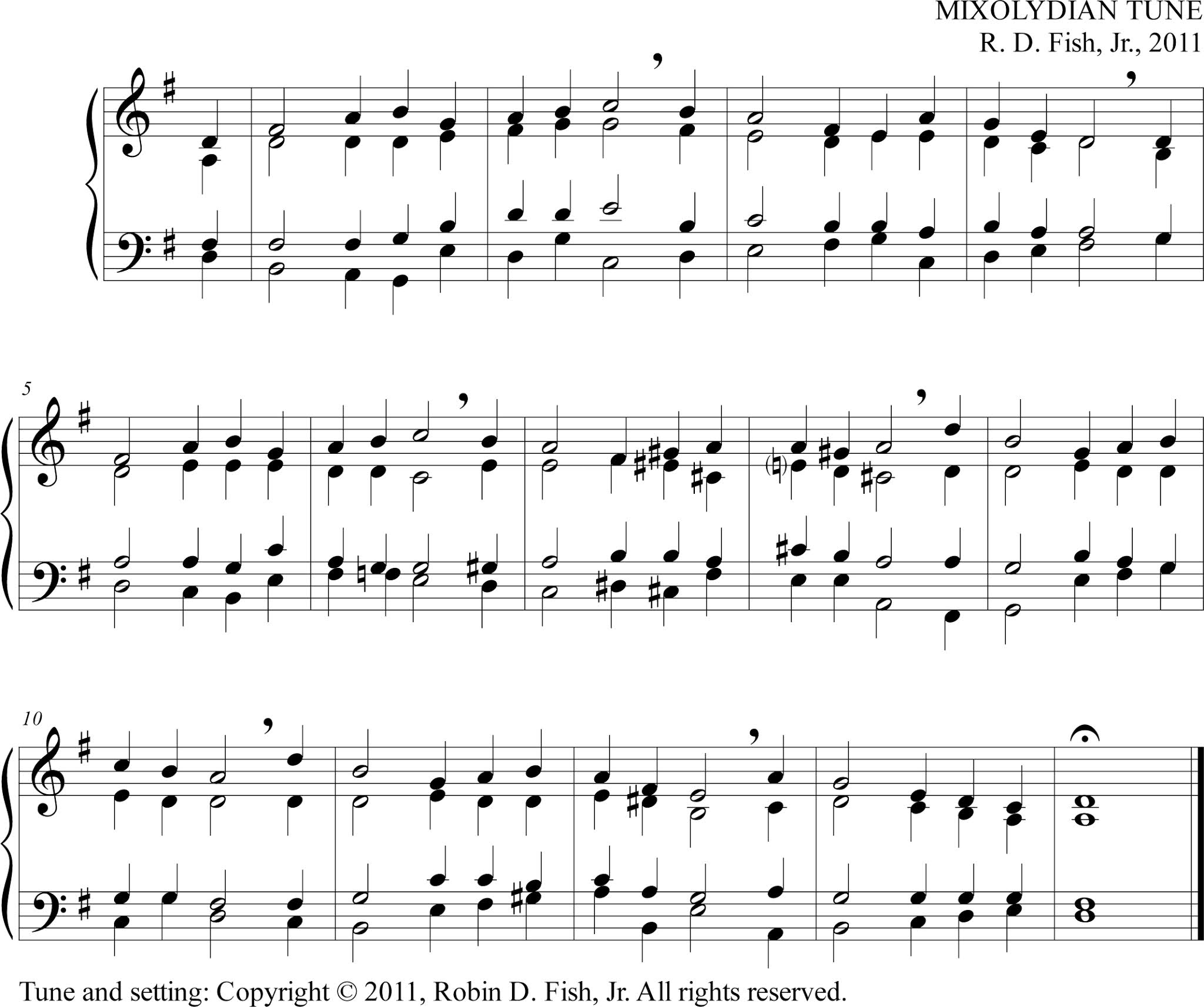
This tune occurs twice within four hymns in UH – the hymns for Judica (the 5th Sunday in Lent) and Quasimodogeniti (the 1st Sunday after Easter). It's kind of weird that it works for both. I think it may have something to do with the ambivalent mood of the Mixolydian mode (the answer to your question, "Why is the key signature missing a sharp?") and the rhythmic energy (look! palindromes in measures 2, 6 and 10!) that can be interpreted as either earnest or joyful.
With this melody for a polemical hymn about objective justification, I was thinking about writing an almost-alternate tune to GOTT DER VATER WOHN UNS BEI. This is what I got. It might be just a bit weirder than I really intended.
I wrote this tune for a "hymn for good preaching" that, in stanza 2, makes metaphorical mention of "Farmer Brown." Because of this, one of my friends in the church musicican/composer community said he refused to read one line further. Well, you can't please everyone. It's another piece with the kind of rhythm that I find interesting – alternating groups of 6 and 8 beats, with triple rhythms coming and going. If, after writing as many tunes as I have, you're not doing something that you find interesting, brother, you're going to burn out.
This ballad-like little number was written for a hymn that Rev. Dr. John Kleinig included in his CPH Commentary on Hebrews. I wrote a tune for another hymn he put in there, too, and I'm so thrilled that after seeing them, he agreed to let me publish both hymns in
Edifying Hymns.
Written, natch, for a hymn of lament – which, as I recall, begins each stanza with a different interrogative pronoun ("Who, what, when," etc.) – this is the one I mentioned before as bearing a slight similarity to ISAIAH; only not so slight that it didn't drive me crazy when I ran across it, recently, and wondered why it reminded me of something else I had written.
Here we have another one of my rare "first and second ending" notations, which I really put here to save space repeating two phrases that only differ by the last three chords. It's named after a fellow member of my former home church who was suffering from late-stage dementia and whose husband was movingly devoted to her care. I'll never forget the words he said the day he put her in hospice care: "I think this is the worst I've ever been hurt." My feelings overflowed into a hymn with the refrain, "Remember us, Lord Jesus." And this tune, which I think expresses those feelings pretty well.
I guess I was trying to sound chant-like again with this tune, for a hymn about the liturgy.
"Maskil" means "a skillful psalm" and that's why I chose it as the title for the tune for one of those acrostic hymns. I imagine it going rather quickly, and the three-voiced setting sounds a little like a horn fanfare to me. Also, remember that musical joke I embedded in ABECEDARIAN? There's something like it in this tune, starting on A and going up by scale member (give or take an octave) – but on the last note of each phrase rather than the first, not including the final cadence.
This tune actually takes its name from the medieval church mode that, again, explains why the key signature seems to be missing a sharp. I wrote it for a hymn about the theology of worship.
This tune to another segment of that acrostic hymn takes its name from a bit of alliteration that struck me in the stanza whose lines all begin with M. It kind of has the sound of a chorale that was based on a plainchant melody.
Obviously, I didn't write this tune. But I did write two harmonizations of it, which I'm including here just to show what an SOB I am at times. The first arrangement, which has parallel 5ths running brazenly all through the left-hand part, came about as my passive-aggressive response to being called upon to play "Amazing Grace" at a church service where one of my Bethany profs was preaching. When I failed to edit my facial expression, he grabbed my beard, pulled hard, and said, "What's wrong with 'Amazing Grace'? Nothing!" So I made sure there was something wrong with it. But I also wrote a more conventional arrangement of it, to make up for my little tantrum.
There are definitely pieces of a couple of chorales in this tune, written for a hymn about worrying. I guess I wasn't worried about being derivative.
Written for the Third Sunday in Lent, this is another one of those AMEN, AMEN type phenomena, still rare compared to my overall output, where I wrote the piece straight out without a pause to look back. It's nice to know I can count on that to happen once in a great while.
This tune is completely made up of gimmicks contrived to cover for a lack of inspiration. To start, the second phrase is repeated verbatim in the second-last phrase. Then, the first phrase is flipped upside down for the last phrase. And finally, everything in between is a lightly disguised, rising sequence. Talk about making something out of nothing! The tune's title is the Greek word translated as "Ye of little faith!"
This tune accompanies the first tune I wrote for
Edifying Hymns, literally before the ink was dry on the first copies of
Useful Hymns. I think it's a fun piece, with a cheerful energy that slightly conceals the economy of thematic material (again, something you make do with when you can't find inspiration.)
This was one of my first hymn tunes written
after the "scratch and dent" period – when I was on vicarage, and I made a study of hymns pass for daily devotions. In
The Lutheran Hymnary I came across an Easter hymn titled "I know that my Redeemer lives" – but not the one you're thinking of; this one was purportedly translated by somebody Oxenford from a hymn by Paul Gerhardt. I didn't think much of the tune in LHy, so I wrote my own tune for it. Check it out, toward the end of the hymns in UH.
This tune, for a Palm Sunday hymn, is in another rarely-used (by me) key: f minor. I'm not sure it wasn't adapted from sketches put down in my "scratch and dent" days. Which is another way of saying, I'm not altogether happy with it. But it'll do.
I wrote this tune for a hymn by David Rosenkoetter. The tune title is a Greek word meaning boldness or frankness, particularly in speech.
Written not so long ago for one of my "Passion according to" hymns, this tune is another example of making do without inspiration by just taking a couple of intervals and turning them this way and that, until a tune happens. If nothing else, it has the virtue of being tightly organized.
I wrote this tune for a hymn about (natch) the Passover. Again, it's pretty much entirely made up of phrase fragments that are copied and moved around in different combinations, sometimes transposed into the relative major key. It's how we roll in "too busy to wait for inspiration" land.
Both versions of this tune will appear in
Edifying Hymns. I originally wrote it for a hymn by Alan Kornacki, Jr. but he was leery of the limping rhythm (alternating bars of 5/4 and 3/2) so, at his request, I "alt."-ed it to be in 3/2 all the way through. But then I found that I really liked the limping version better; I felt that dotting that half-note in every other bar drained the vitality out of it. So, I kept the original version in my back pocket, and I've already found a hymn to pair it with.
I think I may have been channeling some English Methodist hymn composer when I wrote this hymn for a "peace with God" hymn. I was just trying to achieve a sense of tranquility and stillness. I'm afraid it might have turned out just a touch tacky. With my luck, it'll probably end up being the most famous piece I ever wrote.
The Latin title, meaning "full of days," is a hint that I wrote this tune for a hymn about old age – one of the "litanies for the times of life" I mentioned before. Now that I look at it again, it does have a certain old-fashioned ring to it.
Here's another tune I wrote on vicarage, actually as an assignment from my supervisor. He wanted me to apply my musical skills to give the church's preschool program a themesong. When I re-used it for an "opening and closing of preschool" hymn in UH, however, I found that I had to rewrite the words; the original lyrics were too specific to that local program.
I wrote this tune for a polemical hymn about the Lord's Supper, part of a controversy about whether the whole Christ is present when we receive His body and blood. The hymn has the refrain, "As Thou hast come to live in me, So let me also live in Thee." Clearly, I was modeling my work on the hymn "I come, O Savior, to Thy table." For the tune, I basically aimed for "as close as possible to plagiarizing ICH STERBE TÄGLICH without getting caught."
Naturally, the hymn this tune was written for is titled "Pruning Hymn." I also consider it one of the earlier hymns of my maturity, before I started seriously thinking about gathering them together in a hymnbook. It may also be the first time I wrote a three-part hymn setting, which has sort of become one of my things.
This tune comes from my rush to fix up "scratch and dent" hymns with tunes for the UH 1st Ed. The Latin title refers to the hymn's text from the book of Job, "Why has (the light) been given?" And hey! It's in c-sharp minor! That makes two! My favorite riff is the plunging third-to-last phrase.
And now, putting the lie to my previous assertion that I hardly ever write in the key of A, here's the tune to my "scratch and dent" paraphrase of the Athanasian Creed, whose first word in Latin gives the tune its title.
This tune, for a hymn about bringing little ones to Jesus, is named after my nephew – although the tune existed for more than a decade before he was born. Obviously, I changed its title when I was putting UH together. I think it was originally named after a saintly woman I was acquainted with in college. It's pretty tightly constructed for such a little tune; the first two phrases are the same as the last two, with only one contrasting phrase in between.
There's something vaguely nurseryish about this hymn, even though I didn't write it for a children's hymn; actually, I paired it with the second dedication hymn in UH. Maybe the melodic shape was meant somehow to represent the idea of "stir(ring) up my still heart."
I just wrote this one the other day for that hymn about baptismal regeneration. I mentioned at the time – and that mention actually got me thinking about doing this post – that the driving ideas behind its melody and harmony were, respectively, rippling water and the Spirit blowing who-knows-where.
This is another "rush to melodify scratch-and-dents for the UH 1st Ed." tune. It's not bad for wholly lacking inspiration; again, illustrating how discipline and motivic unity can pass for creative genius when you're under the gun.
This tune, for a hymn for the 4th Sunday in Advent, came into being when someone pointed out that the existing chorale I had chosen for the hymn moved in the wrong direction at the words "Drop down, drop down." I poured through all the hymns in that meter that I could find and there wasn't a single one that tone-painted that direction of motion at that point in the melody. So, I grudgingly wrote one that did. Apart from that, what I like about it are its alternating rhythmic palindromes of "long-short-short-long" and "short-long-short."
This tune was written for the second of six parts of that acrostic hymn, previously mentioned. I trust you can see that I was on one of those "motivic unity" kicks again, as one tends to be when one is writing six hymn tunes in one day.
This tune, also for one of those acrostic hymns, takes its name from a Hebrew word that occurs several times in the text of the Psalms, and that seems to be some kind of musical instruction, like "up music" or whatever. Since the "S" stanza of the acrostic makes reference to that, I rolled with it. And look, there's my favorite meter: 5/4!
This tune in my 3/2-vs.-6/4 hemiola register goes with a hymn about divinity students. It reminds me a little bit of some 17th century chorales.
I might have mentioned, when I first posted this tune not too long ago with a hymn about Jesus' "seven last words on the cross," that I deliberately worked a musical sign of the cross into this tune, three times. Can you spot it? Setting 1 is hymnal vanilla; Setting 2 is three-voice, goofball modern, with lots of parallel 6ths in the lower parts and rhythms in the accompaniment that cross the grain of the melody. Sorry, I can't help it. I'm just weird that way.
The "Psalm of a Sinner-Saint," for which I wrote this tune, was a last-moment addition to UH when the book was almost ready to go. Actually, I wrote a couple of hymns after it that I had been planning to include in the book. This one, however, was unplanned. As you might expect, the tune was as spontaneous as the rest of it. Does it work? I'm not sure. I'm OK with it, but my taste isn't everybody's. For example, I get this crazy pleasure out of rhythmic palindromes, as you can see in several bars of this tune.
I wrote this tune for a hymn by Matthew Carver, a guy who also wrote some tunes for hymns by yours truly. I should work with that guy more often.
I also wrote this for a hymn by Matthew Carver, and named it after a pastor, Rev. Rick Stuckwisch, of our mutual acquaintance. Matthew's hymn was inspired by something Rick said in a sermon, hence the title. It's kind of a playful tune, with a folksy ring to it. I should find another place to use it.
This tune originated as a choral setting of Richard Wilbur's Christmas hymn, "A stable lamp is lighted," that I prepared for my church choir. I liked the text but wasn't quite convinced by the couple of tunes I had seen it set to, so this. To conduct it properly, you need to switch between beating "1" for the 3/4 bars to beating 3/2 across the barline at the phrase breaks with the rests. I chose the title to honor the place where I did my vicarage, which was really the happiest year of my ministry.
I guess starting a tune with the same note repeated three times isn't an idea that flashed upon me with my "God Is Love" hymn. This tune, for a Thanksgiving hymn that I wrote for UH, does yeoman work for a text in an odd little meter.
This whopping piece of pomp and circumstance, with two repeats and all, was written in that 2014 rush to publish the UH 1st Ed. for a "scratch and dent" hymn whose massive stanza structure is definitely something I would know better than to pull these days. Unless I was desperate, that is.

I could just copy and paste what I said under THEE AND ONLY THEE into this space, but I won't, and that's mainly because this piece's harmony reminds me of a thing about me that I've forgotten to point out; and there are other tunes where you can see this tendency. Namely, I like to write big, spread-out, sonorous chords. That chord at the end of the first phrase makes me shiver. Also, if you compare my setting of a tune to one written by some of my contemporaries, you might also notice that I like to use inverted triads way more than they do; and when I'm not purposely keeping the harmony reined in, I tend to run through all the Roman numerals in the music theory book and dip into neighboring keys. I use the word "err" advisedly when I admit that I err on the side of making the harmony as active and rich as possible, because I like it that way even though it probably inhibits some people from enjoying my work.

This is the other tune I wrote for those hymns in Kleinig's Hebrews commentary. It's one of the weirdest things I ever wrote, but I planned it that way because I wanted to convey the sense of a wide-ranging journey. And of course, once again, you can see that limping rhythm that I preferred for PAY HEED, with alternating bars of 5/4 and 3/2. Dr. Kleinig, it was really brave of you to let me publish your hymn with this tune. Thanks!
This angular number seems to be made up chiefly of broken triads, with plenty of wide leaps. So, not one of my easier tunes to sing.
It's A major again! Third time! One of the reasons I don't use it a whole lot is evident from the B-sharps and E-sharps in it, which (I understand) Grandma Smurf doesn't like having to play. You know what, though? I think they're fun.
I wrote this tune for a Passion hymn by N.F.S. Grundtvig, way back when I was still a pastor. I think I might like the tune better than the text.
I wrote this tune recently for a "scratch and dent" that I was buffing out for EH. It's quite weird, but I think that weirdness has something to do with the unusual meter of the hymn. Anymore, I try not to choose really goofy stanza structures, and though I can't always tell when I'm breaking new ground, it's usually an accident because I don't really want to compose an original tune for every single hymn that I write. On the other hand, if this list makes it seem like there are an inordinate number of "scratch and dent" hymns represented – well, in the first place, there
are more than 60 of them; and in the second place, while I tend to look out for existing hymn tunes for many of my mature hymns, I don't think it's fair to saddle someone else's music with my worst poetry. So, maybe a disproportionate number of these tunes were written to order for the "scratch and dents." Huh.
This is another example of me putting in unmotivated melismas. The corresponding hymn is a "scratch and dent" paraphrase of the Venite (Psalm 95) from Matins.
Here's another tune for my series of "litanies for the times of life." Note the similarity between the two pairs of phrases.
Written for a hymn about the process of calling a pastor (or having a pastor who receives a call to serve elsewhere), this tune reminds me of something already existing, maybe a Christmas carol.
Funny story about this one. When I wrote it for a hymn by Andy Richard, his feedback was to write his own tune for the hymn. Anyway, he was nice enough to say I could use his hymn with both tunes in EH (I'll be sure to verify that before it goes to press). The funny part is that I played both tunes for my dad and asked him which one he liked better, and he said he preferred Andy's. Ouch.
This is the tune for a baptismal birthday song for children. In concept, it's a lightly disguised copy of "Happy Birthday to You," flipped upside down.
Here's another awkward case: A tune I wrote for my own original hymn (about the Parable of the Sower), but for which I also have an alternate tune that Matthew Carver volunteered for it. I have no plans to play both of them for my dad. The gimmick of this tune is that the first phrase, going down, and the last phrase, going up, are both composed of the C major scale with extra Cs inserted. I don't know if I was trying to symbolize something there, or what. Maybe I was just trying for something new.
The namesake of this hymn is not hymnwriter John Ylvisaker, of "Borning Cry" fame, but Sigurd Ylvisaker, an early president of Bethany after whom the fine arts building at that school is named, and in whose name a scholarship was created that gave me a two-year full ride on that campus. It's an early tune of mine, composed for a "scratch and dent" hymn.
So like, yes, I've done a lot of this hymn-tune-writing wheeze, at some times with more success than at others. But the two big takeaways I've learned from all this practice are: (1) how not to give up when I don't have a brilliant idea in my head or time to wait for one, and still need to produce a reasonably good result; and (2) the importance of trying different things, like imitating different styles of music, building entire pieces around a piece of musical symbolism, erring on the side of harmonic and rhythmic variety, and just plain having fun. That's why I'm still in it after, lo, 29 years!