I didn't notice that I had failed to write a properly catechetical hymn about the Office of the Keys, or absolution, until somebody on a hymn-writers' Facebook group put out a call for that kind of hymn. So, here is something I've been brooding on since then, and I hope it does the trick. There are several existing tunes that (I think) would pair well with it, but here's the first one that flies off the top of my head: HELA VÄRLDEN FRÖJDES HERRAN, from Sweden, 1676. I'd probably transpose it down a step, though.
Little children, sore convicted
With the consciousness of crime,
Trust in Jesus, once afflicted
For all men, all sin, all time.
What He gives to comfort you
Grasp, for He is always true.
Lest with stricken conscience doubt you
Of an inward pardon's ease,
Christ establishes without you
An external means: the Keys,
Whereby sins are loosed and bound
And a sure relief is found.
Thus an office Christ has founded,
Filled by men called, set apart;
Thus salvation is expounded
To the world and every heart.
Jesus, speaking through their word,
Heals and saves where it is heard.
You who would be thus persuaded
Need but in the Scriptures delve,
Where this burden Jesus laded
First on Peter, then the twelve:
"What on earth you loose and bind,
Shall above be sealed and signed."
Likewise, when their risen Master
Blew on them His holy breath,
He appointed every pastor
To speak words of life and death:
Both to pardon and retain
Sins until He comes again.
Now, beloved, consolation
Comes through Christ's appointed means;
Your assurance of salvation
On this office safely leans.
When guilt lays you in the dust,
In His absolution trust.
For, thank God, though men may falter,
Jesus' promises are sure;
Individuals may alter,
Yet His office will endure.
He will hear what you confess
And through it breathe righteousness.
Therefore, little ones, repenting,
Hasten to receive this grace:
No more new device inventing,
Meet the Savior of our race
Where He promises to be,
Speaking truth that sets you free.
Wednesday, March 30, 2022
Sunday, March 27, 2022
317. Prodigal Hymn
Today's readings from the LSB three-year lectionary revealed another of the many glaring omissions from my body of work as a hymn-writer. My attempt to write a hymn for every Sunday of the Church Year was, of course, oriented toward the historic one-year series. But despite having a passing mention in an omnibus "Parables Hymn," the parable of the prodigal son isn't really covered in my first 316 original hymns;* the closest I could get, in an ongoing project to sing one of my hymns as a solo every week, was that old "Finding the Lost" hymn about the widow's coin and the lost sheep. So, today's hymnwriting project is the first of a bunch of corrections of this type that I see being made for the work-in-progress, Bountiful Hymns. The tune I have in mind is ES GEH, WIES WOLL by Michael Praetorius, 1610.
When Jesus' kind regard was shown
To those in need of mercy,
Some who stood righteous in their own
Raised up a controversy.
That all may see as in God's eyes,
Three parables did He devise,
Their wisdom plain and earthy.
What man of you, our Shepherd said,
One in a hundred losing,
Would not leave all behind, instead
That one's salvation choosing;
And having found what had been lost,
His neighbors joyfully accost,
With hearty joy effusing?
Likewise, what woman with ten coins,
The moment one was wanting,
Would not take light and gird her loins,
Each nook and cranny hunting?
How must she, finding it, rejoice!
The angels even so give voice
O'er one lost soul repenting.
And when a rich man's younger son
Spent all in wasteful living,
He came to feeding swine, yet none
To him a bite was giving.
Home to his father's house he crawled,
Content a mere slave to be called,
His heart so deeply grieving.
The father saw, ran, kissed, embraced
The prodigal returning;
Slew fatted calf and called a feast,
All blame and censure spurning:
"My son is living who was dead;
Is found who had been lost," he said,
His love thus brightly burning.
The elder son began to chide:
"I've served without transgressing.
Why was I such a feast denied?"
"My son, grudge not this blessing.
For all this time, not by your deeds,
But by my care for all your needs,
My goods you were possessing."
Lord, plant this sermon in our heart,
Whichever son we follow.
At times we take the wastrel's part,
In selfish pleasures wallow.
But when the bitterness sets in,
We come to hate the taste of sin;
Its revels leave us hollow.
Convince us that, when we repent,
You'll like that father greet us:
What time and goods we have misspent
Forgiving as You meet us.
A worthy sacrifice prepared,
No sliver of your mercy spared,
Into Your banquet lead us.
And often though the elder son
Be whom You find us aping,
Let scribes and Pharisees have done,
No more our judgment shaping!
For if we are Your holy race,
We have all things alone by grace,
Eternal treasure reaping.
* Actually 317 previous hymns; I keep forgetting that there's a "Hymn number zero" back there somewhere.
To those in need of mercy,
Some who stood righteous in their own
Raised up a controversy.
That all may see as in God's eyes,
Three parables did He devise,
Their wisdom plain and earthy.
What man of you, our Shepherd said,
One in a hundred losing,
Would not leave all behind, instead
That one's salvation choosing;
And having found what had been lost,
His neighbors joyfully accost,
With hearty joy effusing?
Likewise, what woman with ten coins,
The moment one was wanting,
Would not take light and gird her loins,
Each nook and cranny hunting?
How must she, finding it, rejoice!
The angels even so give voice
O'er one lost soul repenting.
And when a rich man's younger son
Spent all in wasteful living,
He came to feeding swine, yet none
To him a bite was giving.
Home to his father's house he crawled,
Content a mere slave to be called,
His heart so deeply grieving.
The father saw, ran, kissed, embraced
The prodigal returning;
Slew fatted calf and called a feast,
All blame and censure spurning:
"My son is living who was dead;
Is found who had been lost," he said,
His love thus brightly burning.
The elder son began to chide:
"I've served without transgressing.
Why was I such a feast denied?"
"My son, grudge not this blessing.
For all this time, not by your deeds,
But by my care for all your needs,
My goods you were possessing."
Lord, plant this sermon in our heart,
Whichever son we follow.
At times we take the wastrel's part,
In selfish pleasures wallow.
But when the bitterness sets in,
We come to hate the taste of sin;
Its revels leave us hollow.
Convince us that, when we repent,
You'll like that father greet us:
What time and goods we have misspent
Forgiving as You meet us.
A worthy sacrifice prepared,
No sliver of your mercy spared,
Into Your banquet lead us.
And often though the elder son
Be whom You find us aping,
Let scribes and Pharisees have done,
No more our judgment shaping!
For if we are Your holy race,
We have all things alone by grace,
Eternal treasure reaping.
* Actually 317 previous hymns; I keep forgetting that there's a "Hymn number zero" back there somewhere.
Friday, March 25, 2022
Intelligent Pain
May life bring you intelligent pain:
The kind that you can use to grow,
To learn to make different mistakes,
Better mistakes, another time.
Gather the tears you shed on seeing
A world round you where you don't belong;
Sweat borne of efforts wasted on trying
To make it better; Spit off a tongue
Oft bitten when you dared not speak;
Wax from ears set to ringing
By the roaring clamor of the age; And blood
Felt in a heart that longs for a better place.
Gather them in fingers that itch to do
A new thing, and draw a door upon the wall,
And go through it, knowing not where it will lead,
And pull it shut behind you.
The kind that you can use to grow,
To learn to make different mistakes,
Better mistakes, another time.
Gather the tears you shed on seeing
A world round you where you don't belong;
Sweat borne of efforts wasted on trying
To make it better; Spit off a tongue
Oft bitten when you dared not speak;
Wax from ears set to ringing
By the roaring clamor of the age; And blood
Felt in a heart that longs for a better place.
Gather them in fingers that itch to do
A new thing, and draw a door upon the wall,
And go through it, knowing not where it will lead,
And pull it shut behind you.
Wednesday, March 16, 2022
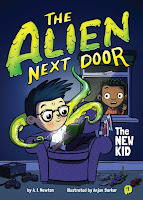
The Alien Next Door
The Alien Next Door (8-book series)
by A.I. Newton
illustrated by Anjan Sarkar
Recommended Ages: 6+
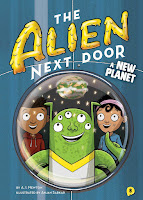
This is actually not one book, but eight books that I picked up as a boxed set at Costco last weekend. (The set also included a children's activity book, with pictures to color, writing prompts, etc.) Their titles are The New Kid; Aliens for Dinner?!; Alien Scout; Trick or Cheat?; Baseball Blues; The Mystery Valentine; Up, Up, and Away; and A New Planet.
While each book stands somewhat on its own on the scale of an elementary-level chapter book, the whole series also works together as a continuous story with each individual book as a kind of chapter in it. My father, who got to it before me, read all eight books in one sitting, and was the first to complain that the last one ends abruptly without really resolving the storyline. Actually, his exact words were, "It just goes pbpbpbpbt." I myself managed it in two settings, but they went quickly in terms of total time. I'm glad to report that according to Fantastic Fiction, a ninth book titled The Marvelous Museum is supposed to come out in October 2022. So, I guess this series isn't over yet.
As for the eight books so far, most of them came out in quick succession in 2018 and 2019 and have charming illustrations, featuring an apparently American (or maybe Canadian?) boy named Harris who begins to suspect that the awkward, lonely new kid next door may actually be an alien from outer space. The more sure of this he becomes, the more his family and his best friend, Roxy, think he's just being mean because Zeke is different. But Harris is right; and after the first couple of books, he and Zeke become friends and Harris begins to share in his secret. Harris and Roxy help Zeke learn about such strange human customs as scouting campouts, trick-or-treating, baseball and Valentines.
Then Zeke finds out his parents, Xad and Quar, have finished their research on Earth and they have to move back to the planet Tragas. At first, Harris and Zeke look for a way to delay their departure. In the last book (so far), Harris reveals Zeke's secret to Roxy, and the two of them stow away on the ship and get to experience the "new kid" phenomenon from the other side, disguised as aliens on a strange new world.
Written at an elementary level, the books are simple and light but they also carry themes, such as being kind to people who are different from you, not cheating or taking shortcuts. They look at American(?) cultural customs in a humorous light, with charm, goofy humor and an occasional flash of wit. The weirdness of Tragas and its cultural customs comes in for some imaginative treatment, too, modeling Harris and Roxy's openness to having new experiences and, of course, their loyal friendship with Zeke. I feel even better recommending these books knowing that there's more to come.
A.I. Newton is also the author of the "Little Olympians" series, also illustrated by Sarkar, in which kid-sized Greek gods go to camp to learn how to use their powers and get along together. Their titles, up to the most recent release, are Zeus, God of Thunder; Athena, Goddess of Wisdom; Hermes, the Fastest God; and Artemis, the Archer Goddess. I can't actually find any information online about A.I. Newton as a human being. For all I know, he may be a fictitious pen-name, maybe with a whole list of author credits under another name.
About illustrator Anjan Sarkar, I've learned that he's a British illustrator of Indian heritage who has contributed art to such books as Rum Pum Pum by David L. Harrison and Jane Yolen, Queen of the Hanukkah Dosas by Pamela Ehrenberg, and Level Up! Last One Standing by Tom Nicoll, among 20-some books.
by A.I. Newton
illustrated by Anjan Sarkar
Recommended Ages: 6+
This is actually not one book, but eight books that I picked up as a boxed set at Costco last weekend. (The set also included a children's activity book, with pictures to color, writing prompts, etc.) Their titles are The New Kid; Aliens for Dinner?!; Alien Scout; Trick or Cheat?; Baseball Blues; The Mystery Valentine; Up, Up, and Away; and A New Planet.
While each book stands somewhat on its own on the scale of an elementary-level chapter book, the whole series also works together as a continuous story with each individual book as a kind of chapter in it. My father, who got to it before me, read all eight books in one sitting, and was the first to complain that the last one ends abruptly without really resolving the storyline. Actually, his exact words were, "It just goes pbpbpbpbt." I myself managed it in two settings, but they went quickly in terms of total time. I'm glad to report that according to Fantastic Fiction, a ninth book titled The Marvelous Museum is supposed to come out in October 2022. So, I guess this series isn't over yet.
As for the eight books so far, most of them came out in quick succession in 2018 and 2019 and have charming illustrations, featuring an apparently American (or maybe Canadian?) boy named Harris who begins to suspect that the awkward, lonely new kid next door may actually be an alien from outer space. The more sure of this he becomes, the more his family and his best friend, Roxy, think he's just being mean because Zeke is different. But Harris is right; and after the first couple of books, he and Zeke become friends and Harris begins to share in his secret. Harris and Roxy help Zeke learn about such strange human customs as scouting campouts, trick-or-treating, baseball and Valentines.
Then Zeke finds out his parents, Xad and Quar, have finished their research on Earth and they have to move back to the planet Tragas. At first, Harris and Zeke look for a way to delay their departure. In the last book (so far), Harris reveals Zeke's secret to Roxy, and the two of them stow away on the ship and get to experience the "new kid" phenomenon from the other side, disguised as aliens on a strange new world.
Written at an elementary level, the books are simple and light but they also carry themes, such as being kind to people who are different from you, not cheating or taking shortcuts. They look at American(?) cultural customs in a humorous light, with charm, goofy humor and an occasional flash of wit. The weirdness of Tragas and its cultural customs comes in for some imaginative treatment, too, modeling Harris and Roxy's openness to having new experiences and, of course, their loyal friendship with Zeke. I feel even better recommending these books knowing that there's more to come.
A.I. Newton is also the author of the "Little Olympians" series, also illustrated by Sarkar, in which kid-sized Greek gods go to camp to learn how to use their powers and get along together. Their titles, up to the most recent release, are Zeus, God of Thunder; Athena, Goddess of Wisdom; Hermes, the Fastest God; and Artemis, the Archer Goddess. I can't actually find any information online about A.I. Newton as a human being. For all I know, he may be a fictitious pen-name, maybe with a whole list of author credits under another name.
About illustrator Anjan Sarkar, I've learned that he's a British illustrator of Indian heritage who has contributed art to such books as Rum Pum Pum by David L. Harrison and Jane Yolen, Queen of the Hanukkah Dosas by Pamela Ehrenberg, and Level Up! Last One Standing by Tom Nicoll, among 20-some books.
Sunday, March 13, 2022
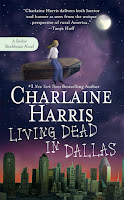
Living Dead in Dallas
by Charlaine Harris
Recommended Ages: 15+
This is the second of about 13 Sookie Stackhouse novels, a.k.a. Southern Vampire Mysteries and the basis for the TV series True Blood. The previous installment was Dead Until Dark; coming next is Club Dead. I forgot to mention last time that an Adult Content Advisory applies, as does an Occult Content Advisory; although it's more Adult than Occult, with explicit love scenes and a particularly unerotic (if not anti-erotic) orgy. On the woo-woo side, for what it's worth, it has telepathy, legalized vampires, illicit werewolves and other shapeshifters, and a creature of the departed Greek god Dionysus known as a maenad. So, we're not talking about Satan worship or witchcraft; but then it also depicts a religion devoted to destroying vampires and that may be the most disturbing part of its environment. Readers with delicate sensibilities have been warned. Most everyone else will likely enjoy the sexy humor, mystery and dark fantasy that collide in Sookie's down-to-earth, low-paid working class, southern country point of view.
The book is structured as a mystery nested within a mystery. The framing mystery has to do with the murder of (another) one of Sookie's coworkers at Sam Merlotte's bar in the small, northern Louisiana town of Bon Temps. Lafayette was not only black but flamboyantly gay, a combination that might not sit well with the up-tight folks of Bon Temps, but what really has people stirred up is the hint that his death was connected with some kind of sex club right there in town. And the fact that he turns up dead in the backseat of a sheriff's detective's car only adds zest to the mystery. Sookie cares because Lafayette was her friend, but her efforts to catch his killer (or killers) and clear Andy Bellefleur's name are put on hold when she and undead boyfriend Bill are summoned by the head of the Shreveport area vampires to loan their investigative talents to the vampires of Dallas.
The trouble in Texas is that one of the vampires in the local leader's nest has vanished, right out of the nightclub the deadies run. Sookie's part in the case starts out as simply reading the minds of the humans who were in the bar that night to find out what they may have witnessed. What she uncovers leads to the murder of a cocktail waitress and a terrifying encounter with anti-vampire cultists, which also leads to Sookie becoming acquainted with some new (to her) aspects of the supernatural world co-existing uneasily with humankind. For example, one of the creatures she encounters is a Renouncer: a vampire who repents of all the evil he has done and takes a vow to "give himself to the sun," i.e. commit suicide. Perhaps surprisingly, this doesn't make him any less dangerous. And then there's those werewolves, of whose existence Sookie first becomes aware right here, as well as a secretive organization of the "two-natured" that even her shapechanger friend Sam didn't know about. And of course, there's that maenad – a being that makes even vampires blanch, not only because of her venomous claws but also because she can "send madness," as she does in a scene from which you'll probably thank Charlaine Harris for letting you look away.
I can't send my writing advice back in time, so of course it was futile for me to expect C.H. to temper the explicitness of her erotic scenes which I felt, both in Dead Until Dark and in this book, took away more than it added. No doubt, my views on this run directly contrary to those of the series' fans, considering the "guess who gets naked this week" tone of the Internet chatter surrounding the True Blood series. (I know the series is over, but the Internet giveth and never taketh away.) Outside Sookie and Bill's bedroom, however, the book continues to build an intriguing fantasy world within the roughly-present-day American South, with a growing community of local characters, increasingly complex supernatural politics and new layers of danger, spookiness and weird revealed on practically every page.
by Charlaine Harris
Recommended Ages: 15+
This is the second of about 13 Sookie Stackhouse novels, a.k.a. Southern Vampire Mysteries and the basis for the TV series True Blood. The previous installment was Dead Until Dark; coming next is Club Dead. I forgot to mention last time that an Adult Content Advisory applies, as does an Occult Content Advisory; although it's more Adult than Occult, with explicit love scenes and a particularly unerotic (if not anti-erotic) orgy. On the woo-woo side, for what it's worth, it has telepathy, legalized vampires, illicit werewolves and other shapeshifters, and a creature of the departed Greek god Dionysus known as a maenad. So, we're not talking about Satan worship or witchcraft; but then it also depicts a religion devoted to destroying vampires and that may be the most disturbing part of its environment. Readers with delicate sensibilities have been warned. Most everyone else will likely enjoy the sexy humor, mystery and dark fantasy that collide in Sookie's down-to-earth, low-paid working class, southern country point of view.
The book is structured as a mystery nested within a mystery. The framing mystery has to do with the murder of (another) one of Sookie's coworkers at Sam Merlotte's bar in the small, northern Louisiana town of Bon Temps. Lafayette was not only black but flamboyantly gay, a combination that might not sit well with the up-tight folks of Bon Temps, but what really has people stirred up is the hint that his death was connected with some kind of sex club right there in town. And the fact that he turns up dead in the backseat of a sheriff's detective's car only adds zest to the mystery. Sookie cares because Lafayette was her friend, but her efforts to catch his killer (or killers) and clear Andy Bellefleur's name are put on hold when she and undead boyfriend Bill are summoned by the head of the Shreveport area vampires to loan their investigative talents to the vampires of Dallas.
The trouble in Texas is that one of the vampires in the local leader's nest has vanished, right out of the nightclub the deadies run. Sookie's part in the case starts out as simply reading the minds of the humans who were in the bar that night to find out what they may have witnessed. What she uncovers leads to the murder of a cocktail waitress and a terrifying encounter with anti-vampire cultists, which also leads to Sookie becoming acquainted with some new (to her) aspects of the supernatural world co-existing uneasily with humankind. For example, one of the creatures she encounters is a Renouncer: a vampire who repents of all the evil he has done and takes a vow to "give himself to the sun," i.e. commit suicide. Perhaps surprisingly, this doesn't make him any less dangerous. And then there's those werewolves, of whose existence Sookie first becomes aware right here, as well as a secretive organization of the "two-natured" that even her shapechanger friend Sam didn't know about. And of course, there's that maenad – a being that makes even vampires blanch, not only because of her venomous claws but also because she can "send madness," as she does in a scene from which you'll probably thank Charlaine Harris for letting you look away.
I can't send my writing advice back in time, so of course it was futile for me to expect C.H. to temper the explicitness of her erotic scenes which I felt, both in Dead Until Dark and in this book, took away more than it added. No doubt, my views on this run directly contrary to those of the series' fans, considering the "guess who gets naked this week" tone of the Internet chatter surrounding the True Blood series. (I know the series is over, but the Internet giveth and never taketh away.) Outside Sookie and Bill's bedroom, however, the book continues to build an intriguing fantasy world within the roughly-present-day American South, with a growing community of local characters, increasingly complex supernatural politics and new layers of danger, spookiness and weird revealed on practically every page.
Friday, March 11, 2022
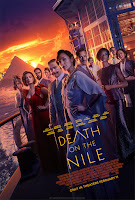
Death on the Nile
Last night, I continued my movie-going spree with another trip to DL for the latest Kenneth Branagh adaptation of Agatha Christie's Hercule Poirot novels. This time it was Death on the Nile, again (like the 2017 version of Murder on the Orient Express) featuring Branagh himself as the fussy Belgian sleuth with the absurd mustache. This time the mustache gets its own superhero origin story, forged on a World War I battlefield and welded to Poirot's face by the heartbreak of a lifetime. Instead of murder and class warfare confined to a snowbound passenger train, this installment features murder and class warfare on a pleasure boat anchored in the I Bet You Can Guess Which River. The murder plot centers around a romantic triangle whose steaminess is somewhat lost in the sweltering Egyptian climate, although some hot blues music and dirty dancing does bring out the sex appeal somewhat.
I counted six crimes that Poirot solves in this story: three murders, one attempted murder, the theft of a priceless jewel necklace and some major embezzlement. The moneyed gentlefolk exhibit a certain capacity for violence and brutality. Death for love, death for money and death for desperation to elude capture all get mixed up together in the type of mystery where all the suspects are confined together for the duration of the great detective's investigation. Culminating, of course, in one of those classic scenes where the survivors are all together in one room and Poirot says (here I paraphrase), "The murderer is one of you." Then casts a couple red herrings before revealing the final truth.
What the movie does well, perhaps better than average for the formula it follows, is involve Poirot personally and bring out his deepest emotions. It presents a real puzzle but with all the pieces needed for alert viewers to put it together themselves, so that as the solution is finally revealed, you sense its rightness and yet, at the same time, experience amazement. It has terrific acting, a beautiful period look and a chilling atmosphere, despite the heat of the setting and the character dynamics. Its cast includes Annette Bening, Russell Brand, Dawn French, Jennifer Saunders, Gal Gadot, Armie Hammer and Sophie Okonedo, among other names and faces you may or may not know. First billing actually goes to Tom Bateman, whose character "Bouc" was also in Orient Express. Because of so-called controversies involving members of its cast, it has been targeted by cancel culture. Looking at the film on its own merits, therefore, it's a classic example of why, in my opinion, nobody whose evaluation of a piece of art or entertainment is based on cancel culture deserves anyone's respect.
Three Scenes That Made It For Me (trying not to spoil too much, but probably failing): (1) Poirot grills Bouc in a final interrogation that (almost) reveals the killer, an emotional high point that earns Bateman his top billing. (2) Bouc's mother (Bening) leans on the arm of the girlfriend she previously disapproved of (Letitia Wright of Black Panther). (3) The "Poirot reveals all" scene with its mindblowing, devastating revelations. Although I also loved the cabaret scene (with dirty dancing and blues singing) establishing the central love triangle – Gal Gadot has never looked sexier – and the atmospheric shore trip to Abu Simbel with a dust storm blowing in and a torchlit temple and already pretty general suspicion of everybody before much (except a little attempted murder) has actually happened.
One thing I could have done without is the mustache origin story and its related epilogue, which I think delves too deeply into the character of Poirot. I wish Branagh would respect the sleuth's privacy and let him be as Christie depicted him, something of an enigma but not so interesting in and of himself that he pulls focus off the mystery at hand. However, the bonus opportunity to hear Sophie Okonedo (or at least, her voice double?) sing the blues makes it almost forgivable.
I counted six crimes that Poirot solves in this story: three murders, one attempted murder, the theft of a priceless jewel necklace and some major embezzlement. The moneyed gentlefolk exhibit a certain capacity for violence and brutality. Death for love, death for money and death for desperation to elude capture all get mixed up together in the type of mystery where all the suspects are confined together for the duration of the great detective's investigation. Culminating, of course, in one of those classic scenes where the survivors are all together in one room and Poirot says (here I paraphrase), "The murderer is one of you." Then casts a couple red herrings before revealing the final truth.
What the movie does well, perhaps better than average for the formula it follows, is involve Poirot personally and bring out his deepest emotions. It presents a real puzzle but with all the pieces needed for alert viewers to put it together themselves, so that as the solution is finally revealed, you sense its rightness and yet, at the same time, experience amazement. It has terrific acting, a beautiful period look and a chilling atmosphere, despite the heat of the setting and the character dynamics. Its cast includes Annette Bening, Russell Brand, Dawn French, Jennifer Saunders, Gal Gadot, Armie Hammer and Sophie Okonedo, among other names and faces you may or may not know. First billing actually goes to Tom Bateman, whose character "Bouc" was also in Orient Express. Because of so-called controversies involving members of its cast, it has been targeted by cancel culture. Looking at the film on its own merits, therefore, it's a classic example of why, in my opinion, nobody whose evaluation of a piece of art or entertainment is based on cancel culture deserves anyone's respect.
Three Scenes That Made It For Me (trying not to spoil too much, but probably failing): (1) Poirot grills Bouc in a final interrogation that (almost) reveals the killer, an emotional high point that earns Bateman his top billing. (2) Bouc's mother (Bening) leans on the arm of the girlfriend she previously disapproved of (Letitia Wright of Black Panther). (3) The "Poirot reveals all" scene with its mindblowing, devastating revelations. Although I also loved the cabaret scene (with dirty dancing and blues singing) establishing the central love triangle – Gal Gadot has never looked sexier – and the atmospheric shore trip to Abu Simbel with a dust storm blowing in and a torchlit temple and already pretty general suspicion of everybody before much (except a little attempted murder) has actually happened.
One thing I could have done without is the mustache origin story and its related epilogue, which I think delves too deeply into the character of Poirot. I wish Branagh would respect the sleuth's privacy and let him be as Christie depicted him, something of an enigma but not so interesting in and of himself that he pulls focus off the mystery at hand. However, the bonus opportunity to hear Sophie Okonedo (or at least, her voice double?) sing the blues makes it almost forgivable.
Tuesday, March 8, 2022
Show but no dinner
On Sunday night, I did it again. I went out of town to look at a movie. This time, however, I ate dinner at home first, so I wouldn't be cast upon the tender mercies of an unknown restaurant. Also, I went to Hackensack, which is only about 30 miles east (and a little south) of where I live and yet, behold, I've never been there before. I have a vague impression that I might have been in the area once as a teenager, but I'm really not sure. I've just had no reason to go there until now, and boy, will I have a reason from now on. It's called the Bear Pause Theater (ha) and it's a big, luxurious, new-fangled movie house just outside a poky little town of 300. I live in a town of 4,000 that has a historic downtown cinema that closes in the winter. I don't get it. But now that I know it's there, I'll probably go back from time to time.
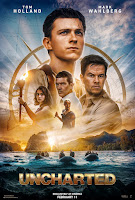
The movie I chose this time was Uncharted, though I knew (from an online review) that it's based on a Playstation video game. I also know (from the same review) that fanboys of the game are, let's say, divided about its faithfulness to the source material. But gawd, we're talking about a Playstation video game; why should I care? The movie features Tom Holland, a 20-something who's been pretending to be a high school-aged Spider-Man for three or four movies now, and whose "kid" mannerisms don't quite jive with his chiseled jaw and highly developed physique. Co-starring with him are Mark Wahlberg, Antonio Banderas and I forget everybody else's name. Look them up, you're on the internet. Everybody in the cast was effective and the movie was totally fun in a way that would be ruined by thinking about it at all. You know, like a Playstation computer game.
Maybe you could say that it's derivative of blockbusters like Tomb Raider and National Treasure, but maybe you could also say that's becoming a legit genre and don't sweat its adherence to formula. The movie does somewhat lurch from one spectacular heist, stunt, chase, fight, or booby-trap-of-death scene to another with only the sketchiest of storylines connecting them; but again, formula. The script does land some laugh-worthy jokes without saying anything particularly clever or well, and without developing characters in whom you feel emotionally invested or who show signs of growth. But did you hear what I said about formula? Those things are all right but they're not why anyone choooses to see a movie like this. And it delivers what those people expect, in sometimes breathtaking fashion. It also delivers not one, but two teasers for a possible future franchise, one just before and the other midway through the closing credits. Without which, the formula says, the movie would seem incomplete.
Holland plays a "kid" (actually a 20-something, for once) who had a sad upbringing by nuns at an orphanage, which became even sadder when his older brother took off. He mixes cocktails for a living and picks pockets for spending money. Nate's only contact with brother Sam (did I remember the names right?), for many years, has been a series of postcards from exotic places, where Sam seems to be searching for a hidden fortune in Spanish gold. Then Wahlberg shows up, or rather a fellow treasure hunter named Sully who, long story short, manipulates Nate into joining his quest for the same treasure by hinting that if they find it, they might find Sam as well. Of course, Sully is lying, but a bunch of other folks who are hunting for the gold are even worse company – including an evil Spanish guy (Banderas) and his goon platoon, headlined by a woman whose favorite treasure-hunting tool is a throat-slitting knife. Yeah.
So their chase for the doubloons takes the (relatively) good guys and the bad guys halfway around the world and includes a slapstick heist at a New York auction house, a catacomb quest in Barcelona, aerial high jinks over the Philippines and ... huh. I've run out of storyline to synopsize. The only other thing to mention is that Tom Holland spends a night in a tropical bungalow with a beautiful girl and nothing happens between them, other than a little light betrayal between friends; so, clearly, ripped 20-something or not, he's still identifying with kids. Like, you know, the Playstation market.
Oh, well, here are Three Scenes That Made It For Me. (1) All the aerial hijinks involved in falling out of the back of a cargo plane. (2) All of the aerial hijinks involved in fighting hand-to-hand between two 16th century caravels sailing in mid-air, suspended below helicopters. (3) The weird treasure hunt through the nether regions of Barcelona, where places that haven't been seen in centuries are oddly juxtaposed with modern things like a dance club and a pizza place.
But this review would not be complete without adding Three Scenes That Unmade It For Me – things the movie could have done without, or done better. (1) Mlle. Throat Slitter performs her specialty on the character who's been built up as the villain of the piece. Not only is it one of the things you don't want to think about if you don't want to ruin the whole thing (like, what was the point of his whole character?) but it also isn't done well; the guy just keels over with amazingly little struggle or blood. It's a disturbingly undisturbing depiction of a brutal slaying, and the other characters are disturbingly undisturbed to see it. Which, I think, either suggests something disturbing about the audience this film was tailored to suit, or could have a dangerous influence on them. Maybe both. (2) The final shot of the movie, actually that mid-credits teaser scene, features the hero characters turning in shock and dismay to face ... who? You'll never know, probably. (3) The girl (not the throat-slitting one), after the friendly bit of mutual betrayal I mentioned ... never really figures in the story again. You see her realizing what's happened, but for all real dramatic purposes, she's out of the picture. I consider that a wasted opportunity on about the same level as the waste of the Spanish villain character – two instances, maybe enough to form a pattern, of the movie's writers dropping story threads that should have paid off. In a really decent story, like (say) Raiders of the Lost Ark, you would expect them to tie in, or tie up, in a satisfying way. I'm not asking for melting faces or a steamy love scene. OK, maybe I am. I'm just sayin'.
The movie I chose this time was Uncharted, though I knew (from an online review) that it's based on a Playstation video game. I also know (from the same review) that fanboys of the game are, let's say, divided about its faithfulness to the source material. But gawd, we're talking about a Playstation video game; why should I care? The movie features Tom Holland, a 20-something who's been pretending to be a high school-aged Spider-Man for three or four movies now, and whose "kid" mannerisms don't quite jive with his chiseled jaw and highly developed physique. Co-starring with him are Mark Wahlberg, Antonio Banderas and I forget everybody else's name. Look them up, you're on the internet. Everybody in the cast was effective and the movie was totally fun in a way that would be ruined by thinking about it at all. You know, like a Playstation computer game.
Maybe you could say that it's derivative of blockbusters like Tomb Raider and National Treasure, but maybe you could also say that's becoming a legit genre and don't sweat its adherence to formula. The movie does somewhat lurch from one spectacular heist, stunt, chase, fight, or booby-trap-of-death scene to another with only the sketchiest of storylines connecting them; but again, formula. The script does land some laugh-worthy jokes without saying anything particularly clever or well, and without developing characters in whom you feel emotionally invested or who show signs of growth. But did you hear what I said about formula? Those things are all right but they're not why anyone choooses to see a movie like this. And it delivers what those people expect, in sometimes breathtaking fashion. It also delivers not one, but two teasers for a possible future franchise, one just before and the other midway through the closing credits. Without which, the formula says, the movie would seem incomplete.
Holland plays a "kid" (actually a 20-something, for once) who had a sad upbringing by nuns at an orphanage, which became even sadder when his older brother took off. He mixes cocktails for a living and picks pockets for spending money. Nate's only contact with brother Sam (did I remember the names right?), for many years, has been a series of postcards from exotic places, where Sam seems to be searching for a hidden fortune in Spanish gold. Then Wahlberg shows up, or rather a fellow treasure hunter named Sully who, long story short, manipulates Nate into joining his quest for the same treasure by hinting that if they find it, they might find Sam as well. Of course, Sully is lying, but a bunch of other folks who are hunting for the gold are even worse company – including an evil Spanish guy (Banderas) and his goon platoon, headlined by a woman whose favorite treasure-hunting tool is a throat-slitting knife. Yeah.
So their chase for the doubloons takes the (relatively) good guys and the bad guys halfway around the world and includes a slapstick heist at a New York auction house, a catacomb quest in Barcelona, aerial high jinks over the Philippines and ... huh. I've run out of storyline to synopsize. The only other thing to mention is that Tom Holland spends a night in a tropical bungalow with a beautiful girl and nothing happens between them, other than a little light betrayal between friends; so, clearly, ripped 20-something or not, he's still identifying with kids. Like, you know, the Playstation market.
Oh, well, here are Three Scenes That Made It For Me. (1) All the aerial hijinks involved in falling out of the back of a cargo plane. (2) All of the aerial hijinks involved in fighting hand-to-hand between two 16th century caravels sailing in mid-air, suspended below helicopters. (3) The weird treasure hunt through the nether regions of Barcelona, where places that haven't been seen in centuries are oddly juxtaposed with modern things like a dance club and a pizza place.
But this review would not be complete without adding Three Scenes That Unmade It For Me – things the movie could have done without, or done better. (1) Mlle. Throat Slitter performs her specialty on the character who's been built up as the villain of the piece. Not only is it one of the things you don't want to think about if you don't want to ruin the whole thing (like, what was the point of his whole character?) but it also isn't done well; the guy just keels over with amazingly little struggle or blood. It's a disturbingly undisturbing depiction of a brutal slaying, and the other characters are disturbingly undisturbed to see it. Which, I think, either suggests something disturbing about the audience this film was tailored to suit, or could have a dangerous influence on them. Maybe both. (2) The final shot of the movie, actually that mid-credits teaser scene, features the hero characters turning in shock and dismay to face ... who? You'll never know, probably. (3) The girl (not the throat-slitting one), after the friendly bit of mutual betrayal I mentioned ... never really figures in the story again. You see her realizing what's happened, but for all real dramatic purposes, she's out of the picture. I consider that a wasted opportunity on about the same level as the waste of the Spanish villain character – two instances, maybe enough to form a pattern, of the movie's writers dropping story threads that should have paid off. In a really decent story, like (say) Raiders of the Lost Ark, you would expect them to tie in, or tie up, in a satisfying way. I'm not asking for melting faces or a steamy love scene. OK, maybe I am. I'm just sayin'.
Subscribe to:
Posts (Atom)