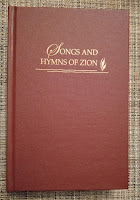
Before I commit myself to another string of "Tacky Hymns" posts, I'd like to introduce a rare Lutheran hymnal that's been sitting on the corner of my piano for about four years now, waiting for me to get up the nerve to review it. Its title is Songs and Hymns of Zion (hereafter SHZ) and it's a publication of the Laestadian Lutheran Church, 2008, headquartered in Loretto, Minnesota.
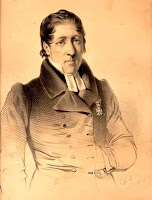
I'd never heard of this group before I moved into the area where I presently live and found a congregation of it in the next town over. Apparently (I'm basing this on their website), they trace their lineage to a Swedish Lutheran pastor named Lars Levi Laestadius, who underwent a conversion experience and went on to start a revival movement that spread across Swedish Lappland. Finnish immigrants brought the movement to the U.S., with congregations starting in Cokato, Minn. and Calumet, Mich. in 1872-73. Subsequent controversies over justification, the church and the sacraments split the movement, leading in 1973 to the formation of the Association of American Laestadian Congregations (AALC), which in turn became the Laestadian Lutheran Church (LLC) in 1995. They have 30 member congregations and more than 100 ministers, mainly in Minnesota, Washington, Arizona, Michigan and Saskatechewan. They subscribe to the Lutheran Confessions and the authority of the Bible as "the highest guide and authority for Christian faith, doctrine and life."
When I found out about the group and the existence of their own hymnal, I got hold of a copy. My intention at the time was to incorporate it into my study of hymn tunes in the tradition of Lutheran hymnals within English-speaking Lutheranism. My plans hit a snag when I realized that, for the hymn tunes, the book provides bare melody and a credit line for its composer or source, but no tune title. I actually reached out to somebody who was involved in the church body's hymnal project and asked whether it would be possible to obtain a tune index with the titles of the tunes, but I wasn't even able to make myself understood. Apparently the convention of tune naming, prevalent among other anglophone Lutheran hymnals, has not yet cracked this small group; and I was daunted by the prospect of having to comb through all my other resources to make correct identification of all the tunes that SHZ has in common with them.
Now that I've done TLH, LSB, ELHy, ELW, CWH and even the Reclaim hymnal, however, I've run out of excuses and it's time at last for me to tackle this project. I'm going to take it slowly, and I'm not going to touch the hymns in this post; that'll be a job for Tacky Hymns 103. For now, let's look at what's in the book besides hymns.
My copy of SHZ is a compact hardcover with burgundy cloth on it. It opens with a preface from the LLC Board of Directors that admirably stresses how "the people of God have been, since the beginning of time, a singing throng." Besides thanks and praise, it says, these songs also express the faithful's thoughts and feelings and give them encouragement and comfort. The current SHZ is built on a previous edition published in 1980, it says.
The acknowledgements page acknowledges a debt to the Central Organization of Associations of Peace of Finland (SRK), among other entities. The Table of Contents lists the sections into which the hymns are organized, then includes "Sacred Acts" (Holy Communion, Holy Baptism), "Prayers" (Prayers for Daily Life, Sunday School Worship), a long list of indices and cross references, and a section of "General Worship" (the Apostles' Creed, Lord's Prayer and benediction at the end of the book). Next is a page explaining abbreviations used in the book.
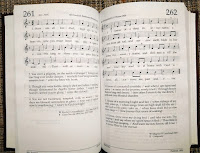
The book's first 602 hymns are divided up thus: The Church Year (1-152), subdivided into Advent, Christmas, New Year, Epiphany, Candlemas(!), Mary's Day(!), Christ's Sufering and Death, Easter, Ascension, Pentecost, Holy Trinity, Michaelmas, All Saints' Day and End of the Church Year; Services (153-269), including Opening of Services, God's Word, God's Kingdom, Closing of Services, Holy Baptism, Holy Communion, Confirmation, Marriage, Funeral and Ordination; Life in Christ (269-419), sectioned into God's Grace in Christ, Repentance and Confession, Faith in Jesus, Thanksgiving and Praise, Tribulation and Comfort, God's Protection and Guidance, Call to God's Kingdom and Love of Neighbor; Daily Life (420-542), sectioned into Home and Family, Mealtime, Health and Illness, School and Study, Children, Youth, Work and Daily Calling, Elders, Morning and Evening, Creation and Seasons, Our Homeland, Journeying and Relocation and The Changing World; and Everlasting Life (543-602), sectioned into Journey in a Foreign Land, Yearning for the Homeland and Death and Everlasting Life.
Turning to the end of the book, the Sacred Acts part of the book begins with Holy Communion on p. 836. It starts as a very spare outline of the service, including Hymn, Prayer, Sermon, Hymn, Salutation. You actually get text to follow for Confession of Sins and Absolution, which are beautifully written although unusual in form. For example, the Confession conjures several biblical examples (the sinful woman, the thief on the cross, etc.), and the Absolution comprises two scripture quotes (1 John 1:7,9 and John 20:22,23) followed by "Beloved communion guest: Be encouraged to hold to these promises of God and believe all your sins forgiven in Jesus' name and blood and be of good cheer!" After the Thanksgiving (another mere bullet point), Words of Institution (concluding with the Lord's Prayer) and the Peace of God, two musical settings of the Agnus Dei are inserted, numbered as hymns 603 and 604. The service continues with the Invitation ("The Lord Jesus says, Come, for all is now ready!"), the Distribution and dismissal, some more spare outline points for the Prayer and Thanksgiving for (after) the Communion, Benediction and another Hymn. Excuse my capitalization; I'm using the book's exact terminology.
It's amazing how much liturgy isn't in here. No Kyrie, Gloria, Sanctus or Nunc dimittis. There isn't even a Creed. The Nicene Creed doesn't even make it into the book. The service outline doesn't even specifically call for scripture readings, let alone fancy stuff like Introits and Graduals. Maybe it's assumed the minister will include those under the rubric of "Sermon."
The service of Baptism again follows an outline format, which keeps it all on one page, with only the Words of Institution (Mathew 28:18-20), a rubric for the officiant putting his hand on the baptismal candidate when praying the Lord's Prayer, and the formula of Baptism (including a blessing afterward) spelled out. Other agenda items include Hymn, Salutation, Speech, Scripture Reading, Apostle's Creed, Prayer, Words of Exhortation, Benediction and another Hymn.
Prayers for Daily Life include "Now I lay me down to sleep," a three-stanza hymn "Lord, as I close my eyes to rest," and Luther's morning, evening and mealtime prayers. Sunday School Worship includes a three-paragraph opening prayer and a four-paragraph closing prayer. The last thing before the indices is the page with the Apostles' Creed, Lord's Prayer and Benediction on it.
You can learn a lot about the priorities of the people who put together a hymnal from the way they designed the indices, and what they do. I've already noted that this hymnal is no help for people who (like me) are interested in the cultural and artistic history of Lutheran hymn tunes. The editors' first priority, in this book, is evidenced by an index converting the hymn numbers in SHZ 2008 to the numbers for the same hymns in SHZ 1980. Then there's a similar index tracing the descent of SHZ's hymns (by hymn number only) to the Ev. Luth. Church of Finland's 2000 hymnal and 2004 worship supplement and the SRK's 1976 hymnal and 2006 supplement. Then there is a series of indices going the other way, correlating the SRK's books, and then the ELCF's, to SHZ. Then an index of the authors, text sources and translators of hymn lyrics; then of hymn tune composers and melody sources; then a "scripture to hymn" Bible reference index; then a "hymn to scripture" one; then an alphabetical index of hymns; and then the Apostles' Creed, Lord's Prayer and Benediction again, on the final printed page (896).
My interest is piqued. All that I've looked at so far hints at a unique experience among anglophone Lutheran hymnals – a great big, unashamed throwback to the Old Country, and it not a country whose hymnody I've ever explored in any depth. It's clearly idiosyncratic among the type of books I've been exploring, deeply marked by an apparent disregard for formal liturgy and an unusual method of organizing its hymns. It shows signs of being put together with an abundance of care to maintain every possible connection to the Lutheran culture of Finland without being concerned at all about what other American Lutherans are doing. I'm not saying it's going to be nothing but news to me, but it really is going to be a different perspective, and no mistake.
Tuesday, February 22, 2022
Saturday, February 19, 2022
Grave Sight
Grave Sight
by Charlaine Harris
Recommended Ages: 14+
Fans of the Sookie Stackhouse series, a.k.a. Southern Vampire Mysteries, will be familiar with a concept that seems to work well for author Charlaine Harris Schultz: A series of romantic, paranormal mystery-thrillers built around a vulnerable and very feminine heroine with a special ability that comes at such a high price that it seems, at times, to be more of a disability. Like Sookie, Harper Connelly is nevertheless a very strong woman at her core, despite her frailties and maybe even because of them. Harper travels around the country with her stepbrother, Tolliver Lang, making a living by using her psychic ability to locate dead bodies and detect their cause of death. She actually depends pretty heavily on Tolliver, both as a business manager and an arm to lean on in her moments of weakness. Despite hiring them to do this, their clients don't tend to like them very much. Everywhere they go they are treated either like charlatans who cruelly exploit families' grief – as if they shouldn't be paid to do what they were hired to do – or, maybe worse, like something evil and demonic.
Actually, they're just a couple of survivors of a group of siblings whose alcholic parents let them down badly, with one sister who disappeared completely and two more who refuse to have anything to do with them. Harper, who gained her powers in her teens when she was struck by lightning through a bathroom window, still suffers from the physical and psychological damage of the strike, and using her powers takes a lot out of her. She doesn't handle thunderstorms well, has a weak leg and muscle tremors, and would just as soon not deal with people if she can help it. Without Tolliver, she would be pretty much defenseless – or so she thinks until their experience in a small Arkansas town where the search for a murdered girl opens up wounds that had better been left buried. Within hours of finding the girl's remains, Harper also detects that her boyfriend – who was believed to have killed her in a murder-suicide – was also murdered ... and so was her older sister, the wife of a local police officer ... and now their mother as well. Something that Harper's gift brought to life has also reinvigorated a killer who's had four victims and now seems to want to make Harper number five.
And then, to make the scene perfect, the local police arrest Tolliver on a trumped up charge and put him in jail, with no chance for a hearing for a couple of days. This clears the way for someone to put up a local high school bully to assault Harper in her own motel room, and for a sniper to take shots at her at the town cemetery. By this time, the siblings want nothing more than just to put the town behind them and let its despicable citizens grapple with their own problems, but a threat on the life of a lovesick teenager draws them back in for one last dark and stormy night of danger and drama.
Harper's special gift is an unusual and intriguing concept, and her relationship with Tolliver pre-loads this series with story possibilities. (Hint: They're not a romantic item, which leaves them both open to kissy-kissy side adventures.) It's definitely a dark concept, with Harper's talent limiting the scope of their sleuthing to "missing and presumed dead" type mysteries; and once the remains have been found and positively identified and cause of death established, any further insight into whodunit and why is a matter for traditional detective work, which they would rather leave to others. Why they do it in this case, at least, has more to do with the situation blowing up in their face than their chosen line of work. That, and the supporting characters drawing them in, against their will, to a puzzle with a dark spot of evil at the center.
This is the first novel in the Harper Connelly quartet by the author of the Aurora Teagarden, Sookie Stackhouse and Midnight, Texas series. Other books in the series include Grave Surprise, An Ice Cold Grave and Grave Secret. This review is based on an audiobook read by Alyssa Bresnahan.
Dead as a Doornail
Dead as a Doornail
by Charlaine Harris
Recommended Ages: 15+
Sookie Stackhouse is a 20-something bar waitress living in the northern Louisiana town of Bon Temps, where she grew up. Despite her good looks, she's not much into romance because of her little "disability" – as she calls her ability to read other people's minds. She's only had two boyfriends and they were both vampires. Literally. And she seems to like it with a little supernatural kink, because a disproportionate number of people in her circle of friends, acquaintances, enemies and would-be lovers are either undead, shapeshifters, werebeasts or fairies. Oh, and witches are also apparently a thing. You'd be surprised how common it is down there (the greater Shreveport area, I mean). The vampires, for example, have come out in public and, apart from some undeadist wackos and a criminal subculture known as drainers (who peddle vampire blood as a performance-enhancing drug), they've pretty much become socially acceptable since the invention of synthetic blood.
But that still leaves a lot of secrets for Sookie to keep a lid on, like the fact that her boss, Sam, can turn into a dog; that her studly friend and would-be fiance, Alcide, is a werewolf; that her brother, Jason, is a member of a werepanther pack, whose leader, Calvin, also wants Sookie to marry him; and that her supermodel-gorgeous friends, twins Claude and Claudine, are fairies. Oh, and there's also the small matter that Eric, the vampire sheriff of the Shreveport district, is one of her two vampire conquests, though he doesn't remember it due to blah-blah-blah see one of the previous books in the series, during which he also helped her dispose of the body of a rival for Alcide's affections whom she killed in self-defense. I think I've just about mentioned everybody in the background of this story except Bill, Sookie's fanged first lover who still lives next door, and Tara, her human best friend, who enjoyed the perks of being a vampire's mistress just a bit too much and is starting to pay the price.
So, as this book picks up on the already established series, Sookie has a lot of things to worry about. A couple of private eyes are looking for the woman she killed, and if they don't suspect her, they may suspect Alcide of making her disappear. Plus, a sniper has been shooting shifters and weirs around town, and Jason's own pack (he was only recently bitten, so they don't know him well) suspect him of doing it. This gives Sookie until, like, the next full moon to figure out whodunit or the local panther pack may tear Jason to pieces. Among the apparent victims are Calvin and Sam, though there's something about the two shootings that doesn't add up. Then there's the small matter of someone setting fire to Sookie's house, and although the apparent culprit is swiftly dealt with, something about that doesn't compute, either. And then again there's a ritual of succession for the area's werewolf packmaster, and because Alcide's father is one of the candidates, he drags Sookie into it. And finally, a bad seed vampire named Mickey has been messing Tara around, and although Sookie is desperate to help, there may be no way to go about it thanks to the complexities of vampire society.
Spunky as Sookie is, the mind-reading beauty would just as soon concentrate on serving drinks at Sam's bar and getting the fire damage on her late grandma's house fixed up. Instead, she's thrust into one supernatural situation after another, fielding romantic advances from five different directions, wading into supe politics just as they take a grisly turn, getting shot at on the street, defending herself and the people she loves from dangerous and powerful beings, solving a more or less interconnected series of crimes and trying not to get too far upside-down in her favors owed to various people (in the broad sense of the word) who take that kind of thing very seriously. Stuck in the middle of a big, hairy snarl of murder, arson, interspecies prejudice, lust, passion, jealousy and suspicion, Sookie cuts through it all with a strength that belies her tiny figure and an unflinching directness that makes her a mesmerizing heroine.
Charlaine Harris Schultz is an author who specializes in some combination or another of paranormal thriller, mystery and romance, leading to 10 Aurora Teagarden novels (inspiration for the series of Hallmark mystery movies), five Lily Bard books, four Harper Connelly books, the Midnight, Texas trilogy (inspiration for the NBC series by that name), four Gunnie Rose books, and several other novels, as well as co-author with Christopher Golden of the Cemetery Girl trilogy. And though this is the first book by her that I've ever read, it's actually the fifth of 13 novels in the "Southern Vampire Mysteries" series, a.k.a. the Sookie Stackhouse series, which also includes a bunch of short stories and novellas and spawned the TV series True Blood. This review is based on an audiobook read by Johanna Parker.
The Enemy
The Enemy
by Lee Child
Recommended Ages: 15+
As I continue skipping around the long series of action-adventure novels featuring Jack Reacher, filling in gaps in the sequence at random, this book is a bit of a blast from the past – taking me back to the early part of the series in which the narrator is Reacher himself, in the first person; but even farther than that, to when he was still a Military Police major in the U.S. Army's 110th Special Unit. He's 29 years old, pretty much smack in the middle of his career as a brilliant investigator and, er, let's put a positive spin on it and call him a self-starter with an idiosyncratic outlook. Alternately, you might call him a hard-headed pragmatist whose insubordination dial goes to 11, and note that it explains exactly why he never ranked higher than a major despite his talent, and got busted down to a captain at least a couple times. You can also faintly detect the traits that will lead him to become a rootless nomad after he gets out of the Army. But as the year turns from 1989 to 1990, he's still a guy who has never, since birth, experienced life outside the military, and who knows how to play the military game better than most, and has no plans ever to do anything else. This might, in fact, be the adventure that changes that for him and opens the door to the Reacher lifestyle fans of the series know.
So, what's going on at the start of 1990? Relevant to the U.S. Army, the Berlin Wall is coming down; the Cold War is approaching room temperature; the invasion of Panama is underway, with only days left in Manuel Noriega's dictatorship; and the Army's Armored division is staring down the barrel of a huge, irreversible change in the way warfare is waged. Relevant to Jack Reacher, he's just been yanked out of the field in Panama and sent, on short notice and with no explanation whatsoever, to serve as the MP executive officer at Ford Bird in North Carolina. Strangely, the MP commanding officer has been sent away on detatched duty at the same time, leaving Reacher as acting CO of the base's military police. Even more strangely, exactly the same thing has been going on at bases all over the country, all at the same time, putting the best and brightest middling-rank MP officers in all the key positions, and none of them know why. It's as if someone, somewhere, knows that something is about to happen. And then something happens, right outside Fort Bird.
What happens, you ask? Don't worry, I'm getting to that. It starts when a two-star general drops dead of a heart attack in a seedy motel, apparently while meeting somebody for sex. That's not much of a start for a mystery thriller, I'll grant you. But a couple things about the death bother Reacher from the drop. First, the general is a member of Armored, not Infantry; so why is he hanging around Fort Bird, an infantry base? And why, if he's just dallying with a cheap hooker, would he drive 300 miles each way during a layover in Washington, D.C. while en route from Germany to California for an Armored conference? And where the heck is his briefcase, in which he must have had his wallet, travel papers and conference agenda? And when the wallet turns up, why is the agenda missing? And why do the general's aides swear there was no agenda for the meeting, which is preposterous?
Before Reacher and an attractive young lieutenant named Summer can even begin to answer these questions, the puzzle deepens. It can't be a coincidence that the general's wife was the victim of a homicide only hours after her husband died. Nor that the same, unique weapon used to cave in her skull in Virginia was used again at Fort Bird, a few days later, in the murder of a Delta Force sergeant that's been staged to look like a gay-bashing crime. Nor that the colonel in command of the Delta Force unit at Fort Bird disappeared from his golf club in Raleigh, N.C. that same night, only to be found shot to death in an alley in Columbia, S.C. with a baggie of heroin obviously planted on his body. The pieces refuse to fit together, as the one soldier who looks good for the shooting turns out to have been up to entirely different mischief that night, and the Armored general's trusty aides all have frustratingly solid alibis, and Reacher's boss – a sometime Intelligence officer recently put in command of the entire 110th – is ordering him to whitewash the entire investigation, and backs up his orders with threats and attempts to frame Reacher for the very crimes he is trying to solve. Between that and a little unauthorized leave Reacher has to take – partly for personal reasons, and partly to continue sleuthing outside his general's interference – the lawman risks becoming an outlaw in order to get at a truth that powerful forces within the army don't want him to find.
That's a lot of synopsis already, and it doesn't even get to the side of the story that features Reacher's brother (last seen as a corpse in Killing Floor) and their mother (who, at the end of her life, is revealed to have a past that makes you wonder which of his parents Reacher really inherited his "do what's right at all costs" philosophy from). It's a prequel that shows you an entirely different side of Reacher's character, way back when he was at the top of his career and had never dreamed of doing anything else. It conjures the ironic spectacle of a man who operates within and without the chain of command, both at once and with equal brilliance, and who steps outside the law to enforce it. It depicts a guy who's chasing elusive evildoers and steadily closing in on them, while at the same time being chased and closed upon. It punctuates long passages humming with atmosphere and suspense with sudden eruptions of bone-shattering violence, and culminates in an a bad-guy take-down that takes the descriptor "explosive" to a never-before-seen level. It's a big, shiny gift for Reacher fans.
This is the eighth of 24 "Jack Reacher" novels by Lee Child, not counting installments ghost-written by his brother Andrew Grant writing as Andrew Child. Among the titles from this series lined up on my to-read shelf (which is actually a sofa heaped with books) are The Affair, A Wanted Man, Personal and Make Me.
Sunday, February 13, 2022
Trouble in the Stars
by Sarah Prineas
Recommended Ages: 10+
We first meet Trouble about the same time he meets himself, floating in outer space as a blob of goo. He doesn't remember much about himself, other than that he's a shapeshifter. He finds his way on board a space station, then stows away on a departing ship, eventually taking the form of a human boy. At first, the crew of the ship debates throwing him out of an airlock, but they let him stay and he soon becomes part of their odd family, including several different humanoid species, a lizardian and three insectoids that form a single person. Trouble starts to feel safe and at home on board the Hindsight (that's the ship), while trying hard to learn how to be a human and get enough to eat. But the galactic StarLeague is after him, claiming that he's an escaped prisoner, and somehow, their flagship always seems to find them no matter where they hide.
Trouble doesn't remember being a criminal, and as far as he knows, he's the only one of his kind. News that there may be other shapeshifters out there leads Trouble and friends to visit a strange being, or machine, called The Knowledge, in search of, well, you know – knowledge. Of course, this turns out to be the first of a series of traps Trouble walks into, en route to discovering what he really is and where he belongs.
I'm already afraid my synopsis has given away too much, so I'll stop there. Trouble is a fun point-of-view character, discovering for the first time many curious things about human beings that you and I take for granted. As he discovers friendship, the warmth of family, a sense of home, and many other powerful feelings, he becomes a focal point for an emotional experience that will touch the reader's heart. Meanwhile, young minds will absorb fascinating information about traveling through space, meeting alien creatures (some of whom use the pronoun "they," but not all for the same reason) and finding freedom outside the laws of a benevolent galactic government that has turned a bit too bossy and militaristic. It has scary bad guys but also a hero who can be a little scary, too – but who also has good heart, or whatever it is when he's a blob of goo.
This book's sequel, Asking for Trouble, comes out on March 15, 2022. Sarah Prineas is also the author of the four "Magic Thief" books, the Winterling trilogy, two "Ash & Bramble" books and the novels The Scroll of Kings (also supposedly the start of a new series) and Dragonfell.
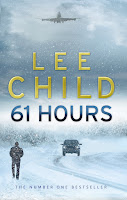
61 Hours
61 Hours
by Lee Child
Recommended Ages: 15+
While crossing South Dakota in the middle of winter, a charter bus swerves on a slippery bridge and gets stuck in a snowbank. Most of the passengers are older couples on an off-season tour to see Mount Rushmore, and residents of the nearby community of Bolton take them into their homes until they can get moving again. One of the passengers, however, is Jack Reacher – a former major in the Army's Military Police, now living on the road, by choice, with nothing to his name but what he wears on his back. A bright young police officer immediately sees the potential in Reacher to help with a big problem: A nice old lady is set to testify against a local drug gang, and she's under police protection in case the gang tries to silence her. Except the police are obligated to drop everything, including protection details, to form a cordon around the federal, state and county prison just outside of town, in the event of an escape or a prison riot. And they expect one or the other to happen soon, as a cover to get at courageous Janet Salter.
While Reacher breaks the habit of a lifetime, passing up the first ride out of town to help protect the lady, another character 1,700 miles to the south is also breaking lifelong habits – a drug kingpin named Plato, who has decided to get personally involved in the assassination of Janet Salter so that that he can sell a certain asset to the Russian mafia. It's all a matter of having a clear title before the deal closes. The real estate involved is an apparently abandoned military installation whose purpose no one can recall. Even when Reacher reaches out to his successor at the 110th MP and talks her into looking into the records (in return for helping her with a case of her own), what's hidden at the site remains elusive while the hours tick away to an explosive confrontation between Reacher and the bad guys.
Each development in this book is marked by a steady countdown to the end of the 61-hour period after Reacher arrives in Bolton, S.D. It simultaneously generates suspense and a sense of mystery about exactly what it's building to. Shocking murders are part of it. Deadly betrayal. A forgotten military secret. Also, a lot more insight into the character of Reacher than you may have picked up in any single book in this series apart from the first – such as his ability to predict, almost to the exact street address, where the MPs will find a wanted fugitive several states away. His personal mottos: "Hope for the best, plan for the worst. ... Never forgive, never forget. Do it once and do it right. You reap what you sow. Plans go to hell as soon as the first shot is fired. Protect and serve. Never off duty." His early development as someone who runs toward danger rather than flinching back – revealed by a psychological study he was part of at age 6, and that made me laugh and get choked up at the same time. One character's assessment that fighting him hand-to-hand would be "like having a running chain saw thrown at you." And another character's apt description of him as "the sort of guy who sees things five seconds before the rest of the world." You want there to be heroes like Reacher in dangerous times. This book fulfills that wish, but at greater cost than most other installments in the series.
As I write this, it's closing in on Valentine's Day in my current hometown of Park Rapids, Minn., where the weather has been above freezing once since Christmas, and most days the average temperature has been below zero (often in double digits), and when it isn't it's usually snowing, and there's still snow on the ground that's been here since November, and now and then we get a blast of wind out of the Dakotas that makes it feel like -50 degrees and that turns the usually well-plowed highway into an obstacle course of wind-polished ice and skid-inducing snowdrifts. So when Reacher suffers through a week in South Dakota during a bitter cold snap with winds out of Wyoming, I know his pain in intimate detail. He experiences an even more unusual pain, for him, in this book – the feeling of being beaten. And for once, Lee Child keeps you on the hook to the last page, and beyond, wondering whether he'll stage a comeback. If it was the latest Reacher novel (which it isn't), you'd lie in bed after finishing this book, wondering if it was the last. And I don't know if this is a spoiler or the exact opposite, but on a certain level, you'll never know how he makes it out of this one. Doesn't that just drive you wild?
This is the 14th of 24 "Jack Reacher" novels by Lee Child, not counting the latest three, which are ghost-written by his brother Andrew Grant (writing as Andrew Child). It's also the 12th installment that I've read, since I'm covering the series in random order as the books come within grabbing range. This doesn't seem to be much of an impediment to following the franchise, however. Only once have I read a book in this series (Worth Dying For) that began with consequences carrying over from an installment I had missed; and this is the first book in the series that I can recall ending in a way that left me wondering what shape I would find Reacher in in the next book. And guess what? That next book is Worth Dying For. As for me, the four Reacher books that I have on my to-read pile, at this writing, are The Enemy (No. 8), The Affair (No. 16), A Wanted Man (No. 17) and Make Me (No. 20). Which still leaves a lot of holes for me to fill in. I can definitely detect a certain kinship between this book and Worth Dying For; not to mention a pattern that there always seems to be a door with something awful hidden behind it in this series. But the thing that makes this volume stand out from the set is the sense that Reacher could actually lose – and maybe does, this time; unlike any of the other Reacher novels, it leaves you guessing at the end.
Tacky Hymns 102
We finally wrap up our long-running review of Christian Worship: Hymnal (Milwaukee: Northwestern Publishing House, 2021). And I repeat:
901 is "O Christians, haste (your mission high fulfilling)" by Mary Thomson († 1923), abr., alt., and set to a tune called REDEMPTION by Bruce Backer, who also wrote TRIUMPH for Martin Franzmann's "Triumphant from the grave" and TREE OF LIFE for Stephen Starke's "The tree of life with every good." Based on these samples of his work, I'm curious about how he and I would get along, chained to the same desk in that probably Chinese-run slave-labor hymn-tune mill that I fantasized about during my last review of a tune by Kenneth Kosche. He writes very good music and seems to shift easily between very different styles, from modern art music to high-concept soft pop; this time around, he's created an almost convincing forgery of a 19th century hymn tune of the oldies-but-goodies persuasion, only perhaps too well written to pass. Thomson's text, including the refrain "Publish glad tidings," etc., does the expected mission-hymn job of impressing on the listener the imperative to make disciples of all nations, but then it goes further (stanza 3) to actually tell the good news, briefly, and concludes (stanza 4) with a specific ask that raises the hymn above the usual call to missions that leaves in doubt who's supposed to do what. Indeed, it calls on the church to "send heralds forth," to pay and to pray for their work. Kind of refreshing, as that type of hymn goes.
903 is "We are called to stand together" by Martin Leckebusch, set to Henry Gerike's tune ASCENDED TRIUMPH ("Up through endless ranks of angels"). I've actually been blessed with the opportunity to hear Gerike play the organ at his home church in St. Louis, and he's quite an impressive talent; I love this tune with its strength, energy and upward surging melodic shape. Leckebusch's text puts missions in the context of Church history, beginning with the apostles, spreading around the world, and continuing until Christ returns.
905 is "Good news of God above" by Timothy Dudley-Smith, set to Kermit Moldenhauer's tune DOUSMAN. Moldenhauer does a good job of varying the harmony to conceal the fact that both halves of his tune are identical. So you could interpret this piece either as four long stanzas or eight short ones alternating between two different musical settings. TDS's rhyme scheme has kind of the same effect, making it conceivable that you could substitue a four-line (SM) tune for DOUSMAN; but I like it as it is, and I think it would be easy for folks to learn.
908 (Type 1) is "Go forth and preach the gospel" by James Chepponis, set to ELLACOMBE ("Hosanna, loud hosanna"). I don't think Chepponis's text does the "mission hymn" job as well as the other hymns mentioned above; for example, it barely touches on the aim of proclaiming the good news (that men may be saved) and even then, it does so in a way that stresses "that all may understand," which sounds to me, just a bit, as if the task of preaching is about imparting information. Yes, Chepponis repeatedly says "The Spirit is upon us," but wouldn't it be nice if he wrote about the Spirit falling upon the people who hear the message and working the miracle of faith! 1/2 tack.
Moving on into "Christian Schools," 909 is "O Lord, our God, your gracious hand" by Oliver Rupprecht († 2000), set to the chorale O HERRE GOTT, DEIN GÖTTLICH WORT ("O God, our Lord, Thy holy Word"). It begins by thanking God for all his daily gifts, then (stanza 2) turns its thoughts toward "our fathers (who) knew and kept in view true wisdom's worth and pleasure," and therefore "prized as jewels their Christian schools." Stanza 3 asks for God's help "to guide our youth to heaven" and to "see the worth of Christian training." Finally, stanza 4 asks God to "grant schools that teach and men who preach true Christian education," and to "let youth grow strong by Word and song." In a time when too many Lutheran congregations are letting their parish schools fall by the board, and when public schools are scheduling activities so that youth have no time for church, a hymn like this could be very powerful.
910 is "Lord Jesus Christ, the children's friend" by Henry Letterman († 1996), set to WAREHAM – indelibly imprinted on my memory by a quiz in hymnology class for which I used the mnemonic "This tune is Wareham, this tune is Wareham" – acknowledges the role of both Christian homes and Christian schools in its prayer for youth to be brought up in the truth. It also has a prayer for forgiveness (stanza 4), to be led to witness joyfully to the Lord (stanza 5), and to be protected to the end (stanza 6). This could be the alma mater of a Christian school.
911 is "God, we sing your glorious praises," an "opening of service" hymn by Bert Polman († 2013) set, again, to ABBOTT'S LEIGH. A well-structured, trinitarian hymn accenting the content of the gospel and the power of word and sacrament, its strength (and maybe its weakness) is the directness and up-to-the-momentness of its language, which might in the future become a little dated sounding. Example: "You meet each creature's needs" (stanza 1).
912 (Type 2) is "Open, lovely doors" by Benjamin Schmolck, apparently a fresh translation of the hymn that TLH gives as "Open now thy gates of beauty."
913 is "Come away from rush and hurry" by Marva Dawn, set to a tune called PROMISE by popular easy-listening church choir/children's choir composer Natalie Sleeth († 1992). The availability of the accompaniment in the pew edition is a plus; the minus is that it sounds like easy-listening church choir/children's choir music. The text is a decent appeal to find peace and fulfillment in Christ, borrowing lines from Psalm 23 (particularly in stanza 2) albeit without employing the word "Shepherd." I particularly admire the last line of stanza 3: "All our longings find attainment when to self we gladly die."
915 is Reginald Heber's "Hosanna to the living Lord," which I hear in my bones set (as in TLH) to VOM HIMMEL HOCH, but to which CWH joins a tune by Christopher Dearnley († 2000) called ST. CHAD. It's not a bad tune, but I think the harmonized setting could be improved to its greater advantage.
923 (Type 2) is "Guide me, O thou great Jehovah" by William and Peter Williams, set quite aptly to John Hughes' equally Welsh tune CWM RHONDDA. Despite being a scion of the TLH tradition, I think this is a better tune than GUIDE ME by George Warren (cf. TLH) or, for that matter, PILGRIM (cf. SBH).
926 is "Lead me, Lord," a one-stanza paraphrase of Psalm 4:8 and Psalm 5:8 (with no other text credit) that I find suspiciously reminiscent of "Grant peace, we pray, in mercy, Lord," set to its own tune by Samuel Sebastian Wesley († 1876). Other than being over in no time flat, I find no fault in it.
928 is "May the grace of Christ our Savior" by John Newton († 1807), another one-stanza "close of service" hymn, set to the early Americana tune BEACH SPRING ("Praise the one who breaks the darkness").
929 (Type 1) is "May the peace of God" by Keith Getty and Stuart Townend, a nice little CoWo arrangement of the Pauline benediction ("May the peace of God," etc.) that has an unnecessary refrain and a redundant second stanza tacked on and, musically, contains an obvious cue to pull out your Bic and flick it. 1 tack.
930 is "Go, my children, with my blessing" by Jaroslav Vajda († 2008), set to the Welsh tune AR HYD Y NOS, that in only a few short years has become one of the immovable monuments of Lutheran hymnody. Pretty soon, people are going to forget that the tune originally went to the song "All through the night."
933 is the Kyrie ("Lord, have mercy") from Franz Schubert's Deutsche Messe, an interesting concept that might end up replacing the setting of the Kyrie in the liturgy, particularly if a choir is involved. Following this are several examples of "service music" (settings of pieces of the liturgy, or hymn paraphrases of them) that may be familiar to well-catechized Lutherans, like "Kyrie, God Father" (934), "All glory be to God on high" (935), "All glory be to God alone" (936), "We all believe in one true God" (Apostles' Creed; 940), "We all believe in one true God" (Luther's Nicene Creed hymn; 941), "Create in me a clean heart" (I think this setting is actually by Johann Freylinghausen, but CWH only credits TLH for it; 942), "Isaiah, mighty seer" (Luther's Sanctus hymn; 943), "Holy, holy, holy" (Sanctus from Schubert's Deutsche Messe; 944), another "Holy, holy, holy" (music by Per Hartling; 945), "Jesus, Lamb of God" (Schubert's Agnus Dei; 946), "Lamb of God, pure and holy" (Decius' ditto; 947), "In peace and joy I now depart" (Luther's Nunc dimittis; 949), "Lord, bid your servant go in peace" (another paraphase of the Nunc dimittis by James Quinn and Henry Gerike, set to the early Americana LAND OF REST; 950), "Lord, now you let your servant" (TLH's Nunc dimittis; 951), two paraphrases of the Te Deum (Michael Schultz's, 952; "Holy God, we praise your name," 953), a Benedictus paraphrase by Carl Daw (954), a Magnificat paraphrase by Timothy Dudley-Smith (955), plus another by Anonymous set to the Scots tune WILD MOUNTAIN THYME (956), and several other pieces, including some you might know from previous hymnals.
Among those pieces is a Marty Haugen-style canticle by K. Lee Scott, "God's right hand and his holy arm" (937); a through-composed canticle setting by Kurt Eggert, "O Lord, our Lord" (939); the "old new hymnal" post-communion canticle "Thank the Lord and sing his praise" (948); A paraphrase of a Latin canticle called Exsultet ("Rejoice, angelic choirs, rejoice" (957) and a Stephen Starke paraphrase of the Song of the Three Young Men "All you works of God, bless the Lord" set to a Jamaican tune with a bit of calypso rhythm in it, on which I hereby award this book's final 1 tack.
So, amazingly, the last chunk of CWH only collected an additional 2-1/2 tacks, bringing the bookwide total to 212.5 out of 658 hymns, or 32 percent. So yes, indeed, the book managed to bring its tackiness average down below 1/3 by the end. All the same, the tackiness is strong with this one, and I observed some general tendencies that do not, in my opinion, bode well for the culture of Lutheran congregations (in the Wisconsin Synod, at least) singing hymns that build up the body in the faith once delivered. There's an awful lot of stuff that seems designed to be sung at the congregation (by a rehearsed soloist or group), rather than by them. While I don't see as many examples, as in some of the previous books I've examined on this thread, of hymns whose lyrics undermine the Lutheran confession, I do think some of CWH's "safe" choices are on the bland or reductively broad side, which doesn't do much to shore that confession up. And while some of the new hymns it introduces are really very strong, the fact that Keith Getty is the book's pet contemporary hymn-writer fills me with concern about where this crowd's priorities lie. If it wasn't too late, I'd suggest they pull it back and give it a little more work. Otherwise, I will only recommend specific numbers in this book, but not the whole megillah.
Please understand the following three "types" of comments for which I'm interested in singling out hymns for special mention. "Type 1" means I wish the editors had shown better taste than to include such-and-such in the book, because it clashes with the decor (i.e. doctrine and spiritual culture) of an intentionally Lutheran church body. "Type 2" is just a point of trivia that I want to raise, like "what an interesting choice of a tune to go with this hymn," etc.; not necessarily an example of tackiness, as such. "Type 3" is the reverse of tackiness: a hymn so marvelous that its appearance in CWH shows up other hymnals that don't include it. (Also, let's assume references are "Type 3" unless otherwise specified, and "tacks" are awarded on a five-tack scale of tackiness.)We resume with the "Missions" section already in progress.
901 is "O Christians, haste (your mission high fulfilling)" by Mary Thomson († 1923), abr., alt., and set to a tune called REDEMPTION by Bruce Backer, who also wrote TRIUMPH for Martin Franzmann's "Triumphant from the grave" and TREE OF LIFE for Stephen Starke's "The tree of life with every good." Based on these samples of his work, I'm curious about how he and I would get along, chained to the same desk in that probably Chinese-run slave-labor hymn-tune mill that I fantasized about during my last review of a tune by Kenneth Kosche. He writes very good music and seems to shift easily between very different styles, from modern art music to high-concept soft pop; this time around, he's created an almost convincing forgery of a 19th century hymn tune of the oldies-but-goodies persuasion, only perhaps too well written to pass. Thomson's text, including the refrain "Publish glad tidings," etc., does the expected mission-hymn job of impressing on the listener the imperative to make disciples of all nations, but then it goes further (stanza 3) to actually tell the good news, briefly, and concludes (stanza 4) with a specific ask that raises the hymn above the usual call to missions that leaves in doubt who's supposed to do what. Indeed, it calls on the church to "send heralds forth," to pay and to pray for their work. Kind of refreshing, as that type of hymn goes.
903 is "We are called to stand together" by Martin Leckebusch, set to Henry Gerike's tune ASCENDED TRIUMPH ("Up through endless ranks of angels"). I've actually been blessed with the opportunity to hear Gerike play the organ at his home church in St. Louis, and he's quite an impressive talent; I love this tune with its strength, energy and upward surging melodic shape. Leckebusch's text puts missions in the context of Church history, beginning with the apostles, spreading around the world, and continuing until Christ returns.
905 is "Good news of God above" by Timothy Dudley-Smith, set to Kermit Moldenhauer's tune DOUSMAN. Moldenhauer does a good job of varying the harmony to conceal the fact that both halves of his tune are identical. So you could interpret this piece either as four long stanzas or eight short ones alternating between two different musical settings. TDS's rhyme scheme has kind of the same effect, making it conceivable that you could substitue a four-line (SM) tune for DOUSMAN; but I like it as it is, and I think it would be easy for folks to learn.
908 (Type 1) is "Go forth and preach the gospel" by James Chepponis, set to ELLACOMBE ("Hosanna, loud hosanna"). I don't think Chepponis's text does the "mission hymn" job as well as the other hymns mentioned above; for example, it barely touches on the aim of proclaiming the good news (that men may be saved) and even then, it does so in a way that stresses "that all may understand," which sounds to me, just a bit, as if the task of preaching is about imparting information. Yes, Chepponis repeatedly says "The Spirit is upon us," but wouldn't it be nice if he wrote about the Spirit falling upon the people who hear the message and working the miracle of faith! 1/2 tack.
Moving on into "Christian Schools," 909 is "O Lord, our God, your gracious hand" by Oliver Rupprecht († 2000), set to the chorale O HERRE GOTT, DEIN GÖTTLICH WORT ("O God, our Lord, Thy holy Word"). It begins by thanking God for all his daily gifts, then (stanza 2) turns its thoughts toward "our fathers (who) knew and kept in view true wisdom's worth and pleasure," and therefore "prized as jewels their Christian schools." Stanza 3 asks for God's help "to guide our youth to heaven" and to "see the worth of Christian training." Finally, stanza 4 asks God to "grant schools that teach and men who preach true Christian education," and to "let youth grow strong by Word and song." In a time when too many Lutheran congregations are letting their parish schools fall by the board, and when public schools are scheduling activities so that youth have no time for church, a hymn like this could be very powerful.
910 is "Lord Jesus Christ, the children's friend" by Henry Letterman († 1996), set to WAREHAM – indelibly imprinted on my memory by a quiz in hymnology class for which I used the mnemonic "This tune is Wareham, this tune is Wareham" – acknowledges the role of both Christian homes and Christian schools in its prayer for youth to be brought up in the truth. It also has a prayer for forgiveness (stanza 4), to be led to witness joyfully to the Lord (stanza 5), and to be protected to the end (stanza 6). This could be the alma mater of a Christian school.
911 is "God, we sing your glorious praises," an "opening of service" hymn by Bert Polman († 2013) set, again, to ABBOTT'S LEIGH. A well-structured, trinitarian hymn accenting the content of the gospel and the power of word and sacrament, its strength (and maybe its weakness) is the directness and up-to-the-momentness of its language, which might in the future become a little dated sounding. Example: "You meet each creature's needs" (stanza 1).
912 (Type 2) is "Open, lovely doors" by Benjamin Schmolck, apparently a fresh translation of the hymn that TLH gives as "Open now thy gates of beauty."
913 is "Come away from rush and hurry" by Marva Dawn, set to a tune called PROMISE by popular easy-listening church choir/children's choir composer Natalie Sleeth († 1992). The availability of the accompaniment in the pew edition is a plus; the minus is that it sounds like easy-listening church choir/children's choir music. The text is a decent appeal to find peace and fulfillment in Christ, borrowing lines from Psalm 23 (particularly in stanza 2) albeit without employing the word "Shepherd." I particularly admire the last line of stanza 3: "All our longings find attainment when to self we gladly die."
915 is Reginald Heber's "Hosanna to the living Lord," which I hear in my bones set (as in TLH) to VOM HIMMEL HOCH, but to which CWH joins a tune by Christopher Dearnley († 2000) called ST. CHAD. It's not a bad tune, but I think the harmonized setting could be improved to its greater advantage.
923 (Type 2) is "Guide me, O thou great Jehovah" by William and Peter Williams, set quite aptly to John Hughes' equally Welsh tune CWM RHONDDA. Despite being a scion of the TLH tradition, I think this is a better tune than GUIDE ME by George Warren (cf. TLH) or, for that matter, PILGRIM (cf. SBH).
926 is "Lead me, Lord," a one-stanza paraphrase of Psalm 4:8 and Psalm 5:8 (with no other text credit) that I find suspiciously reminiscent of "Grant peace, we pray, in mercy, Lord," set to its own tune by Samuel Sebastian Wesley († 1876). Other than being over in no time flat, I find no fault in it.
928 is "May the grace of Christ our Savior" by John Newton († 1807), another one-stanza "close of service" hymn, set to the early Americana tune BEACH SPRING ("Praise the one who breaks the darkness").
929 (Type 1) is "May the peace of God" by Keith Getty and Stuart Townend, a nice little CoWo arrangement of the Pauline benediction ("May the peace of God," etc.) that has an unnecessary refrain and a redundant second stanza tacked on and, musically, contains an obvious cue to pull out your Bic and flick it. 1 tack.
930 is "Go, my children, with my blessing" by Jaroslav Vajda († 2008), set to the Welsh tune AR HYD Y NOS, that in only a few short years has become one of the immovable monuments of Lutheran hymnody. Pretty soon, people are going to forget that the tune originally went to the song "All through the night."
933 is the Kyrie ("Lord, have mercy") from Franz Schubert's Deutsche Messe, an interesting concept that might end up replacing the setting of the Kyrie in the liturgy, particularly if a choir is involved. Following this are several examples of "service music" (settings of pieces of the liturgy, or hymn paraphrases of them) that may be familiar to well-catechized Lutherans, like "Kyrie, God Father" (934), "All glory be to God on high" (935), "All glory be to God alone" (936), "We all believe in one true God" (Apostles' Creed; 940), "We all believe in one true God" (Luther's Nicene Creed hymn; 941), "Create in me a clean heart" (I think this setting is actually by Johann Freylinghausen, but CWH only credits TLH for it; 942), "Isaiah, mighty seer" (Luther's Sanctus hymn; 943), "Holy, holy, holy" (Sanctus from Schubert's Deutsche Messe; 944), another "Holy, holy, holy" (music by Per Hartling; 945), "Jesus, Lamb of God" (Schubert's Agnus Dei; 946), "Lamb of God, pure and holy" (Decius' ditto; 947), "In peace and joy I now depart" (Luther's Nunc dimittis; 949), "Lord, bid your servant go in peace" (another paraphase of the Nunc dimittis by James Quinn and Henry Gerike, set to the early Americana LAND OF REST; 950), "Lord, now you let your servant" (TLH's Nunc dimittis; 951), two paraphrases of the Te Deum (Michael Schultz's, 952; "Holy God, we praise your name," 953), a Benedictus paraphrase by Carl Daw (954), a Magnificat paraphrase by Timothy Dudley-Smith (955), plus another by Anonymous set to the Scots tune WILD MOUNTAIN THYME (956), and several other pieces, including some you might know from previous hymnals.
Among those pieces is a Marty Haugen-style canticle by K. Lee Scott, "God's right hand and his holy arm" (937); a through-composed canticle setting by Kurt Eggert, "O Lord, our Lord" (939); the "old new hymnal" post-communion canticle "Thank the Lord and sing his praise" (948); A paraphrase of a Latin canticle called Exsultet ("Rejoice, angelic choirs, rejoice" (957) and a Stephen Starke paraphrase of the Song of the Three Young Men "All you works of God, bless the Lord" set to a Jamaican tune with a bit of calypso rhythm in it, on which I hereby award this book's final 1 tack.
So, amazingly, the last chunk of CWH only collected an additional 2-1/2 tacks, bringing the bookwide total to 212.5 out of 658 hymns, or 32 percent. So yes, indeed, the book managed to bring its tackiness average down below 1/3 by the end. All the same, the tackiness is strong with this one, and I observed some general tendencies that do not, in my opinion, bode well for the culture of Lutheran congregations (in the Wisconsin Synod, at least) singing hymns that build up the body in the faith once delivered. There's an awful lot of stuff that seems designed to be sung at the congregation (by a rehearsed soloist or group), rather than by them. While I don't see as many examples, as in some of the previous books I've examined on this thread, of hymns whose lyrics undermine the Lutheran confession, I do think some of CWH's "safe" choices are on the bland or reductively broad side, which doesn't do much to shore that confession up. And while some of the new hymns it introduces are really very strong, the fact that Keith Getty is the book's pet contemporary hymn-writer fills me with concern about where this crowd's priorities lie. If it wasn't too late, I'd suggest they pull it back and give it a little more work. Otherwise, I will only recommend specific numbers in this book, but not the whole megillah.
Subscribe to:
Posts (Atom)