Sunday, December 5, 2021

Two cheapo DVDs

This weekend, I decided there was nothing playing at any movie theater within a 90 minute drive of home that I gave a toot about, other than the last couple that I've already seen. You'd think the holiday season would be the time of year when all kinds of wonderful things would be coming out, but meh. So, instead, I pawed through the cheapo DVD bin at Walmart and surfaced with these two movies.

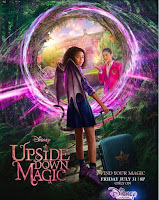
Upside-Down Magic is a 2020 made-for-TV Disney movie based on a children's book, actually a series of books, by the writing team of Sarah Mlynowski, Lauren Myracle and Emily Jenkins. Having three authors is a bit of a red flag for me; I'm not a big fan of writing by committee, so that may be why I never followed up on any opportunity to read these books. I might actually be interested now, if only to fill in a missing piece of my survey of stories about magical schools (and I'm only one book into the "Worst Witch" series, too). Another reason might be to see if the book is better than the movie, which could definitely be improved on. However, it wasn't awful.

The premise (of the movie, mind you) is that Nory and her best friend Reina have been accepted to a school of magic. Since age 7, Nory has had the ability to transform into different creatures – and I mean really different. Not just a kitten, no, not she; she becomes a kitten with a dragon's wings or an elephant's trunk, without much control over what she becomes. Reina is just a vanilla firestarter. They both go to school anxious about how they'll do, but despite Nory having a more optimistic outlook, it's Reina who gets accepted into Sage's school of fire magic while Nory, along with three other misfits, gets placed in UDM: the school for kids whose magic is too wonky to be trusted.

The UDMs are supposed to refrain from using their talents until the magic in them dries up and goes away; then they'll be safe for the boring, non-magical world. But Nory leads a rebellion, convinced that each of the UDMs in her year has something unique to contribute. Eventually, even their teacher (an unreconstructed UDM himself) joins the revolt, and just in time. Because it turns out that the threat of Shadow Magic doesn't just manifest in UDMs; this year's victim, whose power threatens the whole school, turns out to be Reina herself, leading to a climactic magical fight in the middle of an alumni day celebration in which a boy who can shoot smoke out of his fingertips (but no flame), a boy who can fly upward really fast (but can't come back down without help), a girl who can make objects fly away from her (but not toward her), and "be the best abomination I can be" Nory save the school as well as Reina.

OK, kind of a spoiler there. But really, what else could happen based on the story that's set up? It's a cute movie, nicely made, with attractive kids and teachers whose heads you want to conk together. (A few students like that, too, if we're being honest with each other.) It's no Harry Potter. But it does make some original fun with kid-sized magic and an uplifting message. Its big stars include Kyle Howard (whom you may remember from his roles in the short-lived TV series Grosse Pointe and Love Boat: The Next Wave, the role of Arlo in Orange County, etc.) as Skriff, the UDM teacher, and Vicky Lewis (TV's News Radio) as the obnoxious headmaster.

It's a light, frothy trifle of a movie, hard to mistake for a theatrical release. At times, however, it exceeds expectations, particularly (I thought) in the dark stuff surrounding Reina's struggle with the Shadow Magic. It has drama, but it could have more; the school is interesting, but not as much as it could be; it's funny and magical and kind-hearted and whatnot, but also a little predictable.

Three Scenes That Made It For Me: (1) The entrance exam, which each of the UDM kids fails spectacularly. (2) A deleted scene, in which Nory almost but not quite catches Skriff using his upside-down power on a goat. (That sounds so wrong when I say it out loud.) (3) When Reina realizes that the girl who has been trying to tempt her with the book of Shadow Magic is actually the Shadow Magic itself, and only she can see her. Crrrreepy!
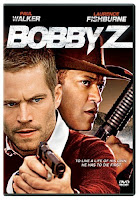
My second never-heard-of-it masterpiece was The Death and Life of Bobby Z, a 2007 flick starring the late, lamented Paul Walker. I guess it's also been marketed as Kill Bobby Z, Let's Kill Bobby Z and just plain Bobby Z. I don't understand why I've never heard of it before. At least, I can't remember having heard of it. Maybe it's just a big marketing fail, since it was produced and distributed by companies I've never heard of either. But it has a terrific cast, decent production values and is altogether entertaining. It's the kind of unexplainable bomb that I've set off in past cheapo DVD binges; thank God for Walmart, I guess.

In this movie, Walker – who had a tendency to come across as a nice guy with a pretty face and not much else going on – develops a dangerous side that could have made him even more of an action hero and male sex symbol than those horrid Fast and Furious movies, if anyone had noticed. (On the record, the first F&F flick gave me such a pounding headache that I swore never to see another in the series, and I've kept that promise.) He plays Tim Kearney, a former marine whose last name everyone including himself mispronounces in various ways that will be eternally irritating to anyone from the vicinity of Kearney, Mo. (I used to live near there) or Kearney, Neb. (visited just once). Please, people. But never mind. Tim is a three-strike convict, mostly because of bad luck and the stupidity of friends and neighbors, about to go down for life in the California penal system, and not expected to have a very long life with a biker gang out to get him. (See Strike Three, slitting a biker dude's throat with a license plate in a workshop brawl.) A couple of feds offer him a deal: impersonate a dead drug dealer named Bobby Z, participate in a hostage exchange with a vicious Mexican drug lord, and take his chances from there on. Maybe as a free man; maybe as a dead man.

Understandably nervous, Tim crosses the border in a nighttime hostage exchange, but it all goes wrong when one of the feds (played by Laurence Fishburne) takes a rifle shot at the back of his head. By sheer luck, he trips and falls at that exact moment, and survives the ensuing melee. He gets taken alive to the drug lord's compound, where one of the real Bobby's ex-girlfriends happens to be staying. But she plays along with his impersonation and even tells him that the 12-year-old boy she's caring for is his (Bobby's) son by another woman, who does not appear in the picture. The kid picks up on Elizabeth calling Tim "Bobby," looks at some beat-up old photos of his father, puts two and two together, and when Tim decides to make a break for it, the kid (named Kit) goes with.

From that point on, the runaway pair is pursued, on the one hand, by the biker gang that wants revenge for Maddog's death (that's license-plate-in-the-neck dude), and on the other hand, by the drug lord and his goons, who believe he's Bobby Z. Fishburne is always somewhere in the background, pulling strings based on a corrupt agenda of his own, which I won't spoil for you at this time other than to say, you can expect a couple of mind-blowing plot surprises in the final quarter-hour or so of the movie. There's lots of carnage. Stuff blowing up. Shoot-outs, hand-to-hand combats, all to the death; some of them over quickly, others taking a while and exacting a toll on the hero. He's an amazingly tough guy to kill, though, to Fishburne's chagrin – I'll spoil this much, at least: Tim's real job, though he didn't know it, was to serve as a handsome corpse. It's so hard to find good help. And in the end, it's his relationship with a kid who isn't even really his son that will either destroy or save him.

I really, really liked this movie. I think it's the best work I've seen Paul Walker do. The Three Scenes That Made It For Me are all going to be about him: (1) The smile that he gives Olivia Wilde when she tells him why she knew he wasn't the real Bobby Z – a smile of incredible charm that he's saved up for the entire movie and you only realize it now; a smile that instantly makes this crime flick, at least in part, a love story. (2) The moment when Walker grins an insane grin – nothing like the aforementioned smile; for just this moment, you're terrified of him – and says, without hyperbole, "I'm gonna kill every man in this room." In the interest of fact-checking, he had a little help. Nevertheless, this is the scene that seals the deal for my theory that Paul Walker should have been an action hero, if only he had lived. Not just this scene; specifically, that insane grin. (3) The climactic showdown on the bridge, when Kit's voice yelling "Dad!" clinches who lives and who dies.

Why did this movie sink without a trace? It has a great structured story; fun performances by a huge, talented cast; a cool musical soundtrack; a gritty, western look; several over-the-top villains, each with different motives; and the whole, mind-@#$% issue of how a guy who's known to be Tim, not Bobby, gets away with being Kit's "Dad" at the end. It's a movie you're tempted to think about for a while, but you really shouldn't; you should just go with it and enjoy. And in case I haven't sufficiently underlined what a great cast it has, here are some of its names: Keith Carradine (whose character spends his last moment doing a "well, shit" eyeroll), Joaquim de Almeida (a Portuguese actor known in the U.S. for Desperado, Clear and Present Danger and a role opposite Paul Walker in Fast Five), J.R. Villareal (Akeelah and the Bee), Jason Lewis (Sex and the City, Mr. Brooks), Jason Flemyng (The League of Extraordinary Gentlemen, The Red Violin), Josh Stewart (whose character on Criminal Minds has a tortured Louisiana accent), M.C. Gainey (ConAir, Lost), Margo Martindale (Justified, The Americans), David Ramsey (John Diggle on Arrow), and an uncredited Bruce Dern as the crazy hippie on the beach who provides an over-the-top framing narration, like a Greek chorus on marijuana.

Saturday, December 4, 2021

Tacky Hymns 94

As we reach the end of the church year-oriented hymn sections of Christian Worship: Hymnal (Milwaukee: Northwestern Publishing House, 2021), I repeat:
Please understand the following three "types" of comments for which I'm interested in singling out hymns for special mention. "Type 1" means I wish the editors had shown better taste than to include such-and-such in the book, because it clashes with the decor (i.e. doctrine and spiritual culture) of an intentionally Lutheran church body. "Type 2" is just a point of trivia that I want to raise, like "what an interesting choice of a tune to go with this hymn," etc.; not necessarily an example of tackiness, as such. "Type 3" is the reverse of tackiness: a hymn so marvelous that its appearance in CWH shows up other hymnals that don't include it. (Also, let's assume references are "Type 3" unless otherwise specified, and "tacks" are awarded on a five-tack scale of tackiness.)
473 (Type 2) is "Look, ye saints, the sight is glorious" by Thomas Kelly († 1855), filed under Ascension. I'm a bit of a Kelly fan, having noticed high quality in many of his hymns. This particular hymn I've seen paired with several different tunes: William H. Monk's CORONAE (TLH), Henry J. Gauntlett's TRIUMPH (SBH), William Owen's BRYN CALFARIA (also SBH, as well as LBW, ELHy and LSB; LW pairs it with George Bourne's hymn "Lord, enthroned in heavenly splendor"). CWH goes out on a limb and introduces a new tune by Kenneth Kosche called GLORIOUS VISION. It's a nice tune, very dignified, so maybe it's just the side of me that hates change speaking (but I doubt it, because I've been totally into lots of changes), but I don't think you can top the majestic, awe-inspiring BRYN CALFARIA as a setting of this hymn.

In further "Type 2" business, be it also understood that several hymnals (e.g., LBW, ELHy) update the language of Kelly's text so that the first line reads, "Look, oh look, the sight is glorious." I have no idea why; if it's about cleansing the world of Jacobean usages, they could have just changed "ye" to "you." And I can't see any point in expunging the word "saints" from the middle of the line; it's not as if it's gendered or anything. The most pernicious aspect of this tendency to update the language of great writers is how inconsistently it is applied; Christians learning these hymns from different books will simply be divided, forever, as to how to sing them. Meanwhile, no one can explain why an author in the middle of the 1800s (way past the era of Jacobean language) must have his diction corrected, as if it wasn't obviously a conscious creative choice, while someone more recent like, say, Martin Franzmann can choose to write thees and thous and the editors let it stand. Maybe it's that Franzmann's work is still protected by copyright and Kelly's isn't. Behold, how sad it is when one's work outlasts its copyright protection! But anyway, I'm preaching to the choir: CWH rolls back the updated language, and I humbly approve.

475 (Type 2) is "We thank you, Jesus, dearest friend," translated from German by the great Matthias Loy, and set to Nicolaus Herman's powerful tune ERSCHIENEN IST. I love this tune, and I also love Michael Praetorius, who composed the setting used here, but I don't love Praestorius's setting and that probably goes back to that tendency to distrust change. I'm just used to a setting from at least TLH, LW and LSB that has some passing notes and a few snappier rhythms. I wonder how many people familiar with that setting were tripped up by this book's introduction of the Praetorius setting. I've noticed similar problems in other books regarding Bach arrangements of hymn tunes, harmonies that I love but that maybe weren't best judged as the arrangement to put in the pew book; this is a subtler case of that issue.

478 is "When God the Spirit came," a Day of Pentecost hymn by Timothy Dudley-Smith, paired with a striking tune by Richard Dirksen († 2003) called VINEYARD HAVEN. It's such an attractive and well-structured melody that my fingers cry out to try it on the piano; but again, the pew book omits the harmony. Which, as I've said again and again, is a shame when they're introducing new music for which a reasonably well supplied musician can't find the notes elsewhere, except by ordering an expensive companion book to this one. 1/2 tack for cussed cheapness. And before I forget to comment on Dudley-Smith's text, it's also a tightly-structured thing that holds up the example of the first generation of Christians and applies it (stanza 5) to "this present hour." The phrase "in Pentecostal love and power" will have to be understood in a non-Neo-Pentecostal sense, however.

479 is "God's Holy Spirit came" by Mary Jackson Cathey and Michael Denham, set to the Hebrew tune YIGDAL (which you may know as the tune to "The God of Abr'ham praise"). As pianist/organist, I'm interested in the fact that CWH transposes it down to E minor (one sharp), making one less opportunity for precocious brats (I'm thinking of myself, starting out) to practice sight-reading in F minor (four flats). But that's neither here nor there. Now, while the Day of Pentecost following Jesus' death and resurrection was certainly a milestone in church history, I feel I must question the accuracy of saying, as this hymn does, that "The Spirit thus began God's holy work on earth at Pentecost," as if the Holy Spirit had not operated on earth before, was not at work in Jesus' disciples before, etc. I would rather say He was poured out dramatically, with audible and visible signs, and blew the church in a new direction. But I know, poetic license, the requirements of the meter and rhyme scheme, keeping it simple for the people in the back row, etc., etc.

480 is "Sing praise to our Creator," an Holy Trinity hymn by Omer Westendorf († 1997), set to a 19th century Dutch tune, new to me, called GOTT VATER SEI GEPRIESEN. What'll probably strike you about this hymn, off the bat, is the refrain: "O most holy Trinity, undivided unity; holy God, mighty God, God immortal, be adored!" The three brief stanzas may do their work more subtly, with one confessing that God adopts us as His children in baptism; another, that we are made one as members of Christ's body; and the third, that the Holy Spirit "sanctifies and guides us, confirmed in our rebirth." My goodness, what a baptism-centered hymn! And when you think about it, that's pretty appropriate for a Trinitarian devotion.

482 is "Triune God, O be our stay," a late medieval German hymn adapted by Martin Luther, set to the great chorale GOTT DER VATER, WOHN UNS BEI. I'll say it again, no matter how often I said it before; I hate these latter-day hymnals' insistence on replacing the three-stanza version of his hymn ("God the Father, be our stay," followed by "Jesus Christ, oh, be our stay" and "Holy Spirit, be our stay" on successive sing-throughs of otherwise identical petitions) with a one-stanza, catch-all, "Triune God" version. To start, I'm not sure I'm comfortable just addressing God as "Triune God" rather than naming the Persons individually. It makes the hymn, at best, a glib and unhelpful refresher in trinitarian theology; it also gives people fewer opportunities to struggle their way through the long, uniquely structured tune which, in my experience, tends to start sounding good on the second or third try. Semi-props to CWH for at least including the three-stanza version as an italicized option, under the one-stanza main argument; I just hope nobody ignorantly decides to make a four-stanza extravaganza out of it. It'll be impossible to correct the error if the congregation decides on its own to do this; so, if you're going to sing the three-stanza version, be sure to announce loud and clear what you're going to do. 1/2 tack.

485 is "Day of wrath, O day of mourning," the medieval sequence hymn for the Mass for the Dead, set to the tune DIES IRAE as found in TLH. CWH sections it under "Second Coming," i.e. the end of the church year, which is a good use for it. The Latin-to-English translation has been altered somewhat, and 12 of the 19 stanzas supplied by TLH have been omitted. This might not be a bad thing; the Dies irae does rather fixate on the terror of facing eternal judgment and is, to put it mildly, slow to arrive at anything like gospel comfort. But you know, if you're going to transmit a piece of church history like this, you should transmit it and not just a watered-down fragment of it. It may end up being one of those things that's only in the book for people to look at and ponder; or maybe portions of it, at most, will actually be sung in church; and maybe I'm being inconsistent in saying this after all the flack I've given this book and others for wasting space on material no congregation is likely ever to sing. But I'm also the guy who has, consistently, stood up for very long hymns on the rationale that being sung from beginning to end isn't the end-all-be-all of why they should be in the book.

487 (Type 2) is "Lo, He comes with clouds descending" by Charles Wesley, here set to Thomas Olivers' stately, high-Anglican sounding tune HELMSLEY. I've previously seen it set to this hymn as well as the French, plainchant-sounding tune PICARDY, as well as other tunes; I'd take either of these two melodies any day as musical vehicles for this very impressive Second Coming hymn, which some hymnals file under Advent. There is, indeed, a crossover between the two categories, which I suppose creates a continuity from the end of one church year to the beginning of the next.

489 is "The King will come at age's end" by Laurie Gauger, set to an original tune by Joyce Schubkegel. It's a simple but effective melody, achieving unity and an impressive character in only three phrases plus an Alleluia. Gauger's thoughts are also solid, as usual, though there are a few details that feel a bit off, like "the trumpets trill" in stanza 1, and "The Book of Life will name its names" in stanza 2. I think these word choices inject a tone of levity into a gravely serious subject. But current turns of phrase and variegated textures might just be the cost of doing business with contemporary creative artists. You want good quality, modern hymns? Be happy with what you get.

492 is "A few more years shall roll" by Horatius Bonar, set to Michael D. Schultz's original tune TALENTS. I guess I've seen this hymn before in something like American Lutheran Hymnal (1930), where it was set to the rather boring tune LEOMINSTER; TALENTS is definitely an improvement. And though I wouldn't consider Bonar a great friend of Lutheran thought, most of his hymns that I've looked at weren't bad at all, this one included. Nevertheless, its tightly structured argument borders on mannered repetition, which I think may be a sister to romantic sentimentality. It would be possible, no doubt, to read this hymn as an edifying prayer to be prepared for Jesus' second coming; but it would also play as a wallow in self-indulgent spirituality. For me, the decision might depend on which side of the bed I awoke on.

494 is "See, he comes, the King of glory," also by Gauger, with its own original tune by Jeremy Bakken. The music is very impressive sounding, in maybe a cliched way, but the harmony (which CWH is kind enough to include, this time around) isn't chorale, it's organ or maybe piano with a really wide reach. Open fifths, five- and six-note chords, open chord spacings ... It's not unique in this respect. I know of a tune by Gustav Holst that's even more pianistically (or organistically) challenging, not to mention a couple tunes in LW and LSB with fistfuls of notes, for example. They can be very impressive when pulled off, but I wish CWH would show some consideration for Mrs. Hasenpfeffer, who only plays one pedal note out of three and whose arthritis doesn't permit her to reach farther than an octave. She'll probably be grateful if the accompanist's book has an easier, alternate setting. Backing up to Gauger's text, her depiction of Christ's second coming carefully balances the awe and fear of judgment with comfort for the faithful. Stanza 2 is a beautiful versification of Jesus' saying about the sheep and the goats. Stanza 3 falls into more of a casual, contemporary idiom but continues to voice strong ideas, like "We serve not so God will save us; we serve God because we're saved." And stanza 4 again strikes a balance, this time between keeping our eyes and ears peeled for Jesus' return and, at the same time, serving our neighbor.

495 (Type 2) concludes the Second Coming section with "The King shall come when morning dawns" by John Brownlie († 1925), abbr., alt.; the tune is the Irish traditional FLIGHT OF THE EARLS, which has a little bit of the pomp and circumstance you would look for in a depiction of Jesus' majestic return, but perhaps just a wee dash of sentimenality with it. Like the kind of tune that men in a pub would sing at the top of their lungs, arm in arm, with tears rolling down their cheeks. My, what an imagination I have. Anyway, I've grown accustomed to hearing this tune paired with CONSOLATION (cf. LW, CWALH, ELHy, ELW and LSB).

499, sectioned under Minor Festivals: St. Michael and All Angels, is "Christ, the Lord of hosts, unshaken" by Peter Prange, set to Carl Schalk's tune FORTUNATUS NEW, as in LSB. Prange, an exact contemporary of yours truly, is another writer who combines strong ideas with very contemporary word choices, like "slams them in their steely cage" (stanza 1) and "You'll lie crushed beneath his feet" (stanza 3); but his depiction of Jesus' triumph over the devil's power is undeniably powerful. Meanwhile, the tune might by Schalk's best work.

So much for the church year section. More topically-oriented categories start with hymn 501. So, to sum up so far, I think I added a total of 1 tack this time, bringing the total for CWH's first 200 hymns to 45 tacks, an average of 0.225 tacks per hymn. While it's nice to see a tackiness quotient of less than one quarter, there's room for improvement. And it remains to be seen whether the part of the hymnal unconstrained by liturgical necessity (like seasons or feasts of the church year) shows more or less interest in bringing forth treasures, new and old, that sit well on the foundation of the Lutheran faith.

Friday, December 3, 2021

Tacky Hymns 93

Before continuing with the Easter hymns of Christian Worship: Hymnal (Milwaukee: Northwestern Publishing House, 2021), I repeat:
Please understand the following three "types" of comments for which I'm interested in singling out hymns for special mention. "Type 1" means I wish the editors had shown better taste than to include such-and-such in the book, because it clashes with the decor (i.e. doctrine and spiritual culture) of an intentionally Lutheran church body. "Type 2" is just a point of trivia that I want to raise, like "what an interesting choice of a tune to go with this hymn," etc.; not necessarily an example of tackiness, as such. "Type 3" is the reverse of tackiness: a hymn so marvelous that its appearance in CWH shows up other hymnals that don't include it. (Also, let's assume references are "Type 3" unless otherwise specified, and "tacks" are awarded on a five-tack scale of tackiness.)
439 and 440 are both "Christ Jesus Lay in Death's Strong Bands," Luther's great Easter hymn. 339 is set to the original tune, CHRIST LAG IN TODESBANDEN, adapted for the hymn from a medieval Latin chant (it bears a family relationship to the tune CHRIST IST ERSTANDEN, "Christ is arisen"), and already known to millions of Lutherans around the world. It's been the subject of countless cantatas and organ pieces by composers from J.S. Bach to yours truly, and any intentionally Lutheran congregation that hasn't learned it should get working on it. In an apparent attempt to relieve them of any sense of obligation to do so (at least as far as the tune goes), 440 replaces CHRIST LAG with a pleasant, modern tune called NORTHBRIDGE, by Kermit Moldenhauer. In case I didn't make my feelings sufficiently clear when LSB attempted a similar substitution for a couple of Luther's hymns, I regret to say – regret, because Moldenhauer's tune really is quite nice – that switching tunes at this point is going to hurt rather than help the cause of uniting worldwide Lutherans around the spiritual and cultural treasures of historic Lutheran hymnody. To put it in crass terms that no one can mistake, the best result that can come of this is to have a bunch of Lutherans get together to sing this hymn and end up divided over which tune to use. Don't tell me that's ridiculous. I speak from experience. 1 tack.

447 (Type 1) is "Christ is risen, He is risen in deed" (first line, "How can it be, the One who died") by Keith and Kristyn Getty and Ed Cash. It's a CoWo ditty that I'm going to ding, for starters, for being printed with melody only (complete with rests suggesting an instrumental bridge) because, again, it's a new, unfamiliar piece and some of us want to be able to play it and hear how it goes without splashing out on the accompanist's edition. A second, closely related ding: given its style and layout, it will tend to be performed at the congregation, rather than by them. It can't be asserted strongly enough, or often enough, that the Lutheran reform survived and flourished to a great degree because of the chorale, and its unique way of involving the congregation in singing the faith; today's church tampers with that at its own peril. Ding 3 is the layout's need for additional roadsigns, directing singers to sing stanzas 1 and 2 before going to the refrain, then 3 and 4 before ditto, then to go back to stanza 3 or 5 after each refrain, etc. – a complexity of layout that a hymnal editor (cough, blush) might be forgiven if he's a lone ranger working on no budget whatsoever, but that will probably leave Grandma and Grandpa Smurf fidgeting in puzzlement and wishing the book had made it easier on them. If that's even an issue, given Ding 2. 3 tacks.

448 (Type 1) is "Now let the heavens be joyful," a very slender shaving off John of Damascus's Easter hymn "The day of resurrection" (cf. 450) set to a traditional French tune that I don't find particularly attractive. Compared to this piece, Hymn 450 includes twice as many lines of John Mason Neale's translation of the same hymn, sets it to a catchier tune and doesn't waste our time with a tacked-on refrain. 2 tacks.

451 (Type 1) is "See, what a morning" by Keith Getty and Stuart Townend. Sight-singing through it in my head, it sounds like a nice solo piece for the type of singer who clutches a microphone, backed by a pop music ensemble; in three words, Christian yacht rock. Very appealing if you're into that stuff. It's not shaped at all like a melody for a large group of untrained, unrehearsed musical laypeople to sing in unison. And while I'm echoing my dings for hymn 447, it's another case where the accompaniment is left off the page (an economy measure, I'm sure), so curious pianists like me can't play through it without making an additional investment. The text is good, though; I'd be interested in hearing it set to a more practical, participational tune. 2 tacks.

453 (Type 1) is "The tomb is empty" by Sylvia Dunstan, with additional text and a tune by David Haas. If I'm starting to sound like a broken record, it may be a sign that the Easter hymns section is particularly susceptible to this type of CoWo infiltration. Again, no accompaniment in the pew book; again, a melody structured more to be sung at than by hoi polloi. In addition, however, I have some issues with the text. Stanza 2 says "He lives again in all your Galilees," which borders on being too precious and seems, at least, a rather glib way to telescope the historic event of Jesus' resurrection with its application to our lives today. Stanza 4 wants us to meet Christ but isn't very clear about how or where. Haas's stanza (5) tacks on a commission to make disciples but, again, isn't explicit about the how. I'd like to say it's a well-structured text, inviting each of the senses (see, hear and touch, plus meet and serve) to take in the news that Christ is risen. But then I'd have to take it back, because at the same time, the structure involves an irritating pattern of quasi-stammering repetition, like "is empty, is empty" and so on. 4 tacks.

454 (Type 1) is Herbert Brokering's "Alleluia! Jesus is risen," on which I have already commented. I don't know, 2 tacks.

456 and 457 are "O sons and daughters of the King," the Easter evening/First Sunday after Easter (Quasimodogeniti) hymn from a late medieval Latin writer, which I have previously seen set (usually not within the same book, however) to both tunes presented here. 456 has GELOBT SEI GOTT by Melchior Vulpius; 457 has O FILII ET FILIAE. I'm pretty ambivalent about which tune I'd prefer. I wish one could lead the congregation in both versions. GELOBT is a strong, confident, jubilant chorale; O FILII is a hauntingly beautiful chant melody. I grew up on the one, and as an adult I wrote a choral arrangement of the other. So I'm partial ... to both. Well, props to CWH for leaving the dilemma up to each parish pastor and/or musical leader to work out as they see fit.

458 and 459 are "Christ is arisen" and "Christ the Lord is risen again," the one from 12th century Germany and the other from 16th century writer Michael Weisse, set to distinct but closely related variants of the same medieval chant tune. I've seen both in the same book before, but I don't recall seeing them placed side by side, as if for comparison. Interesting.

460 is "Alleluia, alleluia! Hearts to heaven" by Christopher Wordsworth, to which my only objection (1/2 tack) is co-opting Beethoven's HYMN TO JOY (or rather, Ode to Joy) melody, or worse yet, a dumbed-down version of it. But I'm tired of explaining why I despise this business of ripping classical music themes out of their native habitat and domesticating them as hymn tunes; I've explained it so many times on this thread that, rather than chase down every previous mention, I'll just refer you to this post, where I apply the principle to this tune and several others.

463 (Type 1) is "Hail thee, festival day," which I've mentioned a couple times before, notably here. 1 tack.

466 is "Christ has arisen, alleluia," from East Africa, which I previously dinged but only for a reason that doesn't apply here. No tacks this time!

468 (Type 1) is "These things did Thomas count as real," a hymn that I've already critiqued, although CWH sets it to a different tune than the last book I saw it in (Southern Harmony's DISTRESS). I reckon it's worth 3 tacks, and none of them are for the tune.

With the Ascension section starting with hymn 472, that's all I've got for today. As I noted in passing above, the Easter hymns developed a bumper crop of tacks compared to the preceding sections of CWH. Maybe it has something to do with the happy-clappy tendency of Easter rejoicing. The butcher's bill: 20-1/2 tacks, for a new running total of 44 tacks in 171 hymns, or a tackiness quotient of 0.26 tacks per hymn. Ouch! And hey, I'm not opposed to listening to happy-clappy Easter songs. I've rather enjoyed Keith Green's "Easter Song" since I was a youngster. But I would never mistake it for a hymn that the congregation should be asked to try. It's totally a solo, ensemble or choir number, and that goes for several of the CoWo pieces in this book – songs that have merit, on their own terms, but that just don't accomplish the purpose implied by including them in a pew hymnal for a singing, participating congregation. So, with that reproof, I'll let CWH slink off and lick its wounds until another day.

Wednesday, December 1, 2021

Tacky Hymns 92

Before continuing with the Lent and Passion Week sections of Christian Worship: Hymnal (Milwaukee: Northwestern Publishing House, 2021), I repeat:
Please understand the following three "types" of comments for which I'm interested in singling out hymns for special mention. "Type 1" means I wish the editors had shown better taste than to include such-and-such in the book, because it clashes with the decor (i.e. doctrine and spiritual culture) of an intentionally Lutheran church body. "Type 2" is just a point of trivia that I want to raise, like "what an interesting choice of a tune to go with this hymn," etc.; not necessarily an example of tackiness, as such. "Type 3" is the reverse of tackiness: a hymn so marvelous that its appearance in CWH shows up other hymnals that don't include it. (Also, let's assume references are "Type 3" unless otherwise specified, and "tacks" are awarded on a five-tack scale of tackiness.)
395 is "What grace is this," about which I have previously commented (not altogether negatively). Wisconsin Synod folks may be used to it, but I still have some doubts about the musical setting's chances of success with a musically average congregation.

397 and 399 (Type 2) are both "My song is love unknown," a beautiful Lenten hymn by Samuel Crossman, with 398 "Not all the blood of beasts" stuck between them (on the bottom half of a right-hand page) to economize on space. To start with, it's a little weird to see alternate-tune settings of the same hymn spread out with other hymns between them, though I can't honestly say I haven't seen it before. More to the point, I like both tunes – 397 has LOVE UNKNOWN by John Ireland, and 399 has RHOSYMEDRE by John Edwards – but to be honest, Ireland's tune is so beautiful that it really puts the Edwards in the shade, and it seems a shame not to play, sing and hear it at every opportunity. Also, RHOSYMEDRE requires the singers to repeat the last couple phrases of each stanza to make the text fit the melody, so it isn't quite as perfect a match for the hymn as the tune expressly written for it. Though I suppose it's the one some people are used to, I'm for deploying RHOSYMEDRE elsewhere.

401 (Type 1) is William Cowper's "There is a fountain filled with blood," to which I have previously objected in the strongest terms, not once but twice. Elsewhere, I have seen it set to E.J. Hopkins' tune ST. HUGH, Lowell Mason's COWPER, William Horsley's HORSLEY and I don't recall what else, but CWH pairs it with the 18th century American traditional tune CLEANSING FOUNTAIN. To say that it might be the best pairing with this text yet is not altogether a compliment. 4 tacks.

403 is "Lamb of God," a paraphrase of the Agnus Dei interspersed with verses from Psalm 103 by Kenneth Kosche, who also wrote the tune. It's kind of a modern concept, musically, but the idea of inserting additional material into a liturgical text goes back to the middle ages (cf. "Kyrie, God Father," etc.) Other than sounding a little commercial and having a bar of rest at the end of each verse, which leads me to suspect there's an accompanist's score hidden somewhere, I see no harm in it.

405 (mild Type 1) is "On my heart imprint your image" by Thomas Kingo, a one-stanza Lenten hymn that I memorized (to two different tunes!) as a kid, only to be continually tripped up by each new hymnal's tendency to change the lyrics at least a little bit. CWH follows the version in CWALH, but that's as new to me as the variants in LW and LSB so you might as well tie my shoelaces together and give me a little push. 1/2 tack.

408 is "He stood before the court" by Christopher Idle, set to Leland B. Sateren's tune MARLEE (which I associate with "Deep were His wounds and red"). Idle's text explores the rich, judicial paradox of Christ fulfilling all justice by being condemned under the Law in our stead, the innocent for all the guilty. And Sateren's tune, though my mind's ear has difficulty loosing its grip on that prior association, jives beautifully with the serious character of the hymn.

415 is "Exult today, Jerusalem" by Stephen Starke, paired with a tune called ZEHNDER by Scott Hyslop. It's a Palm Sunday hymn that crams in a lot of prophetic references to Jesus, including "royal Son of Bethlehem" (Micah 5), "greater Jonah" (Matthew 12, Luke 11), "Zion's daughter" (Zechariah 9), a prophet like Moses (Deuteronomy 18), "Lift up your heads, you mighty gates" (Psalm 24), Melchizedek (Genesis 14, Psalm 110), concluding with a song to Jesus that joins the Hosanna of Palm Sunday to the "O Come, Emmanuel" (Isaiah 7).

416 is "When you woke that Thursday morning," about which I've previously grumbled twice without ever awarding any tacks. Unlike a certain WELS hymnal supplement I was reviewing back here, CWH goes back to pairing this hymn with JOYOUS LIGHT, which, I now know, comes from Marty Haugen's Holden Evening Prayer, and to which it was set when I first critiqued it.

417 (Type 1) is "It was a dark and dismal night," an altered version of Isaac Watts' Maundy Thursday hymn that I know (from TLH) as "'Twas on that dark, that doleful night." Updated language hasn't done this 18th century poem any favors; instead, it has invited impious minds to connect it with Edward Bulwer-Lytton's infamous novel-opener, "It was a dark and stormy night." 1 tack for not knowing when to leave well enough alone.

418 is "The Blood of the Lamb," first line "The Father sees his children's chains," with words by Laurie Gauger and a reasonably decent modern tune by Sarah Lambrecht. The text stresses the connection between the first Passover and Jesus' sacrifice for sinners and finally links this to the Sacrament. It's the third text by Gauger that I've had occasion to review and all of them got good marks; maybe we should be paying attention to this lady's talent.

421 is "Son of God, by God forsaken" by Herman Stuempfle, set to the 17th century chorale OMNI DIE. It's really a very fine Passion poem by an author whom this book has repeatedly forced me to speak well of, despite all differences I've had with his work in the past.

423 is "The Power of the Cross," first line "Oh, to see the dawn of the darkest day," by Keith Getty and Stuart Townend, an OK passion hymn in a contemporary Christian music idiom. I would rate its merit somewhere below a Lenten hymn written by authors and composers at the top of the art form, but considerably above the old timey Americana and repetitive, content-minimal spirituals that seem to inspire most of the CCM repertoire, so that's a plus.

424 is "The Garden of Gethsemane" by Michael D. Schultz (words and music), who views the entire Passion of Christ from the point of view of Gethsemane – His agony there, then moving on to Calvary and the result, that for us "there is no cup ... to drink, no curse, no penalty." It's a tightly structured text that makes its appeal via a kind of hymnological equivalent of the Aristotelian unities. The tune is inoffensive, but I don't think it adds much in originality to the repertoire already extant.

426 (Type 1) is "Were you there" – and indeed, I've been there. 4 tacks.

433 is "God was there on Calvary" by Kurt Eggert (words and music). It's a very simple, tightly argued little hymn that briefly tells us how God, all the world, sin, love, life and we ourselves were involved on Calvary.

436 is Michael D. Schultz's "Their nails were freshly driven" – a seven-stanza hymn on Jesus' seven last words on the cross. I would just like to point out that my record (for doing a hymn like this in the fewest words) still stands. Set to the fine chorale HERZLICH TUT MICH VERLANGEN and with the accompanying biblical text for each stanza provided at the bottom of the right-hand page, Schultz's hymn is a fine contemporary addition to this little corner of hymnody. It draws specific gospel comfort from each of the seven words.

437 is "Rest, O Christ, from all your labor" by Herman Stuempfle, paired with the tune O MEIN JESU, ICH MUSS STERBEN (better known, at least in my circles, as the tune to "Stricken, smitten, and afflicted"). It focuses on the crucified Lord's Sabbath rest in the tomb. From the top, it reminds me of the concluding chorus of Bach's St. Passion ("Ruht wohl ihr heiligen Gebeine"), at least in the role it could play as the fitting end of a Good Friday ceremony or the beginning of an Easter Vigil.

I think I awarded 9-1/2 tacks this time, bringing CWH's running total to 23-1/2 tacks in 147 hymns, or an average of approximately 0.16 tacks per hymn. It's a slight uptick but still a respectable number, I suppose; if I'd kept a running score like this, I wonder how TLH and LSB would have fared? Not that you'll have noticed, because I omitted mention of perfectly fine hymns that I've seen elsewhere, the book also seems to be keeping a pretty strong representation of high-quality, historic hymnody, while also sticking its neck out to introduce new(ish) numbers with, I think, maybe better judgment on the whole than CWALH showed. On deck: the Easter hymns (438-471).

Tuesday, November 30, 2021

Tacky Hymns 91

Before continuing with the New Year, Epiphany and Transfiguration sections of Christian Worship: Hymnal (Milwaukee: Northwestern Publishing House, 2021), I repeat:
Please understand the following three "types" of comments for which I'm interested in singling out hymns for special mention. "Type 1" means I wish the editors had shown better taste than to include such-and-such in the book, because it clashes with the decor (i.e. doctrine and spiritual culture) of an intentionally Lutheran church body. "Type 2" is just a point of trivia that I want to raise, like "what an interesting choice of a tune to go with this hymn," etc.; not necessarily an example of tackiness, as such. "Type 3" is the reverse of tackiness: a hymn so marvelous that its appearance in CWH shows up other hymnals that don't include it. (Also, let's assume references are "Type 3" unless otherwise specified, and "tacks" are awarded on a five-tack scale of tackiness.)
368 (Type 2) is "Now greet the swiftly changing year," a Slovak New Year hymn that in other books appears as "Greet, man, the swiftly changing year" or "Greet now the swiftly changing year." Sometimes (cf. LBW, LW) it is set to the 17th century tune ROK NOVÝ but here, as in LSB, it is paired with Alfred Fedak's SIXTH NIGHT.

369 (Type 2) is "Now let us come before him" by Paul Gerhardt, set to The New English Hymnal's setting of the 16th century tune NUN LASST UNS that actually makes it sound more interesting than it usually does. Never a particularly striking melody, this arrangement trades out the rhythmic hemiolas (alternating bars of 6/8 and 3/4) that traditionally characterize the tune, in favor of a flowing 6/8 arrangement with some attractive passing notes added.

371 is "A child is born in Bethlehem," another selection of stanzas from the same Latin hymn that figured in the Christmas section as hymn 348. I guess the editors just separated the Epiphany-specific parts of it out to avoid confusing the two distinct holidays.

373 (Type 2) is "Brightest and best of the stars of the morning" by Reginald Heber, set in this case to the 17th century French tune O QUANTA QUALIA. Many of us know it best as "Brightest and best of the sons of the morning" and as set to John P. Harding's tune MORNING STAR, which is a tour-de-force of 19th century shmaltz. O QUANTA preserves the same rhythmic cadence but conveys a more churchly and dignified character that I think brings out the better qualities of Heber's text.

376 is "Rise up and shine" by Carl P. Daw, Jr., set to the Christmassy tune FOREST GREEN. The text is a nice paraphrase of the Isaiah 60 prophecy traditionally associated with Epiphany, hinting at an application to today's believers watching for the return of Christ.

377 is "To Jordan's river came our Lord" by former Wisconsin Lutheran Seminary professor James Tiefel, a Baptism of Jesus hymn laid out on the same two-page spread as 378, Martin Luther's "To Jordan came the Christ, our Lord." I regard the latter as a very important Lutheran hymn, and CWH sets it to the right tune (CHRIST UNSER HERR ZUM JORDAN KAM from Johann Walter's 1524 Wittenberg hymnal). This isn't to be taken for granted, since the hymn has been completely omitted from certain significant Lutheran hymnals within the past century (cough TLH cough) and others (like LSB) have made efforts to alienate it from its historic tune – which, I would argue, only creates divisions among those Lutherans who do make the effort to learn it and use it regularly. I approve of using either hymn, but I strongly recommend at least learning Luther's for the spiritual growth of the church.

379 is "Christ, your footprints through the desert" by Herman Stuempfle, another Baptism of our Lord hymn set to Amanda Husberg's tune LOVE'S LIGHT (which LSB paired with "Swiftly pass the clouds of glory"). If the general tone of my remarks on Stumpfle's hymns has, until now, been a little hostile, let there be peace now; I think this is an excellent hymn.

382 (Type 1) is "The people who walked in darkness," an Isaiah 9 paraphrase by Mary Louis Bringle, set to an original tune by Sally Ann Morris titled, like, ISAIAH 9. This is one instance where I'd like to award CWH a tack for publishing only the melody in the pew book, with no accompaniment, since it's a new hymn and those of us with the wherewithal to play it and an interest in hearing how it goes must now invest in a copy of the accompanist's edition or go home unsatisfied. My vague impression, based on the melody alone, is that it's kind of a Church Music Publisher House Style-style choir piece that finagled its way into the hymnal, and if a congregation ever successfully pulls it off, it'll probably be a big, town-gown outfit with superlative musical leadership.

385 (Type 1) is titled "Christ Begins," first line "We stand and we watch," by Luke Thompson (b. 1981), who also co-wrote the tune (CHRIST BEGINS) with Kent Reeder. This time, CWH included the piano part, and it's really a piano part, written to accompany a contemporary Christian pop song. Mrs. Hasenpfeffer may have trouble playing dotted-eighth chords in the right hand against eighth-notes in the left (2-against-3 rhythms), and a whole bar of piano figuration again shows that this is more of a Church Music Publisher thing than a pew hymnal-appropriate piece. But enough about the music; the lyrics dwell in that fantasy land where the singers imagine themselves as characters in the story (i.e. Jesus' baptism, stanza 1; the wedding at Cana, 2; His transfiguration, 3; and if I'm reading stanza 4 correctly, His ascension). Finally, I'm not exactly sure how the phrase "Christ begins" applies. So, 3 tacks.

386 (Type 2) is "Songs of thankfulness and praise" by Christopher Wordsworth, which, interesting to note, CWH sets to Jacob Hintze's tune SALZBURG – perhaps a different tune than the one you're used to singing it to.

387 is "Arise, your light is come" by Ruth Duck, set to William Walter's († 1893) tune FESTAL SONG. It's a pretty little fanfare-like piece, with a unison broken triad in the first phrase. The text's four brief stanzas do borrow biblical imagery appropriate for the Epiphany season, but at the same time it seems to be all exhortation toward Christ-like service and proclamation, albeit without ever specifically mentioning Christ. So, while it may have its uses, I would limit them to after a thorough exposition of the gospel.

388 is "Down from the mount of glory," a Transfiguration hymn by Werner Franzmann, set to the Bartholomäus Helder chorale ICH FREU MICH IN DEM HERREN. It's a tune I like so well that I paired it with one of my own hymns in Useful Hymns. Franzmann's text beautifully depicts Jesus' transfiguration (especially in stanza 2), putting it in the context of his journey to the cross. The parallelism between the "mount of glory" and the "hill of shame" (stanza 4) is especially poignant. Truly, a superb hymn.

389 is "How good, Lord, to be here," a language update of "'Tis good, Lord, to be here," the well-known Transfiguration hymn by Joseph Robinson, with a new stanza inserted toward the end to underscore Jesus' choice to "leave this glorious hill to die." This may be a case of a book having to tart up a hymn whose popularity outstrips its merits. While the additional stanza helps, I'm not sure it really fits – cue an analogy to using new skin to patch old wineskins.

390 is "Jesus, take us to the mountain" by Jaroslav Vajda, set to Carl Schalk's tune SILVER SPRING. The text suffers from a mild case of that Vajda tendency to invite the singer to imagine himself into the story, ameliorated perhaps by the language praying Christ to reveal what he wants us to see there. It does score some palpable hits, like stanza 2's "Clothed in flesh like ours you go, matched to meet our deadliest foe." It also asks him to "take us to that other mountain," etc., like 388. It's basically a lighter version of Franzmann's poem, which some people (taste being what it is) may even prefer.

391 is "This brightness, Lord! What shall I say" by Michael D. Schultz (director of the WELS hymnal project), set to the Southern Harmony tune PROSPECT. In "I" language addressed to Christ, it professes not to want to leave the mountaintop, but after receiving the witness of Moses, Elijah and the Father's voice, it acquiesces (stanza 3) in coming down and following Jesus to the cross. Stanza 4 is an interesting profession of "the truth behind the bloody tree" – namely, that Christ "made my sin no longer mine." Stanza 5 professes faith that Christ will help "me" bear the trials and troubles of "the plains below," and stanza 6 looks forward to the vision of everlasting light in heaven. So, it's a surprisingly complete Transfiguration devotion, despite the discouraging first glance of its me-centered language; my tack dispenser was cocked to fire, but I stood down.

The prevalence of new(ish) hymns in CWH's Transfiguration section bears witness that this is not a very well-stocked topic in Lutheran hymnody, though it also shows that it may be on its way to being one. Meanwhile, excepting only a couple hymns, it continues to average out as quite a good collection. With (I believe) 4 new tacks, this segment brings our running total to 14 tacks out of 91 hymns so far – still an average of 0.15 tacks per hymn.

Monday, November 29, 2021

Encanto

Last night I took myself back to the movies to see Disney Animation Studios' 60th animated feature, with a huge ensemble cast playing members of the magically gifted, Madrigal family. Most of them aren't familiar enough for me to call out except John Leguizamo, Wilmer Valderrama (That 70s Show, NCIS), Diana Guerrero (Doom Squad) and, apparently, the voice of Alan Tudyk as a bird. Also, songs by Lin-Manuel Miranda. It's really a Colombian-inflected, full-length musical with animated characters performing the songs and dances, which really opens up the choreography a lot.

It's so beautifully filmed, there were moments when I forgot it was animation. It also has some belly-laugh moments and an emotionally affecting storyline about the one girl in the family who doesn't have a special ability, and how her efforts to belong and to help her family become (in her stern abuela's opinion) a threat to the survival of their sentient house, the ever-burning candle that blesses it, and the village protected by their magic. Really, it turns out that what was really fixing to break the family was the abuela's rejection of weakness in the members of her family – including super-strong Luisa, who is cracking up under all the pressure; always-perfect Isabella, who makes flowers grow but who doesn't really want to marry the handsome villager whom abuela considers a good match for the family; Tia Pepa, who has trouble controlling her emotions and the weather they generate; and Tio Bruno, the family outcast, whose visions of the future are blamed for everyone's misfortune.

I'm gonna move on quickly to Three Scenes That Made It For Me, and because they could very easily be Three Songs That Made It For Me, I'll set those aside as a separate category. Scenes: (1) Mirabel (the hero girl) discovers the long-banished Bruno living inside the walls of the family's casita, served hand and foot by a coterie of rats. The highlight of this sequence may be the moment when the pair is dangling over a seemingly bottomless pit, until a rat pops out of his sleeve, causing Mirabel to let go of Bruno's hand. (2) Mirabel tells the secret she has discovered to her father, but cousin Dolores, who has super-hearing, hears all. What follows is some of the most entertaining ensemble acting in the annals of animation. (3) The side-eye the donkeys give each other during Luisa's rant.

And now the Songs: (1) Luisa's terrific song, "Surface Pressure," with the "drip, drip, drip" of her anxiety forming a memorable theme. (2) The spectacular ensemble piece "We Don't Talk About Bruno" (no, no). (3) Mirabel and Isabella's duet, "What Else Can I Do?" in which the "perfect" sister admits that she wants to do something different. These all have the potential to become hits, but I thought especially the first one could come up for a "Best Song" Oscar.

The main feature was accompanied by a Disney animated short, Far from the Tree, featuring mostly un-anthropomorphized animals, including a coyote, a bunch of seagulls and at the heart of the story, a family of raccoons. Despite the dialogue being limited to animal screeches, it was an effective story with a warm current of emotion in it, although I thought the color palette was a little flat and the animation didn't rise to Disney's highest standard.

Saturday, November 27, 2021

Ghostbusters: Afterlife

We can now offically put the 2016 gender-flipped Ghostbusters reboot (a.k.a. Ghostbusters: Answer the Call) behind us, and move on as if it never happened, and enjoy this threequel to the 1984 classic Ghostbusters and its somewhat disappointing 1989 sequel, Ghostbusters II. It features original cast members Dan Aykroyd, Ernie Hudson and Bill Murray in "special appearances," and even enlists the actual ghost of Harold Ramis – albeit with the assistance of archival footage, CGI and Bob Gunton (the warden in The Shawshank Redemption) as a body double. Mainly, however, it's a vehicle for a relatively unknown cast, with the exception of Paul Rudd (lately People magazine's "sexiest man alive") and Finn Wolfhard of It and Stranger Things. Oh, and let's not forget Oscar winner J.K. Simmons, whose character comes back from the dead just long enough to say one line before being slit from guggle to zatch by good ol' Gozer the Gozerian.

I beg your pardon. You might have no idea what I'm talking about. Assuming, of course, that you've been living in a bunker since 1983 or earlier, Ghostbusters is the brilliant 1980s comedy that featured Murray, Aykroyd, Ramis and Hudson as four guys who used ray-guns to hose down ghouls and specters all over New York City, which was on the point of a paranormal apocalypse. It also featured Sigourney Weaver and Annie Potts (who both make brief appearances in this flick) as well as Rick Moranis (who, alas, doesn't), and culminated in a showdown with an androgynous Sumerian god atop a creepy high-rise building, assailed by slimy revenants, dog-like demons possessing the bodies of Moranis and Weaver, and a terrifyingly cute, giant Sta-Puft Marshmallow Man. This movie's rampaging marshmallows are tinier but no less vicious, and the ghostbusters are mostly a group of kids who discover a few gizmos left behind by Ramis's character, Dr. Egon Spengler, after his death.

Since the events of GB2, apparently, Spengler became estranged from his fellow ghostbusters and his family. Skip to the present day, when his broke daughter (Carrie Coon) and her two kids (Wolfhard and a female "young Sheldon" type played by Mckenna Grace) are being evicted from their apartment in the city, so the only place left for them is Egon's abandoned dirt firm in Oklahoma. Joined by a couple other local kids and a science teacher (Rudd), they start to investigate how the town's daily tremors might somehow be connected with an impending ghost apocalypse, which explains why Egon went AWOL all those years ago. He's been trying to hold back Gozer's return. But one thing leads to another and by the end, it's all hands on deck to keep Gozer from unleashing hell on earth. Again.

All in all it's a fun movie, with some slow parts to develop the creepiness and give the characters time to accept what's going on around them. They do accept it, surprisingly smoothly, although I still can't remember what happened to the uncooperative sheriff (played by Bokeem Woodbine). There's a lot of fun action in it, good character based comedy, and a certain emotional warmth that might moisten a cheek or two (on your face, dummy) toward the end. And of course, it builds up to a spectacular climax. Be advised, there's not only a bonus scene in the middle of the end credits, but a second one at the very tippy-tail end, hinting at another sequel which, to spite the 2016 movie, I'm going to call Ghostbusters IV.

Three Scenes That Made It For Me: (1) Podcast (don't ask, he's one of the local kids) comes up with an outside-the-box strategy for liberating the kids' ghostbusting equipment from a police evidence locker. Hint: "Muncher" seems to be a relative of the original movie's "Slimer." (2) A plague of marshmallow men gradually leads Rudd to realize that his late-night trip to Walmart isn't going to end well. (3) The mother of all jump scares happens, I won't say when. After all these years and who knows how many creepy movies, it still got me.

Bonus scene: Any time a character (mostly Grace or Coon) calmly accepts the fact that Egon's ghost is communicating with them. Without a line of dialogue like the painfully obvious (but never spoken) "Oh my God, I'm spending time with grandpa's ghost," Grace observes out loud that two whatsits are missing from a gizmo, and a drawer shoots open revealing replacement whatsits. She says, "Needlenose pliers," and the lamp turns to illuminate one sticking out of a jar. This casual acceptance of magic, even in its daftest forms, is one of the charms of this entire franchise. I really do hope they cook up another sequel.

One more thing ... I noticed that the music in this movie was really interesting, quality stuff. For what it's worth.