Friday, May 31, 2013

Our Mutual Friend

Our Mutual Friend
by Charles Dickens
Recommended Ages: 13+

Death by drowning in the River Thames. Murder by blunt object, made to look like death by drowning. Innocent hands made to look guilty of said murder. Money, and expectations of inheriting money, acting as a poison that corrupts men's (and women's) virtue, hardens their heart, blights their future, destroys their life. Poverty, even unto starvation, appearing less horrible than the remedy thereof—and possibly even redemptive. Greed, envy, avarice, ambition, fraud, debt, and revenge wreaking their havoc on persons of character ranging from shallow to deep. And above all, the barriers between socio-economic classes, enshrined in codes of conduct too venerable to be violated without scandal—while acts of greed, envy, avarice, ambition, fraud, debt, revenge, and starvation furnish polite society merely with fodder for titillating conversation. Horror, guilt, mistaken identity, deliberate disguise, irony, disappointment, joyful discovery, touching friendships, and violent enmities blurring the above-mentioned social barriers and lines of conduct. Such are the spirits blended in the cocktail this book's readers will imbibe.

And yet you still don't know what it's about, do you? Supposing (perhaps foolishly) that your experience is like mine, I would guess that you know a little about Oliver Twist, David Copperfield, Great Expectations, and A Tale of Two Cities... and nothing whatsoever about this book by the same author as all of the above. So know this:
  1. There are two pairs of lovers in this novel, whose chances of happiness together are threatened by the corrupting influence of money (in the case of John and Bella) and the social stigma of marrying across class boundaries (in the case of Lizzie and Eugene).
  2. There are at least five distinct villains in this novel: the sponging and blackmailing Silas Wegg, the swindling and adventuring Alfred Lammle, the mercenary liar and tale-bearer Roger "Rogue" Riderhood, the unrepentant would-be murderer Bradley Headstone, and the despicable moneylender "Fascination" Fledgeby.
  3. On a scale of villainy, from off-white to pitch-black, moneylender Fledgeby seems far darker than even Bradley, since the one really seems to enjoy ruining people while the other simply can't help himself.
  4. Other grotesques and reptiles among the denizens of this novel include Bella's majestic mother Mrs. Wilfer and contrarian sister Lavinia; the Veneerings, whose rise and fall in the best society is founded on sheer waffle; the Podsnaps, an old-money family exemplifying all that is vicious about the class system; Charlie Hexam, Lizzie's selfish ungrateful wretch of a brother; and Lady Tippins, in whom are wedded a highly cultured vulgarity and an intolerance for anything below her class, no matter how fine.
  5. On the side of the angels are: Bella's cherubic father Mr. Wilfer; Eugene's devoted, tolerant, and none-too-ambitious friend Mortimer; a lame doll's dressmaker named Jenny Wren; an unusually (for that time) sympathetic Jewish character named Mr. Riah; a poor old woman named Betty Higden, who lives in terror of falling into the hands of that embodiment of British philanthropy known as the Workhouse; Mr. and Mrs. Boffin, a couple of servants who inherit the property of their dead master by default, when his son is apparently murdered before he can claim his inheritance; and Mr. Twemlow, a nebbishy little man who earns your respect before the end.
Everything is set in motion when a mean-spirited miser dies, leaving everything to his estranged son John Harmon on the condition that he marry a spoiled young lady named Bella Wilfer; failing which, everything goes to the Boffins. But then John goes missing after his arrival in England, and a body found floating in the Thames is identified as his. And yet, to make it really complicated, John is actually alive and well. He only meant to disappear for long enough to find out whether he and Bella could truly love each other, only to be caught in an awkward position when another man's murdered body is mistaken for his own. By another mistake, suspicion of this murder falls on a Thames waterman named Gaffer Hexam, whose virtuous daughter Lizzie is a perpetual martyr to her family's honor. After Hexam himself drowns, the case seems to pass beyond possibility of being solved. Meanwhile, John Harmon has decided that he is better off dead, and becomes a secretary to the Boffins under an assumed name. The Boffins also more or less adopt Bella, by way of compensating for her disappointed hopes. Then, through a plot that is either comic genius or (more likely, in my opinion) an offensively absurd load of codswallop, they and "John Rokesmith" bring out the pure, loving, right-minded girl that has always been buried deep within the spoiled, mercenary Bella.

Meanwhile, acting as the legal counsel for the Harmon estate, especially as it is concerned with the supposed death of John Harmon, are two "idle rich" young men: Mortimer Lightwood and Eugene Wrayburn. The latter falls in love at first sight with Lizzie Hexam, but finds himself in a dilemma between doing the honest thing (marrying her) and the socially acceptable one (which, given their circumstances on opposite sides of the class line, definitely isn't marrying her). Worse still, Eugene has a rival for Lizzie's hand: a hot-tempered young schoolmaster named Bradley Headstone, whose tutelage has alienated young Charlie from his sister and who conceives such a hatred for Eugene—not altogether unprovoked—that it seems only a matter of time before he clubs the latter like a baby seal. There's also a good deal to do with usury, blackmail, swindling, government corruption, and matrimonial adventuring—in other words, a few of the many wonderful ways money makes people so miserable that at times it almost seems as if they would be better off poor. It's an ironic way of looking at things, which stimulated a good deal of thought and debate in its time, and still could do the same.

Charles Dickens serialized his last completed novel in 20 monthly numbers from 1864 to -65. This reviewer read it in 15- to 30-minute snatches, during breaks and lunches at work, over a period of two and a half months. I'm not sure whether I should say this process compressed or stretched out the experience of the book's original readers, who absorbed the book in blocks of four or five chapters in successive issues of a magazine. Nor am I quite ready to take a critical stand on what this book's position in the Dickens canon says about his artistic and spiritual development. I am still torn between being impressed with this book's psychological insights and socio-political message, and being appalled by the preposterous plot contrivances disclosed in the final chapters; between wanting to rise to the book's defense against earlier generations of critics (who acknowledged it as the work of a great artist, but a seriously flawed work as such), and wanting to heap my own layer of damningly faint praise on it.

But before I make up my mind, let me at least say that, after all, this is a novel by Dickens. Because it is a novel by Dickens, the reader will be richly rewarded for bearing with the vicissitudes of its being a novel by Dickens. And with perhaps two exceptions appearing to my judgment, a certain unevenness must be expected of all his novels. No one ever achieved what Dickens did in the art form of the serialized novel, but the process has drawbacks that noticeably affect even his best works. There may be continuity errors, arising either from lapses of memory or from new ideas flowing into an already partly-published work. Passages of tedious prolixity may be added when a manuscript chapter runs short of its allotted space. Gaps and omissions may stem from the manuscript overflowing the space allowed, and needing to be cut. The pressures and temptations of pleasing a public whose opinion of the yet-unfinished work can immediately impact the circulation of the magazine, may lead an artist to make compromises. He might side-slip into vulgar sentimentality (cf. the Little Nell chapters of The Old Curiosity Shop), might soften an inevitably and intentionally tough ending (cf. the revised ending of Great Expectations), might even change the entire trajectory of the story (cf. The Pickwick Papers) or the nature of its characters (cf., again, The Old Curiosity Shop).

Bearing with such blemishes is one of the habits of a highly successful Dickens reader. But the rewards include a fascinating menagerie of characters, kaleidoscopically shifting atmospheres of mystery and horror and romance and farce, vivid descriptions of cityscapes and countrysides, thought-provoking pokes at the foibles of society, the use of haunting and disturbing patterns and symbols, and (particularly in this book) a deeply detailed portrayal of the minds and motives of desperate people. Dickens captures, in a series of word-sketches, an assortment of people whom many critics of his day refused to believe could ever exist, but whom he personally encountered in his activities as a journalist. He judges society with a tone ranging from mild whimsy, by way of merry lampooning, to bitter sarcasm and righteous fury. And on many, many issues, his critique hit the mark and stimulated the public, and its leaders, to work for change. Between Oliver Twist and this book, for example, Dickens helped knock Britain's vile old Poor Law on the head. And that's only one example among many.

As to where this book fits into the Dickens canon, and the significance of its position as "dead last" of a sequence of novels that are widely perceived to grow darker and more pessimistic all along, peace! I've now read almost all of Dickens' novels over a richly rewarding ten-year period. In my experienced judgment, a list of their titles in order of their publication would, in a general way, be almost identical to a chart representing their overall quality, from most imperfect to least imperfect (as works of art), or from least satisfying to most satisfying (as pieces of entertainment). The two books immediately preceding this were A Tale of Two Cities (the book that made a Dickens believer of me ten years ago) and Great Expectations (which I have been reading concurrently with this novel). I candidly regard those two as the acme of Dickens' achievement as a novelist, and I suppose them to be that in part because the process of publishing them in weekly installments forced the author to condense his thoughts and streamline their structure. For Our Mutual Friend, Dickens reverted to the more leisurely pace of the monthly serial, which this book shares with eight of his thirteen previous novels. This gave him room to be more expansive, and more temptation to adorn the plot with ludicrous complexity. But just as the two immediately previous books surpassed their three weekly predecessors, Our Mutual Friend shows Monthly Dickens at his maturest and best.

I would like to go on, at dissertation length, about that great storyteller's split personality—as though Weekly Dickens and Monthly Dickens were entirely different authors. I am almost ready to write an essay on how many ways Great Expectations reads like a rehearsal for this book, or how many of its characters come across as evolutionary cousins of the characters in this book. This is a Dickens of another order, but at his center (one might punningly say, at his Pip) he is still the same Dickens. An older, wiser, sadder Dickens, more convinced of his own mortality, more disillusioned with the world, more afflicted with health problems and disappointed hopes, but still the same genius with the same ear and eye for the human world that was around him, and the same heart and soul for the world that should be.

Two If By Eggplant

I had two days off, back-to-back, after Memorial Day. I decided to spend them with my parents, whom I hadn't visited in a while. I combined this trip with two objectives: first, to experiment on my loved ones with two eggplant dishes, only one of which I had tried before; and second, to get a haircut from my Dad. I totally forgot the second objective until I was driving home on Wednesday. As for the first objective, the results were mixed.

The first eggplant dish—the one I had tried before—was ratatouille. I picked up all the ingredients on my way out of town Monday night, excepting olive oil, salt, and pepper (which I trusted my parents to have handy) and basil (which I forgot about). I actually had to buy a live thyme plant, because it was the only way I could get fresh thyme without making an extra stop. When it came time to cook, I personally hand-chopped the eggplant, yellow squash, zucchini, onion, bell peppers (one each of four colors!), Roma tomatoes, parsley, thyme (not so much chopped as pinched the leaves off the stem), and garlic.

Once the ingredients were prepared, I cooked them as directed, adding a little extra time because I was using up all the ingredients rather than limiting myself to Emeril's measurements, so it took longer for the heat to propagate throughout the dish. The outcome was juicy, colorful, and full of delicious flavors. I was very pleased... except when I realized that my folks could probably make more or less the same dish in half the time, using the vegetable grill basket and a charcoal fire. I liked the dish, but I sensed a lukewarm reception by my parents.

The second eggplant dish was the Middle-East-style dip known as Baba Ganoush. And I'm afraid everything went wrong. For starters, I was counting on my parents using the grill, as they usually do when I come over. Apparently they had no such plans for this time, and I had to improvise using something like a broil setting on their oven. My father and I thought it prudent to line the bottom of the oven with aluminum foil before doing this, to protect the inside bottom surface from eggplant drippings. Disaster #1 was that the aluminum welded itself to the inside bottom surface of the oven. Disaster #2 was that it took ages to show any signs of softening.

Eventually I lost my patience, peeled the eggplant, and tried mashing it as well as I could. Finding this did not answer well, I put the eggplant in a pan on the stovetop and added a bit of water, giving it more time and thermal energy in the hope that it would soften. Finally, I gave it the best mash I could and popped open the jar of tahini that my father and I had found, after I had failed to find any at the store I shopped on the way out of town (at which time I picked up a tub of hummus as a potential substitute), and after we had both failed to find any tahini at a large grocery store down the highway from my folks' place (where I bought some sesame seeds with the idea of making my own tahini). Just for kicks, before returning home from that shopping trip, we poked our nose into the local market across the road from my parents' place. And what did we find? Tahini!

Disaster #3: Upon opening the jar of tahini and sticking a spoon into it, I found that it had coagulated into one very solid lump. I tried to stir it, but the spoon became hopelessly stuck. I tried to scrape out about half of the contents of the jar, but spilled most of it into the mashed eggplant during the attempt. Then I just had to make the best of it, adding more lemon juice than the recipe called for in a hopeless bid to cut the overpowering flavor of sesame. I also added more of the garlic and parsley I had chopped earlier, some cumin, salt, and pepper, but in spite of everything the dip persisted in having an ugly brownish color, clumpy dry pastelike texture, and a flavor strongly suggestive of extra-oily peanut butter, only with an added edge of bitterness. The eggplant would have disappeared into it altogether, were it not for the vegetable's persistence in sticking together in tough, stringy lumps.

The only thing more devastating than having to dump most of the dip into the trash (especially considering the money spent on its ingredients) was bearing the derisive sniffs of my father (who obviously considers me a fool for even trying this) and the studied nonchalance of my stepmother (when I would have fully understood her being furious). I got the distinct impression that I am not welcome to foist an experiment in Baba Ganoush on their kitchen again... Bummer.

Tonight I recovered some of my self-esteem by making a successful veal Parmesan sandwich on ciabatta bread. I felt particularly gleeful about the fact that the bread (a clearance item), the breaded veal cutlets (four in a package), the cheese (pre-sliced mozzarella), and the spaghetti sauce (a jar of the generic brand), added up to a mere $10 at the cash register. With perhaps a side of steamed veggies and noodles in a warm sauce, a restaurant could sell one of these sandwiches for about what I paid for the makings of four of them, plus extra rolls and cheese. Beam with pride, ye bachelors!

Tuesday, May 28, 2013

"Is THAT How You Say" 4

I continue to make strange (and sometimes dubious) discoveries in how the English language is to be spoken, at least according to the cultured-sounding voices who read my audio-books at me. Further to the previous three installments...

Read between the lines, English!
Plaster—It was with feelings of disbelief that I recorded in the notebook I keep in my car the pronunciation "PLAY-ster," when I heard Nadia May use it in the sense of a remedy applied to a wound. This simply puts the pronunciation of any English word out of the guessing-range of anyone, including a native speaker, who has only analogy to similar-looking words to go by. I mean, I have long since reconciled my mind to the counter-intuitive fact that "pasty" (the British pie sort of thing) rhymes not with "tasty" and "hasty," but with "nasty." And now I'm expected to believe that "plaster" rhymes not with "faster" but with "baster." I consulted my father about this, and he is as incredulous as I was. Yet I am quite sure this is what I heard Nadia May say. Not that she is necessarily to be trusted. After all, she pronounces her own name "NAY-dee-a."

Paroxysm—Again, it is to Nadia May that I owe my new understanding of how this word is meant to be said. Not sure that I've heard any American use it conversationally, I have nevertheless gathered (perhaps from my own imagination) that the word is pronounced like "PAIR-ox-ism." But now I must consider the possibility that it should sound like "pa-ROCKS-ism." I'm too jaded from this long list of linguistic surprises to feel a paroxysm (of either laughter or despair) coming on.

Affianced—All along I have heard this word in my head, when I have seen it in print, with stress on the first syllable and a somewhat nasal, Frenchified vowel in the third. I suppose this is another example of my guessing, without having heard any credible interpreter declaim the word, with nothing to go by but the analogy to such words as "fiancĂ©." Proving once again that analogy is no friend to one who would derive the pronunciation of an English word from its spelling, I have heard a series of British audio-book readers (most recently Simon Prebble) stress the second syllable, with a "long I" (as in "eye") in it: "af-FI-anced."

Scone—Whenever I have heard this word uttered aloud by an English speaker from England, it has been pronounced with a short O, rhyming with "gone." The English lady who served me the only "British high tea" I have ever enjoyed (and I enjoyed it hugely) also informed me, very emphatically, that the word is "SKAWN" as in don, yon, and put-upon. And yet I challenge you to try this pronunciation when ordering a scone with your coffee at Panera Bread Company. The barista will give you a funny look and then suggest, with an expression ranging from dawning comprehension to polite condescension, that you might have meant "SKOHN" as in bone, cone, and forever alone. This poem would hardly be so devastatingly on-target if the ending "-one" didn't have at least three too many possible pronunciations, so a little confusion on this should perhaps be expected.

Saturday, May 25, 2013

Dreaming Back to School

My second time through...
This late little while, I've been suffering from a nasty recurring dream. Conscious of my college degrees, my professional experience, and my forty-plus years of age, I find myself enrolling in high school again. And not the nice, small-town high school where I was somewhat happy and graduated with honors, but the inner-city educational slum where I pouted, grumbled, and wasted a couple of the unhappiest years of my teenage life.

These are not the dreams I had back then, and through college—the dreams of being lost in the labyrinthine halls of my own school, missing deadlines, missing classes, missing exams, missing entire terms, and being helpless to catch up. Nothing like that. These dreams depict mundane, everyday school work, extracurricular activities, and research. These things, in themselves, are all right. The trouble comes while I try to fit in among students of a younger generation, and move among them undetected, and justify to myself this return to an educational level I have long since moved past. The thing that makes me wake up with a shudder of horror and despair is the sense that everything I have already achieved is going to waste.

And that pretty much sums up where I'm at in life, and my state of mind as I reflect on it.

The old dreams of failing and falling short, losing my way in the academic jungle, were appropriate when I was still in the striving-for-success phase of my career. Now the vocation(s) that represented my highest achievement in life have rolled up like a scroll, and I find myself in my forty-first year of existence, overqualified, under-employed, and getting chewed out by my hourly supervisor at the discount retail chain where I enjoy what gainful employment I have been able to find. A job to which I could have aspired even if I had dropped out of high school at age 16.

I guess that shows how well one's dreams reflect one's conscience...

Friday, May 24, 2013

Daniel Deronda

Daniel Deronda
by George Eliot
Recommended Ages: 14+

The last completed work by one of the greatest English novelists, this book proves that Victorian literature need not be staid, conventional, and formulaic. In fact, it is such a daring and intricately-wrought book that even some avid readers my be intimidated by it. I won't fib: it's a big bite to chew. But it is also a mouthful of rare, delicate flavors, and nourishing to the mind and heart.

The first way you'll notice this novel departing from the usual rut is its structure. Rather than a straightforward account of events following one another in sequence, it opens with the first chance meeting of its two main characters, then flashes back in time to trace the background of each up to that moment—first Gwendolen Harleth, a spoiled young lady who is tempted to marry an inappropriate (but rich) suitor when her family falls on hard times; then (after a surprisingly long passage in which he does not appear) the title character, who is brought up by a kindly English gentleman, but without knowing the identity of his own parents. Only after their life stories intersect at a roulette table in Leubronn (a fictional resort in Europe) do their separate but intertwining life stories begin to play out in "real time." The effect may be a bit confusing if you're not prepared to spot it. So, there. You're prepared.

Another way this novel stands out (though this is typical of Eliot's work, I believe) is the way it probes the subtle interplay of motives in the minds, hearts, and personalities of its characters. It looks deep beneath the surface of their every word and act. And though it does so with compassion and even, at times, a humorous light touch, the intensity of this examination can become a little overwhelming now and then. This is why I found it helpful to take this book in moderate doses. One way to do this (which I have tried in the past, with some success) is to read only so many pages or chapters at a go, and put it down one day where I pick it up the next. In this instance, however, I simply played the audio-book in my car's CD player during my daily trips to and from work, and a few other road trips. In this way it took me only a bit over two weeks to get through 24 disks, beautifully read by actress Nadia May.

Other surprising features of this Victorian masterpiece include its somewhat un-Victorian frankness about sex. Mirah Lapidoth, whom Deronda saves from suicide by drowning, narrowly escaped being sold into prostitution by her lying, stealing, kidnapping, con-man father. Gwendolen, for her part, finds herself terrorized by the husband she accepted in spite of knowing that he had a brood of illegitimate children. And when Gwendolen looks to the principled, compassionate Deronda for help in her moral crisis, many people—including the husband and even Gwendolen herself—begin to suspect a romantic destiny brewing between them. Deronda's pity for Gwendolen makes it that much more difficult for him, finally, to break the news to her that his destiny lies with Mirah. Gwendolyn is such an egotist that it sometimes seems difficult to sympathize with her; and yet of all hearts broken in this story (and there are quite a few), hers is the heartbreak that will move you most.

Then there is the novel's treatment of the Jews. To his own surprise, Deronda turns out to be one. Before he makes this discovery, however, he and his friends are drawn into the family affairs of a mystical Jewish scholar named Mordecai, and of pretty Mirah, his songbird sister. Not only does the book treat these Jewish characters sympathetically, but it also reflects shame on the widely-held prejudices against Jews at that time, and even casts a glow of understanding over some of the Jewish characters who more nearly approach the unattractive stereotype of their people. And the sunrise(!) into which Deronda sails at the end of the novel (or, to be more precise, is about to sail) is colored by the Zionist hopes for a Jewish homeland, which were already on the simmer in the 1860s or -70s when this book takes place. It is an amazingly liberal admission that the Gentile world was not kind to the Jews, nor grateful to them for their contributions to world culture, sounding some 70 years before the persecution of the Jews reached its gruesome climax.

So don't expect light reading. But then again, don't fear that it will be boring. Many writers could spend a whole page describing how Deronda, seeing his foster-father step off the boat, feels his heart fill with love for the man in spite of their differences—but only George Eliot could keep your eyes (or ears) glued to every word. It's the kind of book in which you may find yourself underlining passages and making marginal notes, so that you can come back later to find an apt quotation. It is a very serious, very grown-up book, written with exquisite grace and humanity and intelligence. It is a book that puts its characters in situations that will squeeze your heart with sympathy, and sometimes suspense, and perhaps even horror. They aren't perfect, and things do not turn out perfectly for them. But they are so life-like, and their story is so rich, that after reading it, you will not be puzzled by the fact that a body of fan-fiction has attached itself to this book. At least, someone named Anna Clay Beecher wrote a supposed sequel titled Gwendolen: Or, Reclaimed.

Of course, this book has its critics, ranging from those who abhor it as racist and want to purge it of its Jewish subplot to those who, on the contrary, consider the Zionist bits the only part worth reading. Frankly, those critics are stupid. The book is much more delightful, more varied, more thoughtful, more enriched by its swirl of contrasts and juxtapositions, than such literary-political zealots can ever conceive. Which is why I recommend it unreservedly to anyone who "gets" the Harry Potter series. They understand, and love, a story that has folded into itself political satire, religious symbolism, fairy-tale whimsy, and folkloric intensity. And they also understand without questioning a female author's choice of a masculine-sounding pen-name (such as Mary Ann Evans' choice of "George Eliot"). Let the intelligentsia throw their critical tantrums and go stumbling in search of the Point. We unwashed, instinctive readers—who read for the pleasure of it, and sometimes get much more—know a good book when we see it. And we love this book.

Sunday, May 19, 2013

The Kite Rider

The Kite Rider
by Geraldine McCaughrean
Recommended Ages: 12+

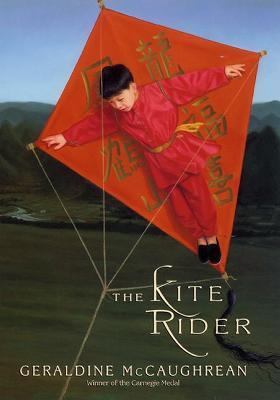
It's the 13th century. Kublai Khan has conquered China, spreading the Mongolian empire from Ukraine to Korea. His epoch-making attempt to invade Japan is about to get underway—the one that will end with Kublai's army at the bottom of the Yellow Sea, thanks to a storm that will go down in Japanese memory as "Kamikaze" (divine wind). At that crucial point in history—to the Eastern world what the sinking of the Spanish Armada was to the West—Gou Haoyou is a sailor's son living in the coastal village of Dagu, downriver from the great city of Dadu (now Beijing). Haoyou's father, Gou Pei, stirs the jealousy of another sailor named Di Chou, who wants Pei's beautiful wife for his own. So, before Haoyou's horrified eyes, Chou has Pei rigged to a makeshift kite and sent aloft to "test the wind" and see whether the spirits are in favor of their ship's journey. When the kite comes down, the ship seems to have won favor... but Gou Pei, overcome by terror, is dead.

This is only the beginning of many wild rises and falls in the fortunes of young Haoyou. In order to save his mother from having to marry Di Chou, he and his cousin Mipeng—widely thought to be a medium—get the bridegroom drunk and try to "shanghai" him on board an outgoing ship. To make sure the ship sails promptly, Haoyou volunteers to serve as the wind tester, willingly subjecting himself to the ordeal that killed his father. This adventuresome act brings him to the attention of Miao Jié, the master of a circus that is headed upriver towards Dadu, Xanadu, and the court of Kublai Khan. And so Haoyou, sometime kite-maker, new-made kite-rider, becomes an act in the Jade Circus.

During the troupe's upriver journey, Haoyou, Mipeng, the Miao, and their friends encounter resistance from villagers who place no value on entertainment. They face challenges to the supreme Confucian values of obedience and submission, especially on the part of youth towards their elders and of females toward males. The deal with a greedy great-uncle who abuses his position as head of the family to get hold of money, which he would then throw away in gambling dens. They find friendship among people of an alien culture, love in defiance of family policy, fame at the cost of danger and betrayal, and courage in the face of certain death.

Haoyou's small body takes a beating in this story of a child facing incredible danger, simply to entertain crowds. His faith in the spirits of his ancestors—especially of his beloved father—is tested to the breaking point. His loyalty to family is tried by the viciousness of Uncle Bo and the competing claims to his devotion by Mipeng, Miao Jié, and his own mother. And in the midst of a disaster that nearly finishes the Khan's power, Haoyou claims the strength and cleverness to make things right for his loved ones.

This fine, colorful novel from the author of Peter Pan in Scarlet moved me on many levels. Besides the obvious emotional impact of what happens to Haoyou, and what he does about it, the book is crammed with details that show the author's deep insight into human nature. The time, place, and culture depicted here will be fascinating and exotic to most readers, while they will recognize the same familiar humanity at the heart of it all. It's nothing if it isn't an inducement to read more books by Geraldine McCaughrean, such as The Stones Are Hatching, Tamburlaine's Elephants, The Death-Defying Pepper Roux, and The Glorious Adventures of the Sunshine Queen. Click here for a more complete list.

Saturday, May 18, 2013

Star of Stone

Star of Stone
by P. D. Baccalario
Recommended Ages: 12+

In Book Two of the Century Quartet, four kids with Leap Day birthdays come together again to solve another puzzle, this time in New York City. Elettra from Rome, Mistral from Paris, Sheng from Shanghai, and Harvey from Manhattan face an evil nightclub owner, five dangerous women, a one-eyed crow flying surveillance for a shadowy group of Native Americans, and a trail of clues seemingly left behind by a man who lived over 100 years without growing old. Their friend Ermete, master of disguise, comes along to help and ends up in the hospital. And while Elettra still struggles to understand the strange power over the element of fire that emerged in her during their previous adventure, the sweetness of first love connects her to Harvey.

Harvey is at the center in this installment. His relationship with his parents is strained, and he still has not healed, since the death of his older brother a year ago. He tries to channel this pain into boxing lessons offered by a basement gym. But then he starts hearing voices—particularly, the voice of his dead brother—and manifesting strange powers that he isn't ready to accept. An antiques dealer notices, for example, that a dead plant blooms after Harvey touches it. And he isn't the only person to notice.

All this has something to do with a secret that goes back to the ancient Chaldeans. The kids have found an intricately carved wooden board, and four wooden tops which, if spun on a map of any place in the world, come to rest pointing at a vital clue. This magic has passed through the hands of Columbus, Leonardo, Aristotle, and countless other discoverers and thinkers. Plus, they have already found the "Ring of Fire" that lay hidden for centuries in Rome; now they must locate a "Star of Stone" somewhere in New York. And it might not hurt to get hold of a fifth top that has turned up in a local antique shop.

If the foursome fails, mankind may default on its Pact with Nature. There are already signs that the Earth is angry. The survival of the whole world may hang in the balance. All this responsibility lands on four scared kids, who have the henchmen of an evil hermit after them, while the only people who can help them are sworn to keep silent and let them work things out on their own. And that means risking trouble in and around such landmarks as Rockefeller Center, the New York Public Library, Ellis Island, and Central Park—to name only a few of the beauty spots, cultural treasures, and dark places to which the clues lead them.

And so Pierdomenico Baccalario ratchets up the danger, the drama, the spookiness, and the magic of this ongoing series. Translated from Italian to English by Leah D. Janeczko, this installment follows up on Ring of Fire. The last two books in the sequence are titled City of Wind and Dragon of Seas. A prolific author in the Italian language, Baccalario's other works in English include translations of the first four books of a twelve-book series under the title and pen-name "Ulysses Moore."